







The Bottleneck Isn’t the Model. It’s the Execution.
By Brandon Brown (ROAM-AI) and Eric Warntjes (U.S. Energy Development Corp.)
For decades, the oil and gas industry has approached ESP optimization the same way. This account comes from two vantage points: the technology side that builds these systems and the operations side that deploys them. From both sides, the conclusion has been the same.
Prior to my position at ROAM-AI, I watched the pattern play out firsthand while leading technology and digital transformation for an operator in the Permian Basin. Engineers reviewed performance data, identified opportunities, coordinated changes with operations, and moved on to the next priority.
The process worked because it had to. Every adjustment required human judgment, operational alignment, and actual execution in the field. Resources were always limited, so teams focused on the wells that showed the clearest need or the most immediate risk.
The scale of the execution problem only became visible once the intelligence layer had matured enough to reveal it. These were not generic AI models. They were physics-aware AI models built around how wells actually behave, continuously refined with live field data. They did not simply surface a handful of additional opportunities. They began identifying orders of magnitude more, with thousands of potential adjustments evaluated continuously rather than through periodic reviews.
Small deviations in intake pressure, gas interference, pump efficiency, or fluid composition that would have been difficult for any engineer to catch across hundreds of wells became visible almost immediately. At first, it appeared the optimization problem had been solved. Then the execution bottleneck became impossible to ignore.
Every recommendation still had to travel through the same manual pathway: engineering review, operational coordination, field execution. Opportunities appeared faster than teams could respond, and many went stale before anything changed at the wellhead. Real progress had been made on identifying value. The harder problem, capturing it consistently at the scale the technology made possible, remained unsolved.
It was clear from the inside that the missing piece was not better models. It was the ability to act on them, which meant hardware, edge execution, and closed-loop control had to be part of the solution from the ground up. That gap is what ultimately drove the decision to cross to the technology side and build what operators such as U.S. Energy Development Corp. actually need. The intelligence layer had scaled dramatically. The ability to act on it at the same pace had not.
A New Optimization Philosophy
That experience forced a deeper look at long-held assumptions. For decades the industry operated on the belief that the biggest gains would come from the biggest, most-obvious decisions. That mindset was logical when every change carried real cost in time, coordination, and field resources. Companies prioritized the highest-impact wells and accepted that many others would wait until the next review cycle, or until problems became severe enough to demand attention.
AI revealed something different. A surprising share of cumulative value came from more modest adjustments executed consistently across a large number of wells—small shifts in pump frequency or tubing pressure, tweaks that would rarely justify pulling an engineer away from other priorities for a dedicated review. Individually, they looked minor. Collectively, when made at the right frequency and without delay, they moved asset performance in ways that added up.
A small frequency reduction that avoids gas locking, for example, may not justify pulling an engineer away from other priorities in a traditional workflow. But executed immediately and repeatedly across hundreds of wells, those decisions accumulate into measurable production and reliability gains.
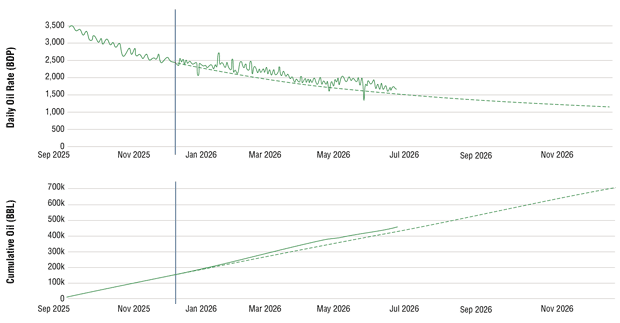
Last December, U.S. Energy Development Corp. deployed closed-loop AI to optimize some of its wells. To demonstrate how effective autonomous optimization can be, this chart compares the actual daily and cumulative production from one well (the solid lines) to the expected values before autonomous AI came into play (the dotted lines).
The solution is not AI in the generic sense. It is physics-aware AI, models built on the engineering principles that govern how wells actually behave, then continuously refined with live field data. The physics that constrain the model are the same ones production engineers work with every day: motor frequency operating ranges, flowing tubing pressure limits, intake pressure thresholds that signal gas interference or pump wear, motor temperature ceilings, and the pump curve boundaries that define where a given unit operates efficiently versus where it degrades.
This changed how we think about optimization entirely. It stopped being a periodic event and became a continuous process. The system watches operating conditions around the clock, identifies emerging deviations as they develop, and acts before small issues grow into larger problems or failures. It operates inside hard guardrails, defined operating envelopes built from the same principles production engineers use to design and evaluate artificial lift systems. The model cannot recommend a setpoint outside those bounds. That constraint is what makes it safe to execute at machine speed.
Importantly, the software itself is not what we describe as Physical AI. The intelligence layer is physics-aware AI, software constrained by the same engineering principles and operating envelopes production engineers use every day. Physical AI emerges when that intelligence is paired with operational control and the ability to execute decisions autonomously in the field. Physics-aware AI understands the system. Physical AI closes the loop and acts on it.
That extra step matters, because the limiting factor on AI-driven production optimization is rarely the quality of the recommendations. It is the ability to turn insight into consistent action without adding headcount or slowing down. That is where operational control became essential, not as a standalone hardware feature, but as the closed-loop capability that bridges the gap between what the model sees and what actually changes at the wellhead. That shift from periodic to continuous does not look the same from every angle.
Building the system to operate that way is one challenge. Trusting it to operate that way in the field is another. Both situations were encountered when the system met real conditions at U.S. Energy Development Corp., a 46-year-old, privately-held independent with assets concentrated in the Permian Basin, Barnett Shale, Haynesville Shale and Powder River Basin.
Proven at Scale
Closed-loop AI had already been validated at scale before it reached U.S. Energy Development Corp. At a Permian Basin operator with more than 250 wells, production exceeded the high end of company guidance for more than six consecutive quarters, with capital expenditures below guidance in those same periods. Management attributed those results directly to AI applied to artificial lift and compression.
Those gains did not come from dramatic interventions on the highest-priority wells. They came from the system running continuously across a large asset base, making incremental adjustments at a pace and frequency no engineering team could replicate by hand. Getting the system to that level of reliability took years of physics integration, control architecture development, and field validation across real operating conditions. What made the difference was not identifying more opportunities. It was executing them consistently, at scale, without adding headcount. That is the pattern that has held across every deployment since, and it is the foundation Eric and U.S. Energy Development Corp. built on.
Beyond production, one of the clearest early signals of a Physical AI system working correctly is what happens to run time. When a Physical AI system is continuously managing an ESP within its optimal envelope rather than allowing conditions to drift until intervention is required, pumps simply stay online longer. That pattern has been consistent across every deployment observed. Small improvements in pump run time, sustained over a full operating season, compound in ways that show up clearly in maintenance costs and workover frequency. Eric’s experience has followed that same trajectory.
What he encountered when the system met real field conditions is best told in his own words.
Eric’s Inside View
When we began evaluating this approach at U.S. Energy Development Corp., my reaction was measured. We had worked with AI tools before, and the pattern was familiar: strong results in a controlled environment, then friction when the system met real field variability. My concern was not whether the model could identify opportunities. It was whether we could act on them fast enough to capture value, and whether the system would stay within operating boundaries our team could trust.
We activated the system across 12 Permian wells beginning in December 2025. What followed was not the dramatic transformation AI vendors tend to promise. It was something more useful: a steady, consistent improvement that built over time. The system executed thousands of adjustments across our well inventory, changes that previously would have required individual engineering review and manual execution for each one. Instead, every adjustment was evaluated against our defined operating envelope and executed automatically when it fell within the approved range.
The results have been clear. Production across those wells increased 12.2% compared to the 90-day pre-activation baseline. The deployment is six months old, too early for a definitive conclusion about mean time between failure, but the directional trend is positive and consistent with what longer deployments have shown.
Those numbers matter, but what I find more meaningful is the operational shift underneath them. My team is no longer spending the bulk of our time on routine setpoint reviews. We focus on the exceptions, the wells that fall outside the envelope, the situations where field experience and judgment are actually required. That is where our expertise belongs, and that is where we are spending our time now.
The skepticism I brought into this did not disappear overnight. It faded as data accumulated and results held across months and varying field conditions. By the time we had a full operating season behind us, the question in our organization had changed. It was no longer whether this works. It was how quickly we could apply it more broadly. Realizing a return on investment that exceeded four times our initial cost inside the first six months made that answer straightforward.
Looking across the industry, few operators have closed-loop Physical AI systems operating autonomously across producing wells with documented operational impact. U.S. Energy Development Corp. is one of them. That is a competitive position we intend to build on.
A New Operating Model
Most operators evaluate new technology through production gains and operating cost. Those metrics matter, but framing Physical AI as a routine technology evaluation misses the point. What we are describing is not a better tool layered onto the existing workflow. It is a different operating model entirely.
The traditional model is periodic and reactive. Engineers review wells on a schedule, make changes, and move on. Coverage is limited by headcount. Problems get addressed when they escalate.
In contrast, the new model is continuous and proactive. The system monitors every well around the clock, executes adjustments inside defined operating envelopes, and catches deviations before they develop into failures. Coverage scales with the asset base, not the staff. Engineers set the boundaries, review exceptions, and focus their expertise where it actually matters. The work shifts from execution to governance, from chasing setpoints to defining operating intent.
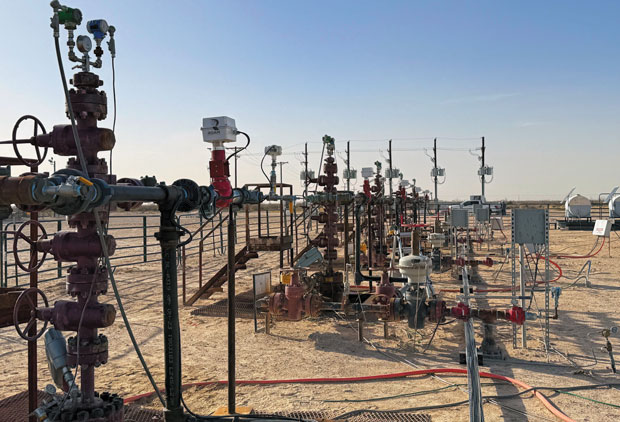
An AI-enabled, multi-well pad outfitted with autonomous back pressure control hardware demonstrates how edge computing brings real-time optimization into field operations.
That shift is key, because asset counts keep increasing and complexity grows with every acquisition. Engineering teams do not scale at the same rate. Under the old model, growth meant adding headcount or accepting that more of the asset base received less attention. Engineering headcount has never scaled linearly with asset growth, and the consolidation taking place in many basins makes that gap harder to close. The new operating model breaks the traditional relationship between asset growth and ESP optimization headcount.
Inside U.S. Energy Development Corp., the impact of the new model was felt before it showed up in the numbers. The engineering workload did not decrease, but it changed in character. Routine setpoint reviews gave way to exception management, production strategy, and deeper analysis on the wells that genuinely required judgment. That change does not appear in a production report directly, but it does reshape how an engineering organization operates.
Across every deployment, we have watched skepticism follow a predictable arc. The early questions are always about trust: how decisions are being made, what safeguards exist, whether results hold under real field variability. As data demonstrates that Physical AI delivers results, those questions evolve, moving from whether it actually works to how broadly it can be applied. That shift is when we know the company’s operating model has changed.
Future Applications
The industry has invested heavily in better intelligence, more sensors, richer data streams, and more sophisticated analytics. That investment has delivered real value. But the next phase is not about generating more recommendations or building more impressive dashboards. It is about closing the loop so those insights turn into consistent action at scale.
The same principle applies well beyond ESPs. Wherever repeatable decisions meet variable field conditions, consistent execution is the differentiator. Chemical management, compression, surveillance, and emissions monitoring could all benefit from Physical AI.
U.S. Energy Development Corp.’s deployment shows that the technology works as designed. The field results are real. The questions being asked today are not about whether Physical AI delivers, but where to apply it next and how quickly. That is what it looks like when a concept moves from definition to operation. It is no longer a promising idea on a slide, but a system making thousands of decisions a day inside defined operating boundaries, with results that show up in production numbers and pump run time.

Brandon Brown is co-founder and chief executive officer of ROAM-AI, where he drives the company’s vision, strategy, and growth in AI-driven artificial lift optimization. With more than 20 years of experience in digital transformation, AI, and enterprise IT leadership, Brown has built and led high-performing teams that deliver advanced technology solutions to complex industry challenges. Before co-founding ROAM-AI, Brown served as vice president and chief technology officer at Vital Energy and as director of intelligent operations at Chesapeake Energy. Brown holds a bachelor’s from Northeastern State University and an MBA from Pepperdine University.

Eric Warntjes is a petroleum engineer with experience in production operations, artificial lift optimization, facility development, and asset management across the Permian Basin. In his current role at U.S. Energy Development Corp., he oversees production operations across the company’s oil and gas portfolio and leads the planning and execution of facility development projects supporting the company’s drilling program in the Delaware Basin. Before joining U.S. Energy Development Corp., Warntjes held various engineering roles at Pioneer Natural Resources, where he focused on production optimization, operating cost management, artificial lift design, and facility performance. He holds a B.S. in petroleum engineering from Texas Tech University with a minor in geology.
For other great articles about exploration, drilling, completions and production, subscribe to The American Oil & Gas Reporter and bookmark www.aogr.com.