








Power Experts Convert Excess Gas Into Savings And Revenue
By Danny Boyd
Three things are certain for U.S. natural gas: record production, anticipation of new markets and expectations for higher prices.
Marketed gas production will hit a record 122.5 Bcf/d this year, up from 118.5 Bcf/d in 2025, according to the U.S. Energy Information Administration. As output grows, operators are eagerly monitoring a host of developments expected to provide access to more markets.
According to the EIA, new intrastate and interstate pipelines will add 44.9 Bcf/d of capacity across the United States over 2026 and 2027. That’s more takeaway for producers eager to supply a growing number of Gulf Coast LNG terminals, data centers, large industrial facilities and new gas-fired power plants cranking out electricity for state and regional power grids that serve homes and businesses.
But despite aggressive efforts to expand takeaway capacity, producers often end up with more gas than they can send to market. Rather than waiting for that situation to resolve, upstream and midstream companies alike are finding ways to transform excess gas production into immediate opportunities such as field power generation.
Producers with remote operations continue to tap their own gas production to fuel onsite power generation distributed across microgrids to electrify downhole pumps, pumpjacks, heater treaters, valves, compressors and saltwater disposal operations. Concurrently, midstream players are generating their own power to run processing and compression.
At the same time, both segments are leveraging their internal power capacity or forming partnerships with independent power producers to capture a new revenue stream: converting abundant gas molecules to electrons for nearby grids, industrial facilities and data centers.
The Business Case
The opportunity is clear: turn locally available fuel into reliable power where and when it’s needed, especially where grid capacity is limited or unavailable. For oil and gas operators, burning their own gas for power helps improve equipment operating efficiencies and meet regulatory requirements governing emissions. For power solutions providers, onsite generation allows them not only to help meet those needs but expand offerings to other energy-related segments.
In addition to providing behind-the-meter energy for upstream work, FlexEnergy Solutions is evaluating whether its 250 kilowatt and 333 kW microturbines can support water management by powering equipment and repurposing the otherwise wasted heat from generators to evaporate water, says CEO Doug Baltzer.
About 90% of the Denver-based company’s rental fleet, which includes 120-130 microturbines, is deployed on oil and gas locations and commercial industrial sites. The units offer the flexibility to burn 350-2,500 Btu gas and Baltzer says they easily accommodate load variance while maintaining low emissions and high fuel efficiency.
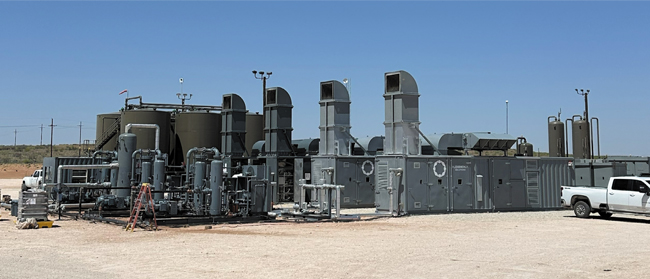
With 90% of its fleet of microturbines producing power for oil and gas or industrial facilities, FlexEnergy Solutions is picking up the pace of manufacturing in Denver for units that require little maintenance, have ultra-low emissions and are capable of burning gas ranging from 350-2,500 Btu.
With rental availability tight, FlexEnergy is stepping up manufacturing at its hometown plant for its units.
“Our turbines are built to be turned on, left on, and not touched,” Baltzer comments. “We only have to perform one scheduled maintenance a year. If you combine performance with super low emissions and little required maintenance, you get really high uptime.”
Multiple units are easily connected in a bank to supply a common switchgear feeding a broad distribution system, says Chief Operating Officer Mark Lindley. As an example, he cites a Delaware Basin project that uses a bank with 8 MW of capacity to power equipment over four miles.
The technology behind FlexEnergy’s 250 kW and 333 kW microturbines traces its roots to Ingersoll Rand, while the company’s 2 MW units are powered by Siemens technology, Baltzer says. The company’s microturbines initially supported commercial industrial projects, with their first oil and gas field project beginning in 2011. The project powered heater treaters and production equipment in North Dakota, allowing operators to use associated gas that would otherwise be flared because of midstream infrastructure constraints.
As the company has expanded to the Permian, other U.S. basins and western Canada, Baltzer says microturbines’ low emissions have become a major selling point. The turbines have converted more than 2.33 billion cubic feet of waste gas into power while eliminating 1.8 million tons of carbon dioxide and 5,000 tons of nitrogen oxides, according to company estimates.
Connected microturbines producing up to 5 MW of power produce the same emissions as some gas- and diesel-powered solutions capable of only 1 MW, delivering five times the power with a comparable emissions footprint, Baltzer says.
He mentions that the company recently rolled out a 2 MW unit in partnership with Siemens Energy. As of late August, four of these larger units already had been deployed on the New Mexico side of the Delaware Basin.
The Speed Advantage
Behind-the-meter oil and gas field power systems have one huge advantage for operators: in-house electrification can often take less than a year to 18 months to install, while hooking up the grid can take two-five years, says William “Bill” Zartler, founder, chairman and co-CEO of Solaris Energy Infrastructure.
Serving mostly midstream players and medium-sized producers, the Houston-based company designs, builds and operates power systems typically producing 20 MW to 1 GW from reciprocating engines and turbines supplied by the likes of Caterpillar, GE and Baker Hughes. Zartler says it uses the latest models to reduce emissions and maximize fuel efficiency.
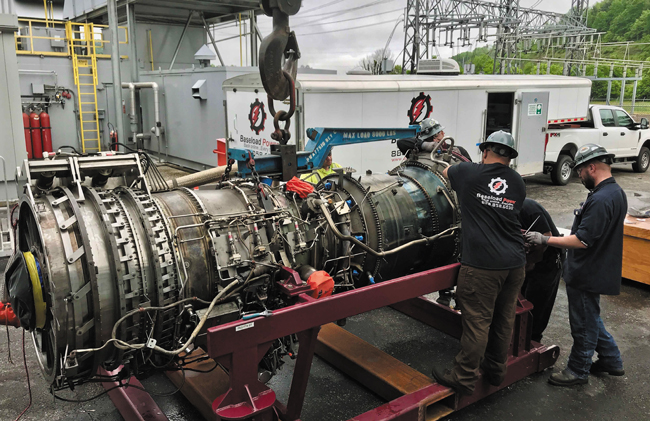
Rooted in Permian oil and gas, Solaris Energy Infrastructure continues to expand its power offerings to oil and gas, data centers and other industry segments. Services are key to in-house power solutions often taking substantially less time than grid hook ups that can take years.
Even with the scale of behind-the-meter systems growing, most companies prefer to deploy numerous small- to mid-sized generators instead of a few large ones, Zartler points out.
“When one unit goes down on a large field power system with 40 generators, you’re only losing one-40th of capacity,” he explains. “There is a reliability factor built into a system.”
Solaris’ power offerings emerged from having to find its own solution for its Permian proppant management and sand loading operations. Often operating in remote areas, the company built its own generation to support its all-electric sand-handling fleet that went into service in 2014.
Zartler also has experience in building islanded power through Aris Water Midstream, a second company he founded, after grid limitations hindered saltwater disposal operations. Aris Water Midstream was taken public and later acquired by a larger midstream company.
Today, Solaris has expanded to offer behind-the-meter solutions for data centers, refineries, chemical plants, factories, utilities, hospitals, gas infrastructure and mines.
Natural gas producers are not only approaching Solaris about their own power needs, says co-CEO Amanda Brock. “They are also coming to us hoping to supply gas for all of the work we are doing with the data centers,” she says.
Data center clients include a well-known AI complex in Memphis, Tn., Zartler says. More data centers will be built in West Texas, he predicts, with the region’s low-cost gas being a chief calling card.
“We’re seeing the integration of the American oil and gas industry with the American data and artificial intelligence industries,” he says. “Powering data centers for artificial intelligence runs on the backbone of one of America's most abundant natural resources: clean-burning, low-emissions natural gas.”
Microturbines’ Role
Fuel versatility, environmental benefits and low-maintenance intensity are the driving forces behind international growth in gas turbine deployment for Capstone Energy+, says President and CEO Vince Canino.
Capstone has a significant presence in U.S. oil and gas, with Canino estimating that at one point, 60-70% of its rental business served the sector. Customers include major players as well as mid-tier producers and midstream companies.
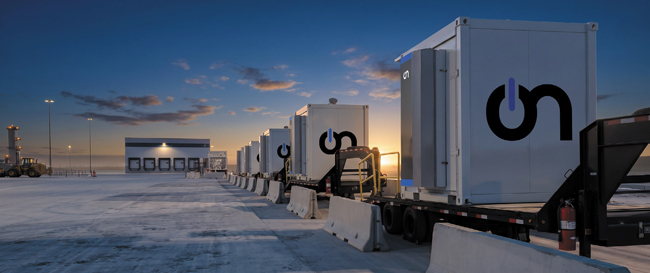
Capstone Energy+ is building on a strong presence in the United States to expand sales of its low-maintenance microturbine technology to international markets. One of its latest projects involves deploying a 600 kilowatt microturbine in Gabon, West Africa, to generate power from associated gas as part of a flare gas recovery platform.
In one of its latest transactions, the Van Nuys, Ca.-based company is installing a 600 kW microturbine in Gabon, West Africa, where French operator Maurel & Prom is converting recovered associated gas to a fuel source for generating power as part of its onshore flare gas recovery platform.
“We do well in the oil and gas space because our turbine technology is premised on a single moving part riding on a cushion of air,” Canino explains. “You have no friction, no oil, no lubricants, and no coolants, and that drives longer maintenance intervals. Our plug-and-play design allows a very simple, very clean installation.”
Capstone’s turbine systems use a modular design that Canino says makes it easy to combine the output of multiple 200 kW generators.
These gas turbines do require some simple maintenance, such as changing air filters periodically, conducting routine connection inspections and applying dielectric grease, with the frequency depending on the environment. However, Canino says major maintenance typically only occurs every three years. It involves swapping out combustion liners after three years of service and replacing power heads every six years for each engine. Each engine action takes less than a day to complete, and on sites with multi-engine configurations, the power system can keep running at reduced capacity while the work takes place.
Because the company’s turbines offer ultra-low emissions, they can operate without additional emissions abatement equipment, Canino says. The current design runs at 9 parts per million of NOx. The company is developing a combustion liner that should reduce NOx emissions to 5 ppm, a prospect that he says is drawing attention from potential data center clients.
“That liner will provide a long-term advantage for a number of folks looking for lower emissions without any operational complexity,” Canino offers.
Although lead times for equipment can be long, Capstone continues to keep up with demand at its Southern California manufacturing plant. Employees on one shift can build and test a 1 MW unit in a week, Canino reveals.
Capstone continues to innovate, with work under way on a 250-kW engine variant that will help improve power density. The company, which also provides waste heat recovery equipment, anticipates performance enhancements from new heat recovery modules as well as engine efficiency improvement initiatives, he adds.
Planning Power Deployments
Assessing available generator technologies and their potential emissions is integral to regulatory review and operational planning as producers press to deploy systems on time and within budget, says Forrest Churchill, a principal at Denver-based power consulting company CANUSA EPC.
Producers often need solutions in place within 9-10 months for smaller projects to meet production site planning and 18 months for larger processing facilities. The amortized cost for behind-the-meter generation is about 50% fuel, with the rest on deployment installation, maintenance and debt service, he says.
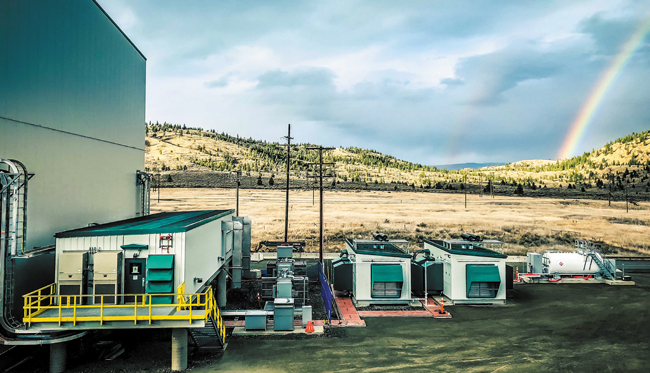
As generation costs rise, CANUSA EPC is helping producers identify power solutions across U.S. basins. The Denver consultant and its customers are pursing projects on two tracts: applying for grid connections that can take years and concurrently formulating solutions to use field gas for generation.
Generation costs vary widely but average about 8-10 cents a kilowatt hour, Churchill explains. The total installation cost budget for reciprocating engines based on kW capacity runs from about $1,000 to $1,600 a kilowatt. Larger turbine generation units start at $2,000-$2,300 a kW of capacity, which translates into 10 MW of generation typically costing about $21 million.
“The process of planning for power options usually runs on two tracts simultaneously: behind-the-meter and utility supplied,” Churchill says. This strategy allows industrial and energy sites to move the critical path of the project with power optionality.
First, producers request a traditional grid interconnection from a utility. Within a month or so, utilities typically indicate that a grid connection could take three years or more, with large demand charge fees and possibly tariffs for the new connection. Utilities also require producers to pay for studies on appropriate high-voltage substations and related transformers, which can further delay power delivery.
During the concurrent processes, CANUSA EPC helps customers assess and navigate regulatory compliance and identify specific field equipment power needs, overall generation capacity needs, generator placement, and distribution system configuration, among other things.
With the recent demand from data centers, the tightening supply of new generators is increasing costs and pushing out projects, Churchill says. However, used equipment can be available with engines overhauled to “zero-hour” or new engine standards. Usually, operators must place a deposit within 30 days of being notified of generator availability to secure production or delivery.
While multiple reciprocating engines can be connected to achieve higher power ratings, more engines mean more maintenance and higher costs, he notes. Turbines usually become more cost- and operationally effective at 30 MW and above.
One of CANUSA EPC’s recent behind-the-meter projects uses 12 MMcf/d of residue and raw gas to generate 31.5 MW, including 17.5 MW from 10 Waukesha generators and 14 MW from a turbine. The project supports a flare gas mitigation effort in the Uinta Basin.
With more investment dollars flowing into generation, large midstream players and operators continue to take advantage of discounted gas to tap a new revenue stream: generating power to sell to large demand users, Churchill notes.
Supplying ERCOT
Independent power producer Conduit Power LLC is teaming up with Permian producers to generate and sell power into the Electric Reliability Council of Texas grid, says CEO Matthew Herpich.
In one of its newest partnerships, the Houston-based company is joining Diamondback Energy and Granite Ridge Resources to develop and produce 200 MW from 20 gas-powered generation sites across West Texas.
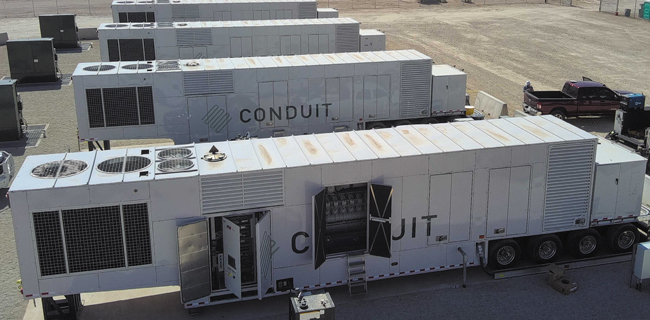
In partnerships with producers, Conduit Power LLC is using Permian Basin gas to generate power for sale into the Texas grid. A venture with Diamondback Energy and Granite Ridge Resources will transform 40 MMcf/d into 200 MWs to meet grid demand in West Texas. With Riley Exploration Permian, Conduit is supplying power to the grid and Riley operations on the Central Basin Platform.
The arrangement utilizes up to 40 MMcf/d of Permian gas for generation to help ERCOT correct imbalances between power supply and demand in a West Texas load zone with a high concentration of intermittent renewable generation and rising power consumption. Anchoring that consumption are the growing cities of Midland, Odessa, San Angelo and Abilene.
With the sites secured and construction already under way, all 20 facilities of 10 MW each can be built within 18-24 months, Herpich says. Each site produces the lower voltages necessary to feed Texas homes and businesses.
“As long as we only build 10 megawatts on a site, we are subject to a totally different interconnection process that speeds things up,” he explains.
Conduit is backed by Grey Rock Investment Partners, which also supports non-op producer Granite Ridge. Under the arrangement, Diamondback and Granite Ridge will each commit to a fixed capacity payment to Conduit in exchange for a preferred share of power proceeds.
The two upstream companies undoubtedly observed the success of Conduit’s partnership with Riley Exploration Permian of Oklahoma City. Conduit and Riley in 2024 launched a joint venture called RPC Power to use Riley’s Central Basin Platform gas production in Yoakum County, Tx., to power Riley operations.
With oil making up about 95% of production, Riley sought to leverage its own gas, which was frequently subject to negative prices and often had to be flared so oil development could continue.
Conduit built a 20 MW facility fueled by 4 MMcf/d of Riley’s output. Now, Herpich says most of Riley’s Yoakum County footprint, producing residual oil from the San Andres bench, is powered by the facility.
The joint venture has built four more power generating sites solely to sell power back into ERCOT, most of which are operational. As of late August, a fifth site is planned.
Under the grid-connected project, Riley benefits from gas re-marketing, in which it buys back gas from large midstream players that supply the fuel gas, Herpich says. Each site, which includes several generators connected in series, can consume up to 2 MMcf/d to generate 10 MW from generators in interconnected rail-sized shipping containers.
The generators are powered by engines from Rolls Royce and INNIO, with complete units packaged by Stewart & Stevenson in Dallas and Oklahoma City and Gruppo AB in Italy, Herpich says.
With Conduit operating other 10 MW units across the region, Herpich predicts the company will have access to plenty of natural gas even as pipelines start up to transport more Permian gas to growing markets.
Power Without Combustion
2T Energy has launched a pilot project with an operator in East Texas that is generating power from a skid-mounted, bladeless centripetal-flow turbine that does not combust or otherwise consume the gas. Instead, the gas, which includes fluid, spins the turbine by applying friction as it flows by.
About 2 MMcf/d of pre-treated gas directly from a flowing well is being routed through the turbine, to generate power for sensors, electric valves and other lower voltage surface equipment.
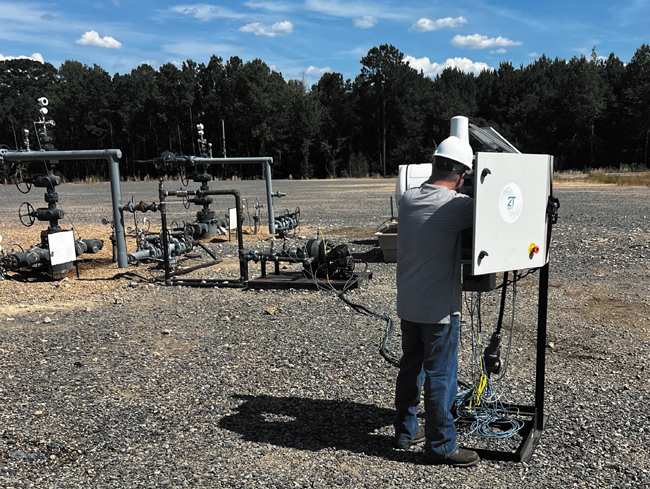
Without combusting a single gas molecule, 2T Energy of Houston is powering sensors, electric valves and other lower voltage surface equipment at a Haynesville well pilot project by diverting 2 MMcf/d from a flowing well through a bladeless centripetal-flow turbine. The company says the technology, which was invented by Nikola Tesla, can compete with solar- and thermal-generated electricity, especially in regions with darker winters.
In October, the Houston-based company plans to assess findings, make any needed modifications and begin designing similar systems capable of producing 0.5 to 3.0 kW for commercial use.
Electricity generated by the bladeless turbine, which was invented in 1906 by Nikola Telsa, is insufficient to power heavy-duty pumping equipment. But 2T Energy CEO Andrew Ladwig and Director of Engineering Aaron Ladwig say it can compete effectively against existing solar-powered and thermal generator surface equipment and recharge lease battery banks to ensure 24-hour operation. It should be especially competitive in Appalachia and other regions where sun-limited winters reduce solar panels’ output.
“We wanted to create a robust turbine that could run off raw wellhead gas, that would be plug-and-play, could always flow no matter what, and was redundantly safe,” Andrew Ladwig says. “The bladeless turbine performs well with mixed flows and heavy particulates, so it holds up with pre-treated wellhead gas.”
After the gas turns the turbine, it flows down the sales line with a slight pressure drop.
The turbine doesn’t experience erosional problems like conventional turbines do and costs less to manufacture and less to maintain, Andrew Ladwig says. The system is easy for field crews to set up, he adds, noting the skid can be piped in next to the wellhead or after a separator.
A control panel drives the turbine. Remote capabilities allow for monitoring RPM, pressures and voltage. There also are applications for midstream and pipelines.
Andrew Ladwig says the turbine does not require much gas to generate meaningful amounts of power, with the floor somewhere around 500 Mcf/d. He adds that producers already are calling to ask about the technology.
“There are a lot of operators in Pennsylvania and the Rockies that have been interested in it,” he says. “They’re watching our field test to see the next steps.”
For other great articles about exploration, drilling, completions and production, subscribe to The American Oil & Gas Reporter and bookmark www.aogr.com.