







AI Coming Of Age In Optimizing Performance Of Gas Wells On Plunger Lift
By Ryan Healy and David Cosby
LAWRENCE, PA.—Gas demand is approaching record territory, natural gas capital spending is at a 10-year high, worldwide artificial intelligence spending according to Gartner is forecast to reach $2.59 trillion in 2026, and the production professionals who know how to operate wells are retiring faster than the industry can replace them.
Specifically, the U.S. Energy Information Administration forecasts natural gas production could increase as much as 40% by 2050. Meanwhile, petroleum engineering graduates fell from a peak of 2,615 in 2018 to only 679 in 2023, according to an article published in the Journal of Petroleum Technology. Put those trends in one room and a simple question arises: How do fewer people operate more natural gas wells, profitably, while producing more gas from assets that are getting older every day?
Obviously, oil and gas companies are turning to AI to find solutions. For the highest-volume and highest-cost wells, the industry already has an answer, and most AI applications are pointed at that end of the spectrum. Electric submersible pumps get the headlines because the equipment is costly and production is substantial enough to justify the expenditure that AI requires. But the question almost nobody is underwriting sits at the other end of the curve on the low-volume gas tail, where plunger lift does the work and where a few cents of lifting cost can decide whether a well stays online or gets plugged.
Twenty years ago, optimizing plunger lift wells meant driving to each location every day, with routes of roughly 40 wells per lease operator. When a plunger lift setpoint changed, 24 hours could pass before the operator returned to see how the well responded. The feedback loop was at least a day long and only as good as the person driving the route.
The industry has come a long way, but it carried forward a mindset that AI must break. For years, the goal was to optimize the plunger, believing that doing so optimized production. Operators chased “no missed runs,” targeted a 750 feet per minute plunger rise velocity, replaced plungers based on a calendar time frame instead of plunger condition, and used pilots or chokes to slow fast plunger arrivals, despite the surface restriction they created.
Those habits optimized the device, but did not necessarily optimize production outcomes.
Shortening The Loop
Modern digital controllers have collapsed the daylong feedback loop to minutes. Wells can open on a casing minus line pressure trigger, close on flow rate and react in near real time. Supervisory control and data acquisition lets operators observe performance without driving to every well every day.
The latest controllers add another layer by capturing and analyzing high-frequency data that can identify events such as plunger arrival, plunger-on-bottom, and slug size. As examples, two of these state-of-the-art controllers are ChampionX’s Smarten™ Unify and Well Master’s Model 786 controller, both of which were introduced in 2024.
The Smarten Unify controller is focused on bringing advanced capabilities to marginal wells. With internal WiFi connectivity, the cost of connecting to SCADA from the field approaches that of a standalone controller. And, by capturing and analyzing one-second data, events such as plunger on bottom, plunger arrival and slug size can be identified for each plunger cycle. The controller enhances operators’ ability on marginal wells to pump by exception, only focusing on those wells that need attention.
Well Master’s Model 786 controller highlights how powerful one-second data collection can be through some unique capabilities. In real time, this controller monitors the plunger rise velocity and throttles the control valve to maintain safe arrivals. When coupled with opening a well on casing minus line and closing on flow rate, the controller maintains consistent plunger cycles without the risk of fast plunger runs that can damage equipment. Additionally, restarting a well after an extended close period becomes safe and routine.
The controller also offers virtual flow rate detection, accurate to within ±2% of the well’s true flow rate. For multiple wells that feed the same flowmeter, knowing the flow rate on individual wells becomes an invaluable tool. Production can be properly allocated, and wells can close on a defined flow rate, thus extending better control to the volume of liquid entering the tubing on each cycle.
These controllers, and others like them, represent meaningful advances to marginal and high-production horizontal wells. But they do not yet autonomously adjust plunger lift set points to attain and maintain production at a desired target. A person must still assess the well, determine whether production has drifted from the desired target, and then adjust operating setpoints.
Organizing Optimization
The operators that get the most from artificial lift are not necessarily those with the fanciest controllers. They are the ones with a disciplined process around it.
A common structure divides the work among optimizers, who establish and tune setpoints; a preventive-maintenance team that keeps hardware and data reliable; and a troubleshooting group that handles exceptions. Large operators often add a control room to monitor wells against a fitted production target or decline curve.
When a well drifts away from that target, the deviation is dispatched to an optimization technician, who diagnoses the problem, implements a solution and reports back to engineering. The objective is not a perfect plunger cycle for its own sake. The objective is to keep the well producing on the natural decline curve.
FIGURE 1
Natural Decline Curve
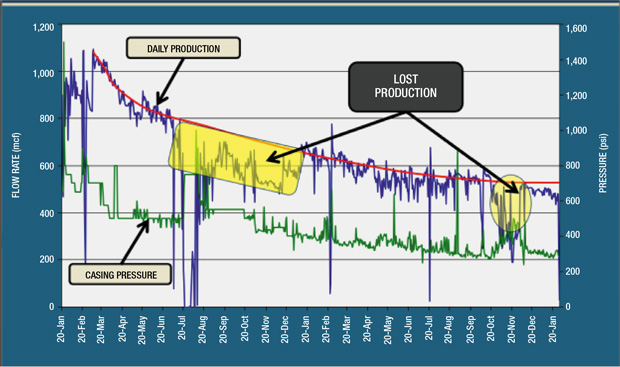
That distinction matters because decline curves are also part of the financial language of the business (Figure 1). They help operators value wells, forecast production and make acquisition decisions. Keeping a well close to its expected production path, unimpeded by liquid loading, is therefore not just an operating goal; it is part of the economic foundation of the asset.
Settings Cannot Be Static
Here is the part skeptical operators often need spelled out: A plunger lift setpoint is not something you set once and walk away from, and good preventive maintenance does not change that.
There is no easy button with plunger lift.
Even with an effective maintenance program, the well itself keeps moving. Casing pressure does not build at the same rate. Liquid does not enter the tubing at the same rate. Line pressure changes. Compressors go down, sometimes for planned work, and sometimes without warning.
The setpoints that were correct become incorrect because the well conditions they were built for have changed.
Opening on casing minus line pressure and closing on flow rate produces more stable cycles, but an operator still needs a production target and still must sort through data, recognize when performance has drifted and determine the corrective action. Every step—searching, recognizing and deciding—can be a bottleneck.
Most operators do not have enough time or enough trained people to continually recalibrate every well as conditions change. That is the strongest one-sentence case for AI in this part of the business: The settings cannot be static, and people cannot keep up with the frequency of changes required across large populations of wells.
But before any of this works, a data layer must exist, and the simple fact is that on many wells, it does not.
The honest version of the AI story is that the algorithm is only part of the solution. Clean, relevant, high-frequency data is equally important. Casing, tubing, and line pressure; flow rate, open and close events; and plunger arrivals must be captured at useful intervals.
Data sampled every 15 minutes is not enough for real plunger optimization. One-minute data has historically supported traditional optimization work, but data recorded at one-second intervals has substantially more value. At that resolution, operators can often see when a falling plunger hits the liquid column, reaches the bottom-hole spring, arrives at the surface, and in some cases, infer the volume of liquid produced (Figure 2).
FIGURE 2
The Power of One-Second Data
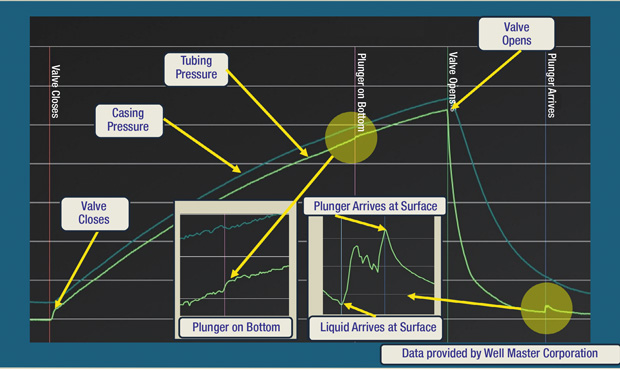
With a one-second data stream delivered periodically to the cloud, an AI agent that understands the characteristics of a field can analyze performance and recommend or implement changes. The controller becomes the implementer, opening and closing the well as directed.
The catch is that many operators are nowhere near a one-second, cloud-connected data layer. The wells where economics are tightest are often the wells most likely to have had telemetry removed to reduce costs. The wells that may benefit most are often the least instrumented.
Closed-Loop Control
The useful AI tool is not another dashboard. It is closed-loop control anchored to an explicit production objective.
An AI agent should monitor actual production against that objective, identify drift and decide when and what to change. It should know when the plunger is on bottom, rather than relying only on estimated fall velocity, keep arrivals within safe limits, identify anomalies and help determine when a plunger should be replaced because of wear.
That frees technicians to spend more time solving real problems and pursuing higher-value opportunities instead of scanning data and making repetitive setpoint changes.
The exact production objective is debatable. Some experienced practitioners argue that a natural decline curve is the wrong anchor because of the ambiguity in how the curve is constructed. They prefer to work each well toward the lowest flowing bottom-hole pressure, lift a small amount of liquid each cycle, cycle as often as the well requires, and keep plunger arrival velocity safe (Figure 3).
FIGURE 3
Typical Plunger Cycle Using One-Minute Data
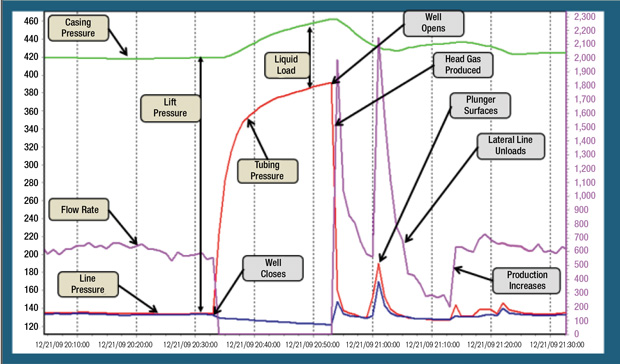
That is a legitimate position. The shared ground is more important than the disagreement: Static setpoints lose. Whatever objective an operator chooses must be explicit, measurable and continuously managed.
Over the past decade, several companies have applied machine learning and AI to production optimization. One of the more developed examples is Ambyint’s Infinity™ plunger lift platform, which combines physics, subject matter expertise, machine learning and AI to continuously evaluate both real-time and historical data, detect anomalies, identify performance drift across large well populations, and recommend or autonomously adjust setpoints within defined constraints.
The platform starts by stabilizing production around a defined plunger velocity window, then fine-tunes open and close setpoints within narrower tolerances. In a published case study, the platform achieved a 7% annualized improvement in production decline across a pilot group of autonomously controlled wells. Once the technology moved to full-scale deployment, it improved the overall decline rate by 1% while simultaneously delivering a 14% improvement in normal velocity plunger arrivals, as well as a 62% reduction in venting events.
Ambyint is not the only company applying AI to plunger lift. Others can be found with a quick internet search. As these companies draw on expanding datasets to deepen their understanding of plunger lift performance and identify new opportunities to improve it, AI-driven plunger lift optimization will have an even greater impact.
For now, artificial lift controlled by machine learning and AI is still in an early development stage. However, the momentum behind it is building, driven by rising gas demand, a retiring workforce, more wells per employee and fewer new petroleum engineers entering the industry.
For plunger lift, the settings cannot be static. Natural well variations will occur. High-frequency data combined with machine learning and AI is one of the best available paths to manage large well populations at lower lease operating expense.
The Money Story
This is where the technology story becomes a money story. Lifting cost is lease operating expense divided by production volume, expressed in dollars per Mcf equivalent produced. Over the past decade, many Appalachian gas producers drove per-unit LOE down as shale plays matured, well counts declined, and production per well increased.
SEC 10-K filings show Range Resources reduced LOE from about $0.16 per Mcfe in 2015 to about $0.13 per Mcfe in 2025. CNX fell from roughly $0.30 per Mcfe in 2015 to about $0.13 per Mcfe in 2024. EQT moved from about $0.12 to $0.09 per Mcfe in the same time frame.
But the line is no longer moving in only one direction. Water handling, completion intensity and other field costs are pushing back. EQT has guided 2026 LOE toward $0.10-$0.12 per Mcfe.
Since Range, CNX and EQT operate many horizontal wells in the Appalachian Basin, their LOE is lower, reflecting more productive wells. As an example of an Appalachian operator focused on mature wells with less production per well, Diversified Energy’s LOE is much higher, roughly seven times that of EQT’s! No matter how experienced and skilled they are, operators of mature, marginal wells often carry much higher lifting costs than those that operate horizontal wells.
That mature well world is where plunger lift often lives. A few cents per Mcfe is not a rounding error. On a low-volume stripper well, it can help determine whether the asset remains economic.
In 2024, the U.S. EIA identified more than 518,000 producing gas wells in the United States. Roughly 78% produced less than 15 barrels of oil equivalent per day and were considered marginal wells. Those wells still accounted for about 7% of U.S. natural gas production.
Small improvements multiplied across thousands of wells become real money. Better optimization can reduce lifting cost, preserve production and free experienced employees to work on higher-value projects, including converting less-economic lift systems to plunger lift or extending plunger lift into higher-rate applications.
Tie the threads together and the strategic conclusion writes itself: Natural gas demand is climbing. The workforce is retiring and the pipeline of new petroleum engineers is thin. Lifting costs are turning back up.
Technology must span the gap, specifically machine learning and AI that can independently maintain production against a defined target.
The operator who gets there first compounds the advantage. The one who runs more wells with less labor, wins over time. A capable AI agent has the ability to operate more wells at a lower lifting cost. That extra margin supports even more wells, which produce more data, which improves the system.
In a consolidating basin, that is not a software feature. It is a strategy. It may even soften the brutal hire-and-fire cycle the industry repeats when prices swing. Institutional knowledge stops walking out the door and starts living in the system.
The plunger lift setpoint that was right last week may be wrong this week. Operators who learn to manage that reality at scale, while reducing LOE, will win the next decade.

Ryan Healy is founder of Cornerstone Basin Advisors, an operations consulting practice serving operators in Pennsylvania, Ohio, and West Virginia. Healy has 18 years of Appalachian Basin operating experience, starting as a lease operator at Range Resources and progressively advancing to field supervisor, district manager, completions manager, director, and senior director roles. He then joined Encino Energy, where he held a variety of roles with increasing responsibility, including vice president of production. More recently, Healy was vice president of operations for a privately held Appalachian operator with more than 10,000 producing wells.

David Cosby founded Shale Tec LLC in 2012 to help gas well operators improve profits by gaining a deeper understanding of plunger lift. He has taught around 150 plunger lift learning classes in locations ranging from Vernal, Ut., to McAllen, Tx., to Elmira, N.Y. Cosby is a professional engineer in Texas, and he earned a B.S. in mechanical engineering from Texas A&M University and an M.B.A. from the Graduate School of Management at the University of Dallas. He has successfully led engineering endeavors in four industries. He is also a published author who has served as an expert witness on patent infringement cases.
For other great articles about exploration, drilling, completions and production, subscribe to The American Oil & Gas Reporter and bookmark www.aogr.com.