








Field Trial Shows That Vibratory Tool Limits Paraffin, Asphaltenes
By Douglas Hamilton
Asphaltenes, paraffin, and scale have long been accepted as part of the cost of producing oil. They plug flow paths, increase drag on rods, stick plungers, foul ESP stages, and frequently require chemical programs that can be expensive, logistically difficult, and hard to optimize well by well.
Producers trying to protect artificial lift systems while controlling lease operating expense can often find a treatment program that is effective initially. The problem is finding time to adjust that program as production changes, water cuts rise, gas-liquid ratios shift, and enhanced recovery programs alter reservoir conditions.
A field trial by Oxy across more than 40 Permian Basin wells indicates that a different approach may help. Oxy evaluated a passive downhole technology that uses vibrational energy to stabilize hydrocarbon molecules at the source.
The tool relies on specially formulated solid materials that emit vibrational energy at targeted frequencies. The goal is to disrupt the weak molecular interactions that allow paraffin and asphaltene molecules to clump together and deposit on production equipment.
Costly Production Problem
The trial removed selected wells from chemical treatment programs for asphaltenes, paraffin, and scale while maintaining corrosion inhibition where needed. The results showed improved run times, measurable production uplift in many wells, and meaningful chemical cost savings, especially in wells with higher-cost asphaltene treatment programs.
Asphaltenes, paraffin, and scale are familiar production challenges. Operators have long managed these conditions through well-designed production chemistry programs that include inhibitors, dispersants, and remedial treatments. Inhibitors help prevent solids from aggregating and forming deposits, while dispersants help keep those solids suspended so they do not reach the surface. When deposits have already formed, remedial treatments may include hot oil, hot water, diesel, xylene, condensate, or other field-proven approaches selected for the specific well conditions.
The requisite investment can be significant, reaching tens of thousands of dollars per well per year. In addition to recurring treatment costs, operators must also account for the financial impact of downtime, interventions, and artificial lift repairs. Oxy experienced more than 300 rod pump and ESP failures tied to asphaltenes, paraffin, and scale in 2024 and 2025, with associated repair costs in the millions each year.
Those numbers help explain why operators continue to evaluate effective alternatives that can complement existing flow assurance strategies, reduce recurring operating costs, and extend equipment runtime. The opportunity is especially meaningful in wells where multiple production challenges must be managed simultaneously, such as corrosion control alongside asphaltene, paraffin, or scale prevention. In those applications, any technology that can simplify field logistics, reduce intervention frequency, or improve runtime can have a direct impact on lease operating expense.
Consistent execution remains essential for any production program. Continuous treatment depends on reliable pumps, power systems, inventory management, chemical delivery lines, and monitoring. Batch treatments must be coordinated around field conditions, weather, road access, and operational priorities. By reducing the number of recurring treatments required in properly selected wells, vibrational energy tools may give operators another practical option for maintaining production, protecting artificial lift equipment, and improving well economics.
How It Works
Crude oil is a colloidal system made up of hydrocarbons that include saturates, aromatics, asphaltenes, and resins. When those molecules remain in equilibrium, they stay suspended. When temperature and pressure change during production, storage, or transportation, that equilibrium can be disturbed.
In paraffinic crudes, long-chain alkanes may aggregate as the crude cools. In asphaltenic crudes, micelles may clump together and form larger aggregates. In heavy crudes, those changes can show up as higher density, higher surface tension, and higher viscosity.
The vibrational energy tool is designed to counter those changes by stabilizing hydrocarbon micelle structures. The technology uses an alumina-silica alloy matrix and a proprietary charging process to emit lattice vibrations that interact with hydrocarbon molecules, emitting energy that resonates with the molecular motions of hydrocarbons and hydrogen-oxygen, thereby promoting micelle stability and reducing hydrocarbon-water interfacial tension.
In practical terms, the tool is designed to keep hydrocarbon molecules from sticking together. For paraffins, that means reducing the tendency of long-chain alkanes to agglomerate into structures that behave like heavier molecules. For asphaltenes, it means limiting the aggregation process that can increase density, viscosity, and the formation of deposits.
Laboratory testing supports that mechanism. Crude oil samples from Kansas, Oklahoma, California, Colorado, Texas, Trinidad, and Argentina were tested at Colorado State University as part of a multiyear research program. Tests compared crude properties before and after exposure to the vibrational energy technology, including API gravity, viscosity, pour point temperature, and wax appearance temperature.
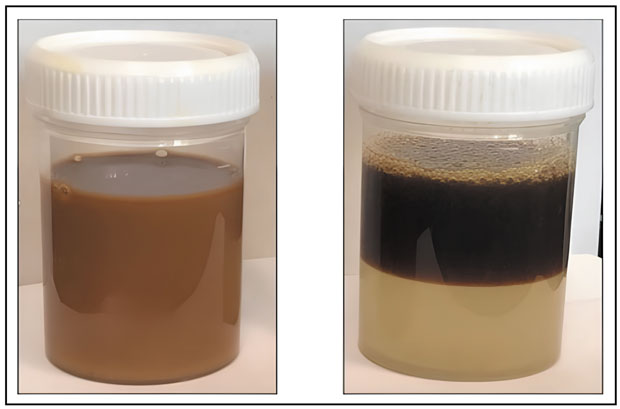
Across the tested samples, crude oil gravity increased by an average of 7.5 degrees API. Lighter oils above 34 degrees API showed a smaller average increase of 4 degrees API. Viscosity was reduced by an average of 94%. As shown in Figure 1, oil-water interfacial tension fell, helping break emulsions. Also, the appearance and pour point temperatures of wax decreased in paraffinic crude oils.
FIGURE 1
Oil-Water Separation Before and After Treatment
Disrupting Aggregation
Gas chromatography-mass spectrometry on a paraffinic Permian Basin crude showed how the technology can influence crude oil density. Before treatment, the crude had a peak in hydrocarbons with carbon numbers from C38 to C50. After treatment, the peak disappeared, and shorter-chain hydrocarbons from C6 to C18 increased, while heavier hydrocarbons from C52 to C60 decreased.
This shift is evidence that long-chain alkane aggregation was present in the untreated crude and that treatment reduced the clumping. Reducing that aggregation improves crude quality and increases API gravity.
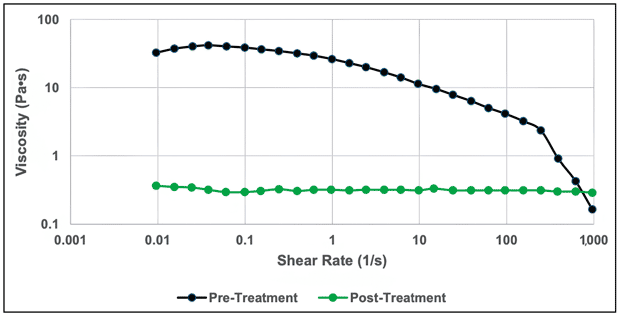
Heavy crude testing showed an even more dramatic viscosity change. A sample from the Lotus Terwort 3 well in the Hardtner Field in Kansas had a pre-treatment gravity of 15 degrees API and viscosity of 42,000 centipoise. After installing the vibrational energy tool, gravity increased to 23 degrees and viscosity decreased to 380 centipoise.
The flow behavior also changed. Before treatment, viscosity declined significantly with increasing shear rate, indicating non-Newtonian behavior associated with high surface tension and heavy-oil molecules sticking together. After treatment, viscosity stayed relatively constant across the shear-rate range, suggesting the crude behaved more like a Newtonian fluid because the heavy molecules were no longer agglomerating (Figure 2).
FIGURE 2
Viscosity vs. Shear Rate for a Kansas Heavy Oil Well
Interfacial tension is another important factor. The tool’s lattice vibrations resonate with hydrogen-oxygen bonds that govern surface tension in oil and water. By reducing surface tension at the oil-water interface, the technology can help resolve water-in-oil and oil-in-water emulsions. That matters because emulsions can sharply increase apparent viscosity. In one mid-range crude example, viscosity ranged from 173 cP to 1,200 cP depending on the water content in the dispersed phase.
For operators, those laboratory findings matter because they connect molecular behavior to field-level concerns: pump loading, flow assurance, separation, chemical requirements, and artificial lift reliability.
Candidate Selection
Oxy developed a new technology implementation protocol (NTIP) before installing the tools. The protocol defined which wells would be selected, how the tools would be sized, and how performance would be monitored.
Candidate wells had subsurface challenges due to paraffin, asphaltene, or scale deposition on rods, production tubulars, and pumping equipment. They also had high annual costs for asphaltene and paraffin chemical treatments, or a history of reactive paraffin interventions during workovers, which increased repair costs through rig time and chemical use. Wells also needed a minimum water cut of 20%, consistent with vendor specifications.
Once selected, wells were removed from chemical treatment programs for asphaltenes, paraffin, and scale. Corrosion inhibition was allowed to continue. Tools were sized based on an oil production threshold of one tool per 35 barrels of oil per day. Oxy then tracked performance through its NTIP process.
That protocol was important because it created a cleaner evaluation. Rather than adding another treatment on top of existing chemical programs, the trial tested whether vibrational energy tools could allow wells to continue operating without the use of asphaltene, paraffin, and scale chemicals.
Exciting Results
Oxy installed vibrational energy tools in 42 wells. At the time of reporting, 38 wells continued to accumulate operating days after installation. Of those 38 active wells, 16 had exceeded their previous runtime benchmarks. In Figure 3, these 16 wells’ runtime is represented by a green bar rather than a red one.
FIGURE 3
Operating Runtime Comparison for Wells With the Vibrational Energy Tool
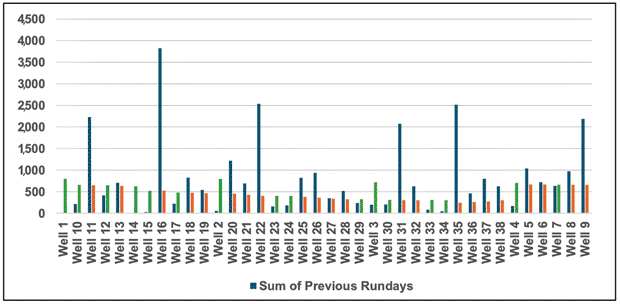
FIGURE 4
Production Uplift Trends in Wells With the Vibrational Energy Tool
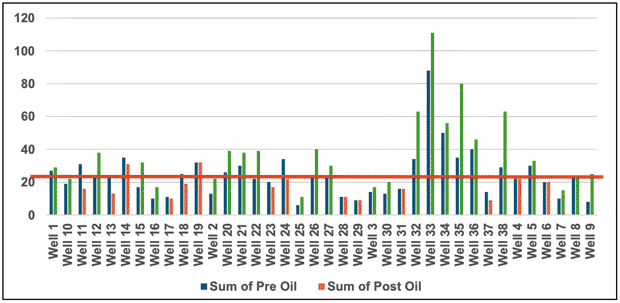
The trial also showed production uplift in a meaningful number of wells. Of the 38 wells still operating, 24 demonstrated measurable oil production uplift. In several cases, the increase exceeded the tool-sizing threshold of 35 barrels of oil per day per tool, indicating that an additional tool would be required if the higher production rate were maintained (Figure 4).
Not all wells performed the same, and the exceptions helped refine the application criteria.
One failure was attributed to improper tool placement. The tool had been installed below a perforated sub in the bottomhole assembly rather than above it, allowing fluid to bypass the tool. After the well was pulled and the tool was repositioned correctly, the well continued to build runtime and surpassed its previous record by a factor of four.
Another well failed after downtime related to gas curtailment, during which a corrosion hole developed in the tubing string. When the equipment was surfaced, only minimal paraffin was observed on the inside and outside of the equipment. The well had achieved a 225-day runtime, roughly double its historical performance. After the tool was removed and the well returned to traditional chemical treatment, it failed twice more, with run times of 139 days and five days.
A third well was proactively pulled for deepening and converted from a sucker rod pump to an ESP after 225 days of runtime. Significant asphaltene and paraffin deposits were found during the pull. The tool was not reinstalled, and the well returned to chemical treatment. It subsequently failed after 16 days.
A fourth well operated for 244 days, compared with a previous 145-day run, before failing due to solids accumulation in the pump. Heavy asphaltene buildup was observed on the pump and lower bottomhole assembly.
In theorizing why that occurred, it’s worth noting the well had a downtime event 10 days before failure, then returned to production and operated for another 10 days without indications of sticking, friction, solids or gas interference. Because the well produced approximately 1.5 million cubic feet of gas and had a high gas-liquid ratio, it’s possible solids may have accumulated in the backside fluid column above the tool during downtime and then entered the pump when production resumed.
Those examples suggest the tool can be effective, but application details matter. Proper placement, fluid flow through the tool, and operating conditions such as high gas-liquid ratio may influence performance.
Economic Impact
The strongest economic case appeared in wells with asphaltene treatment programs, where chemical costs are higher. Oxy compared annual costs for proactive and reactive chemical treatments with the cost of the vibrational energy tool to establish breakeven runtime thresholds. Each day a well operated beyond breakeven represented additional savings.
Oxy reports that wells on asphaltene-treatment programs achieved payout in less than a year. Wells on lower-cost paraffin treatment programs required more than one year to reach payout.
The economics also extend beyond chemical replacement. If a tool can reduce failures linked to asphaltenes, paraffin, and scale, the impact includes avoided repair costs, fewer workovers, less deferred production, and longer artificial lift life. For an operator facing hundreds of annual failures related to asphaltenes, paraffin and scale, as well as tens of millions of dollars in repair costs, incremental improvements in runtime can quickly become material.
Oxy has since qualified the tools for broader use, but subsequent installations outside the original protocol have resulted in a few additional failures. A more detailed review is underway to refine deployment criteria. Preliminary findings suggest possible performance correlations in wells with elevated carbon dioxide concentrations and gas-liquid ratios greater than three.
That qualification work is important. Like any production technology, the tool appears most effective when applied to the right wells under the right operating conditions. The original protocol—candidate selection, chemical removal, proper sizing, installation requirements, and ongoing tracking—helped define those conditions.
Practical Alternative
The field trial shows that vibrational energy technology can provide a practical alternative to chemical treatment for asphaltenes, paraffin and scale in selected wells. The approach does not eliminate the need for corrosion inhibition, nor does it remove the need for good engineering judgment. But it does offer operators another tool for managing solids-related production problems.
The most compelling aspect is that the technology targets the physical behavior of the produced fluids rather than relying solely on chemical inhibition. Laboratory analysis showed increases in API gravity, reduced viscosity, lower wax appearance and pour point temperatures, emulsion breaking, and reduced interfacial tension. Field results showed improved runtime in many wells, measurable production uplift in more than half the active test wells, and strong payout potential in asphaltene-prone wells.
For independent producers and larger operators alike, the lesson is straightforward: asphaltenes, paraffin, and scale do not have to be accepted only as chemical management problems. In the right application, physics can help extend artificial lift runtime and lower operating costs.
Editor’s Note: This article condenses a paper from the Southwestern Petroleum Short Course (numbered 2026055) on using physics to mitigate asphaltene and paraffin. The full paper includes more details on how the vibrational energy tool works and the results seen in the lab, which are supported by 11 figures we did not have the space to reproduce.

Douglas Hamilton is a geologist, medical physician and inventor who works for JW Enterprise, which provides many surface and downhole tools, including Enercat vibrational tools for addressing asphaltenes and paraffin. Hamilton has more than 40 years of international experience in the petroleum and coal industries, including more than 30 years as a reservoir geologist conducting fully integrated geological and engineering reservoir characterization projects on conventional and unconventional reservoirs. He worked for the coal industry in Australia during the 1980s, served as a research scientist for The University of Texas at Austin’s Bureau of Economic Geology during the 1990s, and spent many years in consulting and advisory roles to national oil companies, such as PDVSA and PEMEX. Hamilton has also authored more than 40 publications on depositional systems and reservoir characterization.
For other great articles about exploration, drilling, completions and production, subscribe to The American Oil & Gas Reporter and bookmark www.aogr.com.