






Longer Laterals Reshape Williston Basin Development
By Andrew Linnabary
WATFORD CITY, N.D.—The definition of a long lateral in the Williston Basin keeps changing. What was once considered an ambitious length has now become routine, and operators are already finding new ways to extend wells even farther.
That evolution is redefining development across North Dakota, allowing producers to improve their economics as they begin to lay the groundwork for the basin’s next phase of growth.
Those themes will shape discussions when the North Dakota Petroleum Council holds its annual meeting Sept. 15-16 at the Rough Rider Center in Watford City, N.D., where members will gather to review the organization’s progress, prioritize next steps and celebrate their accomplishments.
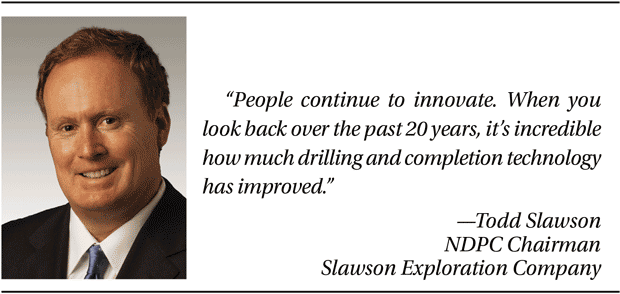
“We’ve definitely seen a shift to longer laterals in the Williston Basin’s perimeter areas,” says Todd Slawson, chairman of the North Dakota Petroleum Council and president of Slawson Exploration Company. “Areas that weren’t economically successful in the early 2010s continue to improve, and the trend now is three- and four-mile laterals.”
Unlike some years, the annual meeting will not center on a packed policy agenda or extensive technical presentations, NDPC says. Coming only a few months after the Williston Basin Petroleum Conference, which drew thousands of attendees in May, association leaders say they designed this year’s event to emphasize connection and networking, along with looking at the overall direction of the industry in the state.
“I think the optimism coming out of the Williston Basin Petroleum Conference has continued,” says Ron Ness, president of the North Dakota Petroleum Council. “There was tremendous discussion about Bakken 2.0 and how to mobilize more oil out of the resource. Operators have remained steady in terms of activity, and while we’ve seen prices react to global events, companies recognize that it is conflict-related volatility rather than a fundamental supply-and-demand issue.”
Instead of making dramatic changes in response to short-term price swings, producers have largely stayed the course, Ness reports.
“We’re seeing steady production and activity, maybe a slight pickup here and there with a few rigs,” he says. “The focus continues to be on our enhanced oil recovery pilot projects and the work we’ve been putting into those. Overall, I feel really good about where we’re at.”
Longer Laterals
The industry’s eagerness to test EOR has not kept it from accelerating drilling and improving completion designs. That progression is extending development beyond the basin’s traditional acreage, Ness reports.
“We’re venturing into Tier 2 and Tier 3 acreage with results that look like Tier 1,” he says. “Technology continues to advance, and so does the productive footprint of the Bakken. That’s probably been the biggest change over the past year and a half.”
Slawson says the shift is becoming increasingly evident in operator drilling plans.
“We’re seeing very few situations where somebody wants to drill a straight two-mile lateral anymore,” Slawson remarks. “Three and four miles are becoming the standard wherever they make sense, and they’ve really improved the economics.”
When lease boundaries prohibit such long laterals, operators are experimenting with innovative well shapes, Slawson says.
Earlier this year, Slawson Exploration completed its first four-mile U-turn well, joining several operators testing designs that maximize reservoir exposure within limited acreage positions.
“It actually turned out to be easier than we expected,” Slawson says. “We didn’t have the friction issues people were concerned about.”
Slawson expects operators to continue adapting well designs to fit individual acreage positions.
“People are getting creative,” Slawson says. “You’ll probably continue seeing different design variations wherever operators can’t simply keep drilling straight ahead.”
The willingness to test new concepts reflects one of the Williston Basin’s defining characteristics, he says.
“People continue to innovate,” Slawson says. “When you look back over the past 20 years, it’s incredible how much drilling and completion technology has improved.”
Bakken 2.0 Progress
The Bakken 2.0 discussion is now moving from long-term potential toward large-scale field testing, Ness says.
“We continue moving projects forward and working through regulatory issues,” he says. “We’re going to have projects this fall with fluid in the ground at scale, and we’ll begin seeing results. We’ve also got another round of incentive grants coming up, and I expect we’ll see a large influx of operators interested in pilot projects.”
The initiative aims to enhance recovery from existing Bakken wells by adapting existing EOR techniques to unconventional plays and pioneering new ones.
Slawson says the industry remains in the early stages of testing several approaches.
“We’re still doing a lot of pilot work,” he says. “The meaningful results are going to come from those pilots, and I don’t think we’re too far away from beginning to learn from them.”
Slawson points out that the pilots receive public support. “It’s a great program because the government helped fund it,” Slawson says. “That means the results become available for everybody to learn from, and the entire industry can build on that.”
Gas Demand
Alongside Bakken 2.0, growing demand for natural gas has become another source of optimism across North Dakota. Discussions surrounding new pipelines, gas utilization projects and artificial intelligence infrastructure have accelerated over the past several months, Ness says, helping give producers confidence in the basin’s long-term outlook.
“We’re having a lot of discussions about gas utilization within the state,” Ness says. “Whether it’s new gas pipelines moving Bakken gas across the state for utilization or data centers, there’s a lot happening.”
Artificial intelligence has quickly become part of that conversation, with multiple large-scale projects now advancing, he says.
“There is a lot of talk about data centers in North Dakota right now,” Ness says. “We’ve got several data centers under construction, numerous others in discussion, and a lot of policy debates at both the local and state level. It’s a big topic.”
For producers, Ness says the projects could create significant new demand for Bakken natural gas. Slawson says that opportunity is developing alongside a more responsive federal permitting environment.
At the Williston Basin Petroleum Conference in May, U.S. Interior Secretary Doug Burgum encouraged operators to report permitting issues directly to his office. Slawson says the industry quickly took him up on that offer.
“Secretary Burgum told us if we were seeing anything they weren’t seeing, let them know,” Slawson recalls. “We contacted them the next week, explained some of the issues we were running into, and his team called us right back. We talked through everything and got it resolved.”
While some permitting challenges remain, Slawson says the willingness to engage directly with industry has been encouraging.
“He wants to know where the problems are so they can address them,” Slawson says. “He’s done a great job.”
Ness says the council anticipates similarly productive discussions with Jerry Davis, who became acting BLM director for North Dakota, Montana and South Dakota in May.
“We’re looking forward to engaging with the new BLM director,” he says. “We’ve developed a great relationship with the Montana-Dakotas BLM office, and there are certainly issues on the radar that we think are important moving forward.”
Leasing activity has also improved considerably compared to previous years, Slawson observes.
“The quarterly lease sales are back on schedule, and that’s important,” he says. “When those sales weren’t happening, operators had to delay drilling plans because they couldn’t cross certain tracts. Now those auctions are back on track every quarter, and that’s helping projects move forward again.”
‘Moving Forward’
North Dakota experienced a wave of mergers and acquisitions during 2024 and 2025, reshaping much of the Williston Basin’s operator landscape, NDPC says. 2026 has been comparatively quiet.
“We went through the big consolidation period already,” Ness says. “This year, operators seem to be settling into those combined asset positions and moving forward.”
Slawson, who will conclude his three-year term as NDPC chairman during the annual meeting, says that consolidation was one of several defining developments during his tenure.
“When I became chairman, we were dealing with permitting issues, the LNG export pause, limited federal lease sales and a much different policy environment,” he says. “Since then, we’ve seen a new administration, a new governor, changes at the Industrial Commission and a tremendous amount of consolidation. A lot has changed over those three years.”
During the meeting, members are expected to elect Darrin Henke, executive vice president and chief operating officer at Chord Energy, as the council’s next chairman.
Slawson says the transition comes at an appropriate time.
“I think Darrin will do a great job,” he says. “He’s got a tremendous amount of operating experience, comes from a major company and will bring a lot to the position.”
Henke will be one of many powerhouses keeping the association in an exceptional position, Slawson adds.
“We’ve got a great president in Ron Ness, tremendous staff and outstanding member support,” he says. “I’m stepping away from my role as chairman with the organization in a great place.”
Reflecting that confidence, this year’s annual meeting will emphasize member appreciation and networking rather than a lengthy policy agenda, Slawson and Ness say.
“Coming off the Williston Basin Petroleum Conference, we intentionally shortened this year’s meeting,” Ness explains. “We really want it to be about our members, where we’ve been as an organization, where we’re going and creating networking opportunities.”
For attendees, he hopes the event reinforces both the industry’s momentum and its collaborative spirit.
“I think people will leave with optimism about the next phase of the Bakken and Bakken 2.0,” Ness says. “The operators have largely settled in after all the acquisitions, and now it’s about continuing to build those relationships and positioning the basin for what’s next.”
For other great articles about exploration, drilling, completions and production, subscribe to The American Oil & Gas Reporter and bookmark www.aogr.com.