








America’s Producers Thinking Positive About Produced Water Strategies
By Andrew Linnabary
ODESSA, TX.—The industry is defined by a paradox of volume. While the world watches the region’s record-breaking oil production, operators on the ground are focused on a much larger stream: the two to ten barrels of produced water that accompany every barrel of crude. In total, the basin brings more than 20 million barrels of produced water to the surface every day.
For decades, the solution was routine: send the water to a saltwater disposal well and inject it deep underground. That approach worked—until recently. Mounting seismic activity has led to regulatory limitations in key production areas, and the industry’s available “pore space” is reaching a physical limit. Together, those pressures have helped reframe the conversation about produced water from “where do we put it?” to “what else is in it?”
Driven by breakthroughs in desalination technology, produced water is no longer viewed solely as a waste stream to be managed at the lowest possible cost. Industry experts report it is increasingly seen as a strategic asset: a “liquid mine” capable of yielding critical minerals like lithium and iodine while also offering a potential freshwater resource in an increasingly parched region of the United States.
Establishing Ownership
Before an operator can justify the capital expenditure required for mineral extraction, they must first answer a fundamental question: who owns the waste? The Texas Supreme Court’s 2025 ruling in Cactus Water Services LLC v. COG Operating LLC helped clarify that question.
Wolf Puckett, a partner at Mullin Hoard & Brown, calls the case a “first-of-its-kind dispute” that sets a vital precedent for the modern oil field.
“Disputes have been emerging about who actually owns produced water, and it has raised a cavalcade of questions,” Puckett explains. “Who controls the produced water, and therefore any valuable minerals in it, is very important. And the Cactus opinion says the mineral lessee, usually the operator, owns the water—that’s the default rule, unless the lease expressly provides otherwise. It highlights how the right to possess and dispose of produced water remains with the party holding the oil and gas grant.”
The Cactus case originated when surface owners signed leases with Cactus Water Services conveying their rights to “water from oil and gas producing formations and flowback water produced from oil and gas operations” in areas where COG Operating had already leased and begun producing hydrocarbons. The courts determined that COG Operating’s hydrocarbon leases implicitly assigned it the right to produced water.
Puckett notes that the implications of the case extend far beyond a single operator, largely because the court focused on the physical and regulatory ability to manage the stream. The court effectively ruled that water produced as a byproduct of oil and gas operations belongs to the party that holds the mineral grant, not the surface owner.
“The Supreme Court observed that the party attempting to lease the water from surface owners, Cactus Water Services, possessed no permits, no infrastructure, and no ability to handle, transport, or dispose of produced water,” Puckett says. “By ruling against them, the court ensured that the water doesn’t become a ‘stranded’ asset held by parties who can’t actually manage the production stream.”
However, Puckett cautions that the specific language in legacy leases still matters. Operators, he says, should not assume every lease provides mineral ownership without reviewing granting clauses that were often written decades ago.
“I just happened to pick out a 50-year-old lease over the weekend to see what it says,” Puckett recalls. “And it said the grant was for ‘oil, gas, and’—importantly—‘all other minerals.’”
Even where ownership is clear, Puckett notes that a royalty structure likely applies under those historical agreements, creating a new accounting challenge for operators who pull minerals out of the produced water.
“Justice Busby, the Texas Supreme Court judge who filed a concurring opinion in Cactus, makes a point suggesting that a royalty should probably be paid on that mineral,” Puckett mentions. “In that same old 50-year-old lease, it talks about these other minerals, and it says the royalty to be paid on them would be one-tenth, either in kind or value. It essentially sets a 10% royalty on lithium.”
End-to-End Desalination
Legal clarity on who owns produced water only matters if operators can economically transform that water from a waste stream into sellable products. That almost always means removing a considerable amount of salt, says Matt Sanderson, executive vice president of Houston-based TETRA.
“Produced water is essentially saltwater,” Sanderson explains. “The salt content, or TDS levels, is higher than what you would typically see in ocean water.”
In the past, these high TDS levels made desalinating oil field brines impractical, Sanderson says. Traditional membrane systems would run into problems within hours, and thermal evaporation was too energy-intensive to scale. Today, he says the industry is moving past those hurdles with “end-to-end desalination” solutions that can handle high TDS levels and other concerns at a reasonable cost.
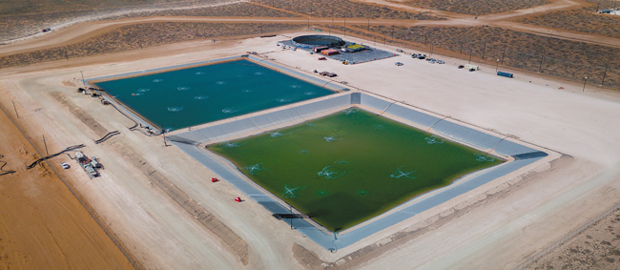
This TETRA automated water treatment and recycling facility in the Permian Basin is helping operators turn produced water into value. With advanced desalination, even high-salt brines can be transformed into usable water and concentrated minerals. By recovering clean water and concentrating minerals like iodine and bromine, treatment reduces disposal costs and creates new opportunities for mineral extraction.
Sanderson emphasizes that success depends on more than simply removing salt. It requires an end-to-end approach designed specifically for water with high salt content.
“The first thing we do is pre-treatment,” he says. “That means identifying some of the undesired chemistries that need to be removed before the water passes through a membrane. Then once we get to the membrane, we’re separating the fresh water from those total dissolved solids so that we get a clean water stream.”
By cutting the volume of water that must be disposed of, treatment reduces both transportation and disposal costs, while simultaneously creating a stream rich enough in minerals which could make extraction economically feasible, Sanderson says.
“Through this process, we can get 50% or more recovery of clean fresh water from Permian produced water,” Sanderson says. “The other half of the barrel is now all those other constituents operators want to separate out, concentrated up by double or more depending on the starting salt content. Because you removed the fresh water, you’ve got a stream where those minerals are available for extraction at roughly twice the concentration than they were before.”
Sanderson views clean water and minerals as two halves of the same economic equation. Addressing the disposal challenge is the “meat and potatoes,” he says, while mineral extraction becomes a value-added “dessert.”
“So, you’ve already concentrated up those minerals,” Sanderson says. “Next, you might look to see if there’s an opportunity that could improve your economics by extracting one or more of them.”
While lithium continues to dominate conversations, Sanderson says other minerals present in oil field brines may offer near-term opportunities, particularly iodine, which plays a critical role in completion fluids.
“If we could extract some of the iodine from produced water, there’s broad market applications for it,” Sanderson says. “One application could be using it in a completion fluid. TETRA has patented technology for heavyweight brines—zinc-free, cesium-formate-free heavyweight completion fluid brines—that could use iodine.”
Beyond these minerals, some operators are looking at other trace elements present in the brines that could find niche industrial applications. For example, bromine is used to make pharmaceutics, paper, agricultural insecticides and other products, and is used in some drilling and completion fluids.
Economics and Risk
Even with legal clarity and improved technology, veteran operators caution that widespread adoption of mineral extraction technology will hinge on one thing: returns. For producers, shifting from straightforward disposal to complex mineral extraction introduces new layers of risk.
Kirk Edwards, president of Latigo Petroleum, says the economics must be compelling enough to justify that leap.
“It has to be economical in a good way for the producer to be able to take the risk on mining that water,” Edwards says. “I would say you’ll need at least a 30% rate of return for somebody to make an investment like that and give the time and effort that has to be put in. Anything lower than that, you’re going to get into quantity risk and pricing, and there’s no telling what will happen with your profitability ahead.”
While desalination and mineral extraction may reduce disposal volumes and generate revenue that could offset water management costs, Edwards says it is far from a cure-all.
“The producer still has to get rid of the water stream,” Edwards explains. “It doesn’t just go away. Even if we take the lithium out, we still have a massive volume of water that needs a home.” Operators who are comfortable with that risk will end up contracting with a third party that has the technology to pull minerals out efficiently, Edwards says. Even for those operators, he predicts that unresolved questions around legacy lease language will slow adoption or complicate early projects.
“The problem is going to be how we, or how the industry, determines who owns what from our old oil and gas leases,” he says. “That’s going to be the $20 question ahead.”
An Existential Threat
Beyond economics, another powerful driver behind the produced water shift is the growing threat of operational shutdown. As disposal capacity tightens, operators may be forced to curtail oil production simply because they cannot move the water.
“Pore space, if you think about it like a swimming pool, is filling up,” Sanderson says. “So it’s getting harder and harder to put that water into that formation. The formation pressures are increasing, which is causing some other undesired effects. And some of those consequences have been well documented.”
Citing data published by B3 Insights, Sanderson notes that disposal capacity in certain areas could be effectively exhausted by the end of the decade. “If operators in those areas can’t find other ways to deal with the water, they might have to start choking back oil production,” he warns. “This is an existential threat. That’s why advances in produced water management are accelerating.”
The urgency is driving interest not only in mineral extraction, but also in finding beneficial uses for produced water outside traditional oil and gas. One of the most frequently cited examples is AI data centers.
“Power generation for AI and data centers uses a lot of water,” Sanderson explains. “At these data centers, a lot of heat is generated, and so they use liquid cooling. That means they also need very clean water.”
From Sanderson’s perspective, produced water offers a largely untapped solution that can be treated economically with new technology. As traditional disposal costs increase and water treatment costs decrease, he sees an opportunity to use this untapped resource.
“We have plenty of water that can be used for power generation and data center cooling,” he says. “All you need to do is clean it up.”
By confronting the disposal crisis head-on through desalination and reuse, operators may be unlocking an entirely new mineral frontier and addressing water constraints with far-reaching effects, he says.
“In the history of mankind, water is a valuable resource, maybe the most valuable,” Sanderson reflects. “Here we are with plenty of water. It’s just not the right type. If we can clean it up, there’s opportunity around agriculture, power generation, data center cooling—all of these things that bring economic benefit. The opportunity is everywhere.”
For other great articles about exploration, drilling, completions and production, subscribe to The American Oil & Gas Reporter and bookmark www.aogr.com.