






Emissions Strategies Evolve From Simple Compliance To Industry Profit Centers
By Andrew Linnabary
HOUSTON—The newest advances in emissions technologies are increasingly being driven by the same goal that has always shaped oil and gas operations: improving performance.
While regulations and methane reduction targets remain important parts of the overall conversation, emissions management experts say operators show the greatest interest in products and solutions that keep equipment running, maximize production and ideally improve profitability.
Those experts add that emissions management is becoming less about finding and repairing leaks and more about understanding and preventing the operational conditions that create them in the first place. Increasingly, that includes technologies designed not only to improve visibility into emissions events but also to improve equipment reliability and overall facility performance.
The ubiquitous natural gas engines illustrate this trend. If one has to run on liquids-heavy field gas, it will emit more than it should. Treat that gas to spec, and the engine will not only produce fewer emissions but also last longer.
“Many times, an emission is the result of something else not working right,” says Scott McCurdy, CEO of Encino Environmental Services. “The root cause is probably impacting the operator’s production and, therefore, finding a solution can have a positive effect on the operator’s revenue.”
Layered Monitoring
As emissions detection technology improves and the industry gains experience using it, McCurdy says it’s getting easier to spot leaks, determine why they’re happening, and prioritize remediation efforts.
In the past, emissions programs relied heavily on traditional leak detection and repair, or LDAR, surveys. While that approach remains an important part of emissions management, McCurdy says operators today have access to a much broader set of tools that deliver information more efficiently.
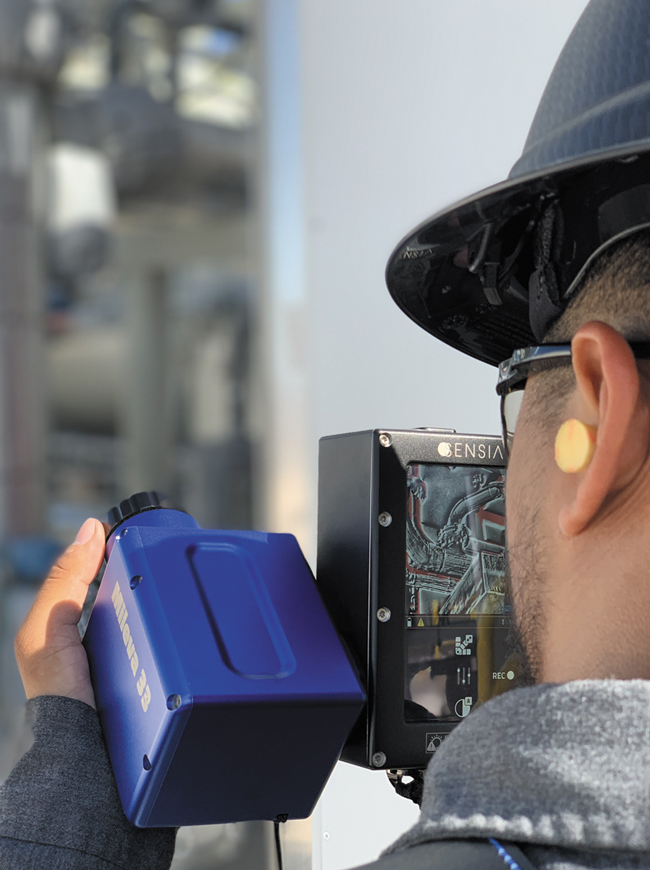
An Encino Environmental Services technician conducts an LDAR survey on an offshore platform off the coast of Africa. Encino says operators are increasingly adopting layered monitoring programs that combine traditional leak detection with technologies such as satellites, fixed cameras and continuous monitoring systems.
“Historically, LDAR has always involved boots-on-the-ground inspection where people walk around with some sort of sensing device to look for leaks,” McCurdy says. “Over the past five or six years, we’ve had the introduction of several different types of technology. Now, companies use some combination of satellites, planes, drones, laser sensors, fixed cameras and continuous monitoring systems.”
The change has been driven by a combination of factors, including stricter monitoring requirements, methane reduction commitments and rapid advances in technology.
“A lot of companies globally have made methane pledges or published specific targets around methane reduction,” McCurdy notes. “At the same time, the technology available has changed dramatically. It’s much easier now to notice leaks, including some of the most significant ones.”
Rather than replacing traditional LDAR programs, McCurdy says many operators are adopting what he describes as a layered approach that combines multiple technologies.
“Typically, LDAR is required every quarter, so an operator may only be getting four looks a year at infrastructure,” he explains. “If they add in a monthly satellite campaign or a continuous monitor, now they’ll be able to catch leaks faster, resolve them faster, and create more accurate emissions inventories.”
Noting that every technology has limitations, McCurdy says the appeal of a layered monitoring program is that each tool fills a niche that capitalizes on its strengths.
“It’s kind of a trade-off,” McCurdy says. “Some technologies give more revisitation but only see larger leaks. Some services can detect smaller leaks with relatively good accuracy, but operators can only have them cover their sites a couple of times a year due to cost constraints. That’s why people talk about a portfolio approach or having a layered system. It’s usually best to combine two or three of these tools together.”
One of the most notable advances, he says, has been the industry’s ability not only to detect emissions but also to pinpoint their source.
“When we started seeing fence-line monitoring come in, it was decent at detecting leaks, but could typically only place those leaks in a general area,” McCurdy recalls. “Now, with fixed cameras that can monitor a facility 24/7, operators can automatically get an alert about a leak, watch it live, see exactly where it’s coming from, and get a real-time quantification of how much methane they’re losing.”
Quantification has emerged as another area where the industry is making rapid progress, McCurdy notes.
“The accuracy has improved dramatically over the last few years,” McCurdy says. “It still isn’t perfect, and it varies by technology, but it gives operators the ability to prioritize repairs and understand the magnitude of those leaks very quickly.”
As more affordable and effective monitoring programs allow operators to gather larger volumes of data, McCurdy says attention is increasingly shifting toward predictive analytics.
“I had a board member who said, ‘We want to move from find and fix to predict and prevent,’” he relates. “Now that companies have a lot of data on where they’ve had leaks and the magnitude of those leaks, they’re figuring out what led to those emissions events and using AI to identify conditions that could lead to future events before they happen.”
Capturing Value
Preventing or finding and fixing leaks is only one of many strategies operators can deploy to reduce emissions while boosting profits. According to Coldstream Energy, it’s also important to consider each engine’s emission profile, which is heavily influenced by fuel quality.
Recognizing that reality, the company says it has developed a fuel gas treatment technology that minimizes the need to burn the heavy hydrocarbons often seen in field gas.
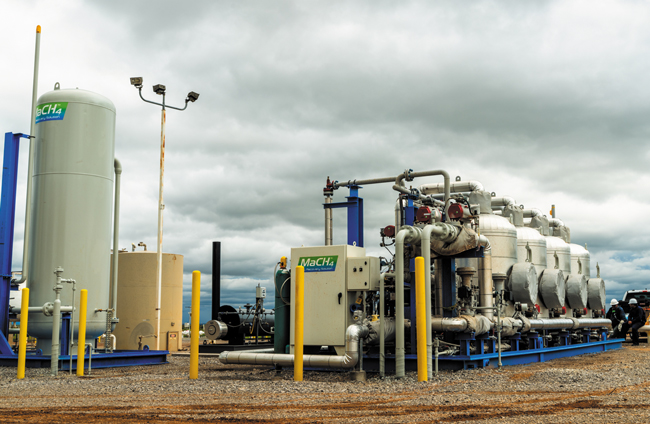
Coldstream Energy's MaCH4 fuel-gas treatment system removes natural gas liquids from the fuel stream, allowing operators to retain and sell NGLs that otherwise would be burned as fuel. The company says the technology reduces emissions, improves engine reliability and can generate substantial additional revenue.
The system uses pressure swing adsorption technology to separate methane from heavier hydrocarbons, producing a cleaner fuel stream for engines while allowing operators to retain valuable natural gas liquids that otherwise could be consumed during combustion, explains Matt Thompson, senior vice president of sales and marketing at Coldstream.
“What we do is provide a much better-quality fuel,” Thompson says. “In the process, we are allowing operators to monetize the maximum amount of NGLs instead of burning them.”
The emissions implications are significant, Thompson says.
“The more heavies an engine burns, the worse the emissions are,” he states. “By stripping out all those heavies, volatile organic compound emissions are reduced by 70% on average. And because the engine has a more complete combustion process, we reduce carbon monoxide by about 20% on average.”
The cleaner fuel stream also improves engine reliability, he adds.
“The more heavies the fuel has, the more detonation you have. It’s an uncontrolled explosion in the cylinder,” Thompson explains. “Detonation will shut the engine down, and many times it will need repairs. So when the engine receives residue-quality fuel, the site will avoid unnecessary downtime.”
Thompson says preventing downtime reinforces the already strong economic case for preserving valuable NGLs that otherwise would be burned as fuel.
“One of our units will produce an average of about $1.2 million annually in NGL value,” Thompson says. “Without it, the station would burn $1.2 million of recoverable NGLs. By solving that, we’re not only improving emissions, we’re creating a revenue stream.”
For other great articles about exploration, drilling, completions and production, subscribe to The American Oil & Gas Reporter and bookmark www.aogr.com.