








AI, Digital Twins Enhance Operations
By Colter Cookson
To meet expected natural gas demand, the Interstate Natural Gas Association of America’s research arm estimates that the United States and Canada will need to build at least 37,000 miles of new natural gas transmission pipelines by 2052. For gathering lines, that number jumps to 103,000 miles.
Given the challenges involved in forecasting 25 years into the future, INGAA’s numbers will almost certainly prove to be incorrect. However, the logic behind them will likely ring true for anyone in the oil and gas industry.
“Even as renewable generation and nuclear power grow and energy efficiency expands, the demand for energy remains too large to be met without natural gas playing a central role,” the INGAA Foundation writes. “Two market forces dominate the long-term outlook: rapidly rising demand for electricity, particularly from data centers, and sustained growth in LNG exports serving global markets.”
For the compression industry, that demand represents a tremendous opportunity. The INGAA Foundation predicts that the additional transmission pipelines alone will require at least 8.6 million horsepower of compression.
In the short term, the industry will struggle to meet the rising need for compression by building new units, according to Chris Wauson, senior vice president and chief operating officer of USA Compression. That’s partly because many data centers would have to wait years to connect to utilities and have decided instead to use behind-the-meter power generators, which has increased competition for engines.
“For the Cat 3600 series engines, which are the core platforms within most contract compression fleets, lead times can be as long as 155 weeks,” Wauson reports. “The skilled labor necessary to package compression is also becoming limited.”
In this environment, Wauson says existing assets that can be redeployed have more value than newbuilds that will take years to arrive. “It’s also more important than ever to maintain operational uptime. Fleet intelligence and knowing where to deploy, how to run, and how to maintain assets will be the key differentiator for gas compression companies,” he says.
For Wauson, true fleet intelligence requires a combination of access to real-time data and rapid analysis. “In the next 12 to 18 months, my goal is to have telemetry on every unit and AI analytics enabling data-driven decisions,” he shares. “We can no longer wait for compressor operators to drive to a unit, manually check it to write up a service report, and import that report into a database before someone can act on the information.”
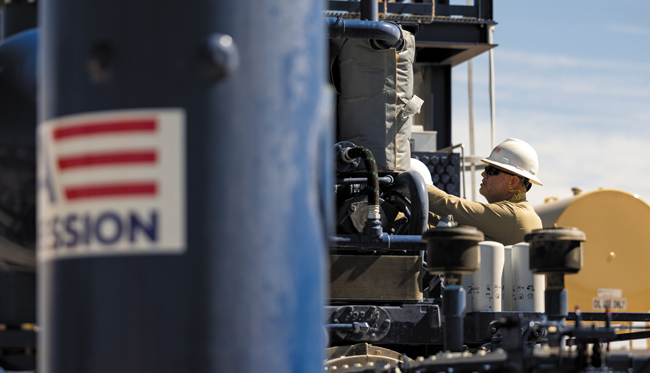
By pairing automatic data collection with AI-powered analytics, compression fleets can increase both uptime and efficiency, USA Compression says. The company sees AI as a critical component of system-supported workflows that use data to guide decisions on everything from maintenance and logistics to compressor upgrades and relocations.
Wauson envisions AI handling routine analyses that would have once required hours of staff time. “We are in the early stages of applying AI. However, we have some platforms we are working on that should be able to predict failure patterns, order parts and optimize when and how we dispatch people for maintenance,” he reports. “The combined effect will be faster decisions, fewer outages and higher asset utilization.”
Empowering Humans
Wauson stresses that AI is not a replacement for human judgement or skill. It can perform some analytical work at a much greater scale, but prioritizing the right analyses and acting on the results will require people who understand the conditions compressors encounter in the field and know how to maintain or adjust the equipment safely and efficiently.
The appeal of AI is its ability to magnify people’s impact by making their tasks as easy as possible. Wauson says this is especially important as experienced hands retire before they can pass down all their knowledge.
“We are moving from relying primarily on individuals’ experience to a system-supported workforce that can capture institutional knowledge,” Wauson says. “The goal is to help good technicians perform more like great ones through technology and system-supported workflows.”
At individual compressors, that philosophy manifests in how data is shown. “On all of our units that are equipped with telemetry panels and sensor packages, the initial troubleshooting is almost like interacting with a computer,” he says. “There is no need to walk around the unit to read temperature and pressure indicators. Everything is already there, and it’s color-coded. If a value is out of the expected range, it’ll be red. If it’s safe, it’ll be green.”
But thanks to remote monitoring, Wauson says much of the work occurs long before the technician reaches the site. It involves looking at dashboards or using AI agents to identify trends, spot early warning signs of future problems, and address them before they lead to downtime.
Timing maintenance is vital because of the remote locations where compression must operate. “In the Permian Basin, even though we have man camps staffed by rotating technicians, some of the units are two, three, or four hours away from the closest technician,” Wauson says. “With remote monitoring and data analytics, we can minimize the amount of time that technician spends driving to and from sites and increase our units’ reliability by a percent or two, which is a huge operational and financial benefit when it’s converted to higher production.”
The Next Step
USA Compression’s contracts call for the company to achieve mechanical availability of 98%, but in practice, Wauson says the uptime typically approaches or exceeds 99%. “Maintaining that level of performance requires coordinated operational execution,” he reflects. “It comes from a combination of factors. On the units themselves, it matters how everything is set up, from the engine to the fuel lines and the hoses that connect lubricants. From an operational standpoint, we have to think about everything from spare part inventories to the experience and placement of our staff.”
As AI accelerates many tasks, Wauson says compression companies’ focus will increasingly shift from fine-tuning individual units to optimizing the fleet. That means using existing units effectively and adding new ones that meet industry needs.
Given the long lead times for new equipment, Wauson says smart purchases require a long-term view. “We have to do research on where the markets are going and stay in tune with what customers are doing today and where they are headed,” he says. “We need to understand their drilling plans not just for the next six months, but for the next five or 10 years.”
It’s also important to right-size the units on site as conditions change and the existing equipment has too much excess capacity to operate at a reasonable efficiency or too little to reliably meet the site’s needs, Wauson suggests.
“Today, we often have to identify those units by traveling to a site to manually take volumes, record pressures and calculate the horsepower loads. That’s time-consuming,” he says. “With telemetry providing the data, AI can come in, weigh all the factors and alert us when it may be time for a unit to move.”
The unit will often return to the facility for refurbishment and get reconfigured to meet today’s requirements. In the past, USA Compression would contract reconfiguration work to third parties. However, it now does most of the work in-house.
According to Wauson, self-sufficiency has a big impact. “Every time we contract something out to a third party, we pay a markup,” he says. “With in-house work, we can eliminate that markup and reconfigure five units for the same cost we used to spend on four.”
He adds that the company no longer needs to fit work into other companies’ schedules. “With natural gas-based power generation becoming a mission-critical reliability layer for AI, the extra speed to redeploy units matters,” he says.
Realistic Models
As compressor fleets seek ways to get more from their assets, they are investing more heavily in sensors and data acquisition, says Dwayne Hickman, who manages the eRCM™ reciprocating compressor modeling product line for ACI Services, a division of Cooper Machinery Services.
“With the computing power now available in purpose-built control panels, those panels can perform calculations that only the big PLC-based ones could in the past,” Hickman shares. “The cost of sensors has also fallen, making it easier to justify the investment.”
With more data and greater computing power, it’s possible to create more precise digital twins of reciprocating compressors. In addition to running on desktops and in the cloud, where they support engineering, trend detection and other analytics, these models increasingly appear at the edge. One of their core functions is to prevent changes to units that would push them outside safe operating parameters.
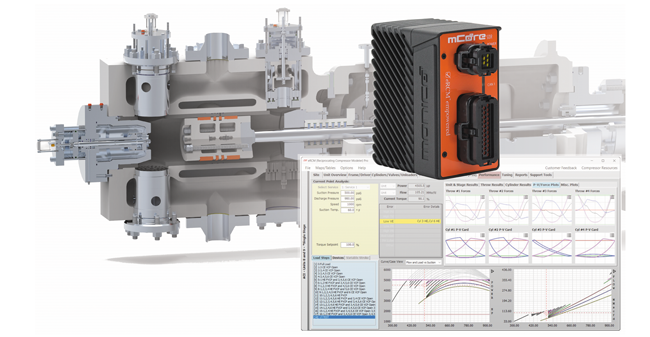
Rugged and powerful edge computers and efficient algorithms have enabled ACI Services to improve the accuracy and precision of its compressor models. Among many other functions, the company says these digital twins can help fleets avoid potentially risky operational changes, anticipate future maintenance needs, and troubleshoot any issues that still occur.
To illustrate that function, Hickman points to speed. “A unit could be running fine at 1,000 rpm,” he relates. “If the site needs to reduce the flow through the unit by 10%, an operator could go up the machine and cut the speed to 900 rpm. That will come close to delivering the 10% reduction in flow.
“What the operator would not realize without help is that the speed reduction could create a pin non-reversal problem on the compressor, meaning a situation where it is no longer getting sufficient lubrication at some of its key points. This allows metal to rub against metal, which generates friction and extreme heat that can cause catastrophic issues.”
That is where the model-supported control device steps in. “Not only does it look at the current speed, but it also looks at other possible speeds and tells the operator how much they can adjust it up or down without creating problems,” Hickman says. “It can provide similar guidance for suction pressure, which stations also pinch back or unpinch to control flow, as well as discharge pressure.”
Today, many companies bring their compressors’ digital twins into cloud-based systems such as AVEVA PI for high-end data analytics, Hickman reports. He says companies will often identify issues by comparing compressors’ expected behavior to their actual performance.
“The analysis can be something as simple as looking at the theoretical discharge temperatures versus what they measure, because usually, when a unit is unhealthy, the compression events have been distorted, and 99% of the time, that leads to a higher discharge temperature coming out of the cylinder than theory would predict,” he illustrates.
Once they have identified a problem, Hickman says fleets can look at trends to figure out what its likely effects will be and pick the best time to send a technician out to address the issue.
Advanced Thermodynamics
Over time, compressor models have become increasingly accurate, Hickman says. He attributes many of those accuracy gains to rising computing power and carefully-crafted algorithms that strike the right balance between precision and speed.
“For example, we have partnered with Fives ProSim to come up with efficient ways to model thermodynamics,” he says. “We are doing the same types of calculations we did 20 years ago, but instead of looking at one point, we can do a hundred or a thousand points in the same period. That lets us move from focusing on where the compressor is at right now to investigating the neighborhood of where it could operate to avoid pitfalls and figure out if any changes should be made.”
Hickman points out that thermodynamics can help users understand how compressors will respond to rich gas. “The gas from many shale plays has high concentrations of pentanes, hexanes, octanes and other gases that can liquify and drop out during compression. Those losses change the composition of the gas as it enters the next stage, altering the power and flow calculations. By using thermodynamics to anticipate those changes, we can model the compressor more accurately.”
The difference can be stark. “We have seen applications where liquid dropouts represent 5% to 25% of the total gas volume. In those situations, horsepower calculations can be off as much as 50% and flow calculations can be off 20-50%,” Hickman reports.
Torsional Calculations
In addition to modeling thermodynamics more precisely, Hickman says ACI is working on calculating torsional forces in real time. “Every recip experiences some torsional forces as the crankshaft twists back and forth during normal operations. However, if these forces get too high, they can shear the crankshaft, and nobody wants that.”
The traditional solution involves conducting a torsional study to find out which operational points will generate excess torsional force. These studies typically only consider about 20 operating points and their speeds. “During real-world operations, the compressor could see hundreds or thousands of points,” Hickman contrasts. “If we can model torsional forces quickly, we can protect the crankshaft by double-checking the points the compressor is about to move to.”
To streamline the necessary calculations, ACI has partnered with Wood, a Calgary-based consultant that analyzes vibration, dynamics and noise. Based on current progress, Hickman says real-time torsional modeling may become available by the end of the year.
Meanwhile, ACI is evaluating whether to model how pulsation affects individual compressors. “Pulsations are acoustic waves that come back into the cylinder and distort the pressure and volume curves,” he says. “When those waves only cause the curves to move up or down by a couple percent, no one cares. But sometimes they can throw horsepower and flow calculations off by 10% or 15%.”
Pulsation effects tend to be more extreme in large compressors, Hickman mentions. Today, most gas companies consider pulsation effects on the overall facility, but not necessarily on each compressor cylinder’s end—and those are the pulsations that alter power and flow. Hickman says ACI is researching whether pulsation has a significant impact frequently enough to justify developing algorithms for modeling it rapidly in the control panel.
“If so, I’m optimistic we’ll be able to model pulsation efficiently within the next couple years,” he says. “At that point, we will have the thermodynamic, torsional, and acoustic effects, along with regular compressor checks. That is 99% of what recip compression experts have always wanted to see.”
Compressing Tough Gas
Rotary vane compressors can provide a low-maintenance option for handling gas streams that contain natural gas liquids, hydrogen sulfide, carbon dioxide, or water vapor, says Travis Sixel, director of engineering for Ro-Flo Compressors LLC.
“Rotary vane compressors handle wet or heavy gases with minimal maintenance because they drive the heat generated by compression into the gas,” Sixel says. “This keeps the liquids in vapor form rather than allowing them to drop out and contaminate the compressor’s lubricating oil.”
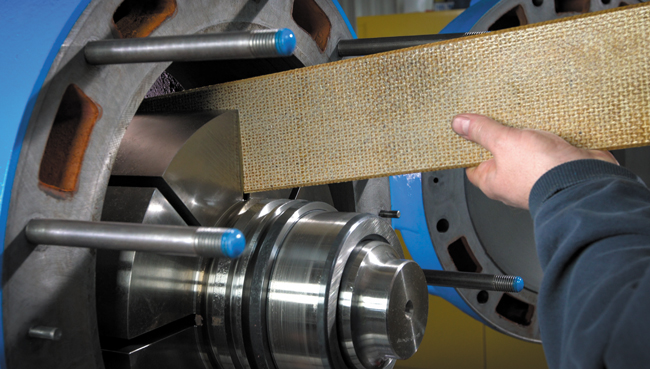
Rotary vane compressors have a long track record of reliable performance in applications where the gas stream contains liquids, hydrogen sulfide, carbon dioxide or water vapor, Ro-Flo Compressors reports. That success largely comes from the compressors’ ability to direct the heat that compression generates into the gas stream, which keeps liquids from dropping out.
In oil-flooded screw compressors, Sixel says such contamination can force technicians to replace the oil filter or the oil itself more frequently. “We have talked to customers who had flooded screw compressors in applications where they had to replace oil weekly or monthly,” Sixel recalls. “Ro-Flo rotary vane compressors do not require that.”
Sixel adds that the maintenance savings from RVCs will be particularly high if the traditional solution needs synthetic oil, as RVCs use a standard mineral R&O that is far more affordable.
Two-stage RVCs generally cost more than equivalent flooded screw or reciprocating compressors, so they rarely see use in applications that involve clean, dry gas. Citing a rule of thumb from packagers, Sixel recommends considering RVCs if a gas stream’s molecular weight exceeds 30. At that point, the lower operating costs will likely offset the higher upfront investment.
“The most common application for RVCs is recovering vapors from oil storage tanks,” Sixel says. “We’ve also seen many units deployed on oil/gas separators coming off the wellhead to depressurize those systems and reduce backpressures on the well, which can improve oil production.”
Other oil field applications involve processing hydrogen sulfide and supporting carbon dioxide-based enhanced oil recovery applications, Sixel continues. “In CO2 EOR, water vapor is often present alongside the CO2, and when water condenses with carbon dioxide, it forms carbonic acid, which is very damaging to equipment.”
To tolerate carbonic acid, Sixel says most compressors need special metallurgy. “With a rotary vane unit, we are driving the heat of compression into the gas, which keeps the water from condensing inside the compressor and prevents the carbonic acid from forming,” he says.
RVCs often serve as boosters for reciprocating compressors that need to handle heavy gas streams. Sixel explains that the RVCs have no internal valves, which eliminates the risk of retrograde condensate forming as the gas travels through valves, the root of some reciprocating compressor failures.
“When we boost low-pressure gas—say near atmospheric pressure–to about 50 psi, propane and other heavy gas components (BTEX) condense out of the gas stream,” he shares. “These gases could cause valve sticking or damage if they were allowed to travel into the reciprocating compressor.”
In addition to minimizing that damage and the resulting maintenance costs, Sixel says an RVC booster reduces capital costs because it’s less expensive than adding low-pressure stages to a recip.
“The main limitation we have for boosting recips is capacity,” he says. “Our largest units handle approximately 3.2 million standard cubic feet per day.”
Sixel says that RVCs perform admirably in any application with discharge pressures under 200 psi.
“One customer, with about 80 RVCs, has gone four years without requiring any major maintenance on the equipment. The only thing he has had to do is fill the oil tank,” Sixel relates.
Because of the compressor’s robustness, Sixel says Ro-Flo has a large install base in plays across the United States and Canada, including the Permian Basin, the Bakken and the conventional fields of California. The company also has units deployed offshore.
“We’ve been fortunate to have some very successful installations with ConocoPhillips, XTO, Targa Resources, and California Resources Corp.,” he says.
For other great articles about exploration, drilling, completions and production, subscribe to The American Oil & Gas Reporter and bookmark www.aogr.com.