







Appalachia Oil & Gas Producers Look To Growing Gas Demand To Spark Next Growth Cycle
By Danny Boyd
The playbook on natural gas supply follows alphabetical order, starting with the letter “A” for Appalachia.
If the Appalachian region were a standalone country, it would rank second in the world for natural gas production, behind only Russia and ahead of the Permian Basin. That is the striking comparison offered by Shale Crescent USA, which is working to turn the Ohio River Valley’s vast reserves of accessible, low-cost natural gas into an engine for long-term industrial growth.
The expansive basin encompassing the Marcellus and Utica shale plays in Pennsylvania, Ohio and West Virginia accounts for almost one-third of total U.S. gas output, averaging more than 36 Bcf/d last year, according to the U.S. Energy Information Administration. Although takeaway constraints have slowed production growth in recent years, more pipeline capacity and in-basin demand enabled Appalachia operators to add more than 1 Bcf/d in 2025 alone, EIA estimates. With more local market options and existing and planned takeaway capacity, the forecast calls for more production growth ahead.
Put it all together, and Appalachia producers of all sizes are deploying advanced technologies to achieve production targets. They are leveraging opportunities to add assets, and formulating innovative business approaches to reinforce market growth both inside and outside the region. That includes shale play powerhouses like Expand Energy and Seneca Resources, as well as conventional oil and gas players such as Artex Oil and Penn View Exploration.
Scaled Portfolio
Adding prospects and increasing productivities are Expand Energy’s goals across both its 1.3-million-acre leasehold in Appalachia and 745,000-net acre footprint in the Haynesville Shale, says Danny Brown, who took the reins as chief executive officer of Expand Energy in late October after formerly serving as CEO of Chord Energy.
“Expand Energy is unmatched with its scaled portfolio of premier assets in the most important gas-producing regions, enhanced by a differentiated commercial platform that serves customers from coast to coast,” he comments. “The opportunity ahead for value creation is significant. Liquified natural gas exports, growing power demand and new industrial investment are creating a greater need for reliable energy, and Expand Energy is uniquely positioned with the resources and capabilities to meet that need.”
Already, the company continues to experience stronger well results from bigger fracs as it cuts costs, adds inventory and gains efficiencies with laterals extending beyond 15,000 feet across Appalachia, says Dan Lopata, vice president overseeing recently combined basin operations.
The addition of marketing powerhouse Twin Eagle Holdings provides additional options both nationally and within the basin for the 4.34 Bcf/d produced from Expand Energy’s northeast and southwest Appalachia operating regions.
“We think about the Appalachian business as the cash flow generating engine for the organization,” Lopata says. “It generates an excessive amount of free cash, and we will continue to do that so that the company can invest in growth.”
Drilling Program
Basinwide drilling inventory exceeds 3,000 locations and counting. This year, Expand Energy is drilling about 130 wells. Included are 80 in the northeast position covering Bradford, Susquehanna, Lycoming, Sullivan and Wyoming counties along the New York state line northwest of Philadelphia. An aggressive northeast leasing program is helping extend the 704,000-acre position, Lopata says.
Expand Energy is forging ahead with a northeastern strategy of returning to existing pads to add three to four wells each. In doing so, it can drill and complete the Upper and Lower Marcellus as one bench in western and northern parts of the region where a distinct dividing line—often the Cherry Valley limestone—can sometimes be largely absent. In such areas, combined play height can extend to about 250 feet, and the productivity uplift has reached in excess of 1 Bcf for every 1,000 feet of lateral length.
Also, hybrid wells provide a combined 10,000-foot lateral that taps both benches more economically with one wellbore where the Cherry Valley clearly divides them and space limitations would otherwise restrict separate laterals in each bench to around 5,000 feet, Lopata says.
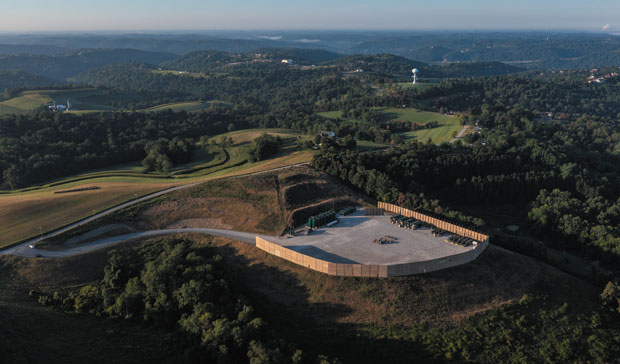
Expand Energy’s drilling inventory includes more than 3,000 locations and counting across its 704,000-acre position. The company expects to drill 130 wells this year targeting the Utica and Marcellus, including wells with lateral lengths of 20,000-plus feet in its southwest Appalachia region.
In the northeast, completions include 3,000-5,000 pounds/foot of 100-mesh, or 40/140 northern white sand from Wisconsin, yielding attractive results.
In the southwest, the company is relying on larger fracs of up to 2,500 pounds/foot in some tests. Pads can include more wells, usually five or six, despite surface constraints in a mountainous region where drilling targets include deep dry gas and wet gas portions of the Marcellus and Utica in Pennsylvania, Ohio and West Virginia.
The company continues to watch for options to add to its 592,000 acres in the southwest, where numerous operators provide periodic opportunities to trade into acreage, extend laterals and bolster working interests.
“In southwest Appalachia, we are pushing laterals beyond 20,000 feet with regularity,” Lopata reveals. “When you combine that with modern generation completions design, even in challenging pricing environments our break evens are competitive and our inventory resilient.”
With longer laterals contributing, efficiency improvements are on the order of 10-20% across drilling and completions. Adding to efficiencies, the company generates all field power using its own gas to feed thermoelectric generators. No production operations are connected to the grid, Lopata says.
The company is pursuing opportunities to sell more gas for data center development and broader electrification.
“With our presence in Appalachia, we are leaning into that Twin Eagle business as well as our corporate development business to gain access to those growing demand centers across Pennsylvania, West Virginia, and Ohio,” Lopata says.
Combining Forces
Growth in the region has been a constant for Seneca Resources, which will be combined with the National Fuel Gas midstream segment into a separate publicly traded Appalachia-focused company.
Set for the second half of 2027, the move positions the combined upstream and midstream business, currently referred to as Integrated Upstream and Gathering, or IUG, as an enterprise able to take advantage of additional growth opportunities, says Seneca President Justin Loweth, who will be chief executive officer of the new company.
Seneca already has a substantial base to build on, including 1.2 million net acres with 5 trillion cubic feet of reserves. More than 300,000 acres across an eastern development area concentrated in Tioga and Lycoming counties provide one of the best remaining development opportunities in the Appalachian Basin, Loweth says. Subsurface understanding, especially in Tioga County, can be leveraged to identify and pursue additional growth.
More than 900,000 acres in the western development area are mostly owned in fee, with Seneca paying no royalties and facing no requirement to drill to hold the acreage.
“At our current drilling base, we have more than 25 years of inventory at break-even prices below $2.25 MMBtu NYMEX,” Loweth said in a mid-October call announcing the planned spinoff. “In a basin where high-quality inventory is becoming increasingly scarce, IUG inventory depth represents a strategic advantage that provides long-term development flexibility, supports sustainable free cashflow generation, and allows us to pace development to meet challenges in changing market conditions.”
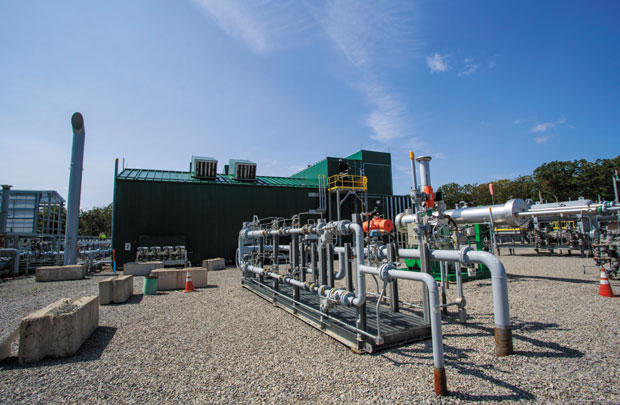
Seneca Resources plans to combine with the midstream segment of its parent company, National Fuel Gas, and spin off as a publicly-traded company with the scale to pursue additional growth opportunities. The merger is scheduled to place in the second half of 2027. Seneca already has 1.2 million net acres with 5 trillion cubic feet of reserves and more than 25 years of inventory at break-even prices below $2.25 per MMBtu.
Seneca’s acreage already provides net production of 1.1 Bcf/d, transported mostly by the National Fuel Gas (NFG) gathering system. In Appalachia, growing transportation capacity will provide even more access to premium markets.
“The backdrop for the natural gas industry is as strong as it has ever been,” says David Bauer, NFG president and CEO. “Natural gas demand is expected to increase from LNG exports, power generation growth, and data center demand, with National Fuel’s and IUG’s assets well positioned to support growth in our region.”
After separation, National Fuel Gas will retain a 19.9% interest in the new independent company. The separation will be accomplished through a tax-free distribution of at least 80.1% of IUG shares to National Fuel shareholders.
After the spinoff, NFG will be a 100% regulated company with about $5 billion of rate base in gas utility operations serving 1.1 million customers across Ohio, New York and Pennsylvania, he points out.
A regulated pipeline storage business will provide nearly 5 Bcf/d in transmission services and 77 Bcf of storage capacity.
NFG’s integrated model provided financial and operating synergies and scale that allowed Seneca to grow. Now, the combined upstream and midstream enterprise has the scale and free cash flow generation to stand on its own, Bauer says. Synergies over the years have been exclusively with the utility and pipeline business on one side and Seneca and NFG Midstream on the other.
“There is very little operational overlap between the regulated and non-regulated sides of the company,” Bauer says.
Conventional Plays
With the Ohio Utica Shale continuing to get attention for attractive oil finds and plenty of deep gas, Artex Oil retains some non-operated shale interests after divesting much of its Utica position to EOG a couple of years ago.
Now, the Marietta, Oh.-based company and other conventional players continue to move westward mostly in search of oil in the Rose Run Sandstone, Beekmantown Dolomite and other formations of the post-Knox unconformity.
Artex operates in Licking and Knox counties northeast of Columbus. Despite focusing on oil, the company encounters plenty of gas, says President Jerry James, who is quick to point out a major reality about the Buckeye State: 82% of its overall energy production is natural gas.
“Gas production in Ohio just dominates everything else, whether it be coal, nuclear, hydro, wind or solar. That is mainly what we produce,” he says.
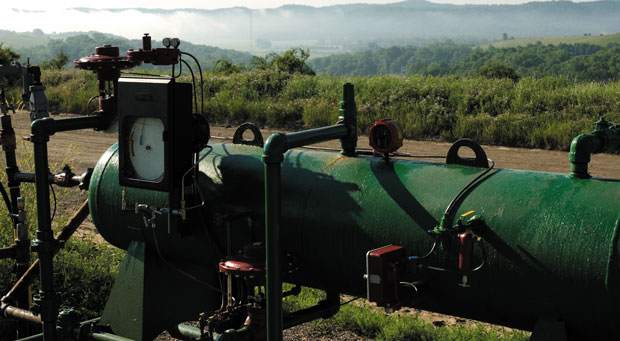
Ohio-based Artex Oil retains non-operated shale interests but is focusing on developing conventional oil and gas targets in the Rose Run Sandstone, Beekmantown Dolomite and other post-Knox unconformity formations.
The emergence of the Utica Shale has played an outsized role in the growth of Ohio gas output. But Artex and other conventional players are doing their part.
Despite challenges that include uncertainty over federal methane regulations, Artex has a history of succeeding over time. A former chairman of the Ohio Oil & Gas Association, James owns the company with Artex Vice President Gene Huck. Founded by the late Art Rupe in the 1950s in Archer County, Tx., the company early on expanded into West Texas and New Mexico and then Appalachia, where Rupe and a group of petroleum engineers eventually formed a new corporation.
Following the emergence of costly methane rules under the Obama administration, Artex tightened its focus and reduced its footprint, James says.
“We did not see any way to financially comply with that and I am still hoping President Trump can do something about it,” he adds.
Despite the topsy-turvy history of gas prices and extended soft markets, James points to anticipated in-basin and out-of-basin demand growth from manufacturing, large population centers and power generation additions as reasons to be optimistic.
He points to the 10-gigawatt data center and matching power generation campus that broke ground in March at the former Portsmouth Gaseous Diffusion Plant in Piketon, Oh. The plant could require 1.25 Bcf/d-1.4 Bcf/d when it comes online. Other power plant projects and proposals dot the Appalachian landscape across Ohio, West Virginia and Pennsylvania.
Improved Differentials
From his Blairsville, Pa., office, Brad Little can literally see construction on the Homer City Energy Campus, where a decommissioned coal power plant in Indiana County is being transformed into a campus spanning more than 3,200 acres with natural gas-powered data centers.
The project is expected to begin producing power next year, with full completion estimated for 2036. Little, who founded Penn View Exploration and affiliated company PVE 25 years ago, says his enterprises may not sell directly to the plant, which will need more than 665 MMcf/d to generate 4.4 gigawatts/day. However, he anticipates a key benefit.
“They will be coming off Texas Eastern Transmission Pipeline for gas, but I can see our basis differential maybe getting closer to zero,” says Little, a board member at the Pennsylvania Independent Oil & Gas Association.
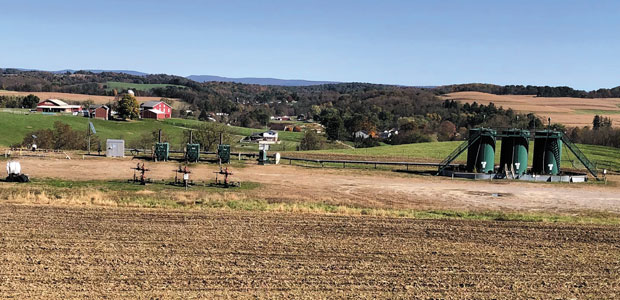
Penn View Exploration operates an oil field with 110 marginal vertical wells in McKean County, Pa., that produces from conventional sands. It holds 20,000 acres in the field, primarily productive of gas, while Penn View’s affiliate company, PVE, holds another 5,500 contiguous acres. Penn View seeks to acquire first- and second-generation horizontals as companies consolidate acreage positions and divest non-core assets.
For Appalachian producers, the discount between gas prices at regional trading points and the national benchmark at Henry Hub in Louisiana has long been a sore point. But increasing demand could narrow the gap.
Little says he hopes additional revenue from improved gas prices can help him acquire more conventional and unconventional proved, developed, producing (PDP) reserves. The company has prospects that currently are too expensive to drill.
“What I am really interested in doing and how I can see Penn View Exploration developing is acquiring first- and second-generation horizontals as companies pull out of the area in acreage they do not consider core,” Little relates. “I have a great deal of interest in being able to acquire those in the future.”
Once a well tender for a coal company, Little founded Penn View when the gas market was doing well. He purchased 50 vertical wells as the unconventional segment in the region began taking off.
Ventures have included partnering with other companies to drill multiple conventional wells for several years and acquiring a small oil field with 110 marginal vertical wells in McKean County that produce from the Bradford Third Sand, Chipmunk Sand and other formations from 2,000 feet down.
Little holds 5,500 contiguous acres in the oil field under PVE and 20,000 acres under Penn View, primarily productive of gas. Penn View operates it all. The company also bought a few unconventional producing wells divested by a major.
While the outlook for prices may moderate, he is concerned about federal methane regulations and moves by Pennsylvania state agencies to implement stricter measures.
“PIOGA is very involved in working with the state to put regulations in place that are beneficial to both parties,” Little concludes.
For other great articles about exploration, drilling, completions and production, subscribe to The American Oil & Gas Reporter and bookmark www.aogr.com.