






The Permian Could Need Even More Gas Production
Rising natural gas demand from Gulf Coast pipeline expansions and gas-fired power generation for data centers could transform the Permian Basin from a region known for gas constraints into one that may face a gas shortage, East Daley Analytics muses in an Oct. 28 webinar.
The company’s analysis considers a scenario in which Permian gas production increases by more than 7.5 billion cubic feet of gas a day through 2036. It envisions the incremental supply filling underused egress capacity and serving new in-basin demand, including data center power generation.
“Waha gas now has value. It won’t be trading negative. It’ll be trading closer to Henry Hub prices,” says Jack Weixel, a senior director at East Daley who focuses on the natural gas market.
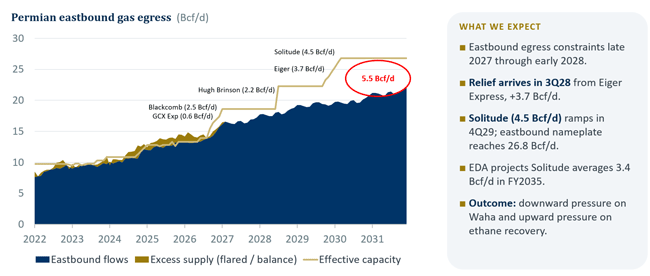
In the short term, price support will come partly from capacity constraints on gas pipelines that take Permian gas eastward. East Daley sees eastbound egress tightening next winter (Figure 1).
FIGURE 1
Permian Eastbound Egress (Bcf/d)
Source: East Daley Analytics
With the Eiger Express scheduled to enter service in 2028 and the Solitude pipeline to follow in 2029, this situation will eventually reverse, with the Permian seeing excess egress. However, East Daley suggests this situation could resolve as storage comes on line in Nash. Tx., LNG exports continue to grow, and data centers turn to natural gas to generate power.
Today, East Daley estimates that there are 32.6 gigawatts of data center load in service. “That took four years to get. We’re looking at 22 gigawatts installed in 2026 in total, so data center load is energizing faster than ever,” Weixel says.
When estimating data centers’ power demand, it’s important to give less weight to projects that will likely never get built. East Daley says it rates projects’ risk on four independent dimensions: permitting and community opposition, timeline uncertainty, power availability, and developer track record.
“Developer track record has become more important as we’ve seen the bigger hyperscalers gain more credibility, diversify their power availability options, etc.,” Weixel comments. “Timeline uncertainty has become more of a problem for some of the smaller facilities, and community opposition is a problem for everyone, at least now.”
Between last year and today, the number of data centers East Daley monitors has doubled from about 450 to almost 900. Chris Noonan, the firm’s chief growth officer, notes that access to power often determines which projects materialize.
“On the power side, there are some kinks in the chain. NVIDIA is supposed to deliver 150 gigawatts of silicone chips next year. We’re not even coming close to (being able to supply) that power, so if you’re looking at the full market, power is still going to be the main driver of growth.”
Regarding public opposition, Noonan casts many data center moratoriums as temporary political moves. “I think we’ll get back into the swing of things after the midterm election,” he says.
So how much will data centers increase gas demand? Weixel offers a conservative estimate.
“If we look at our likely and very likely category, they’re going to add about a Bcf a day of demand in 2026,” he says. “2027 is really the prove it year. Will we layer on that incremental 1.2, or will it be something higher?”
Competition with LNG Exports
Regardless of their precise growth rate, East Daley predicts that data centers will compete for gas with LNG export terminals. Many data centers have the advantage of closer proximity to production.
“75% of expected data center demand (across the United States) is inside (supply) basins. Some of the LNG guys might have first call on the molecules because they contracted years ago, but this next phase of LNG development could potentially be threatened by the needs these data centers are exhibiting,” Weixel says.
The merger between EQT and Range Resources could alleviate some of that competition by allowing more gas to travel from the Northeast to the Gulf Coast. Weixel explains that the combined company, which EQT and Range say will be the largest natural gas producer in the United States, would be a fantastic anchor customer for pipeline egress and may even have the scale to build pipelines itself.
In the Permian, data centers could exacerbate a gas supply shortfall. In its base case, East Daley forecasts that data centers’ demand for Permian gas will reach 2.8 Bcf/d by 2036. However, Weixel says their needs could reach as high as 6.4 Bcf/d if natural gas ends up as the majority fuel of choice. Coupled with out-of-basin demand and other in-basin demand, Weixel says this would increase the net short position of the Permian to almost 12 Bcf/d, which would push up prices at Waha and incentivize producers to move into gassier areas of the Permian, such as Alpine High and the Northern Delaware.
For more context on Permian Basin gas demand, as well as a discussion that highlights growing international demand for U.S. ethane, listen to East Daley Analytics’ Monthly Production Stream webcast or download the associated slide deck from that page.
For other great articles about exploration, drilling, completions and production, subscribe to The American Oil & Gas Reporter and bookmark www.aogr.com.