






Haynesville Sitting Pretty As LNG Export Capacity Takes Off On Gulf Coast
By Danny Boyd
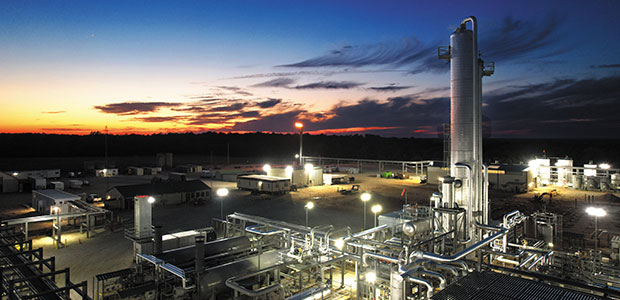
At 7:25 p.m. Central Standard Time on Feb 24, 2016, the Cheniere Energy Inc.-chartered Asia Vision departed the Sabine Pass liquefaction terminal in Cameron Parish, La., marking the first commercial liquified natural gas cargo exported from the Lower 48 states.
Fast forward to 2026 and the United States is now the largest LNG supplier in the world and Cheniere is the largest producer of LNG in the United States. The promise of U.S. LNG has been actioned into an undeniable reality on the global energy scene.
“A decade ago, we started something transformative—producing and exporting LNG at scale from the U.S. Gulf Coast,” Jack Fusco, Cheniere’s president and CEO remarked in recognizing the anniversary of that historic first cargo. “Ten years and nearly 5,000 cargoes later, we continue to lead the way, and our commitment to safety, our people, customers and communities is stronger than ever.”
LNG from Cheniere’s two Gulf Coast terminals has reached more than 40 markets worldwide and counting, improving access to secure, reliable and affordable “USA made” energy. The company says its terminals currently deliver combined LNG production capacity of more than 50 million tons per annum, which is expected to grow to more than 60 MTPA by late 2028, 75 MTPA by 2030, and potentially to more than 100 MTPA by the mid-2030s.
“We have accomplished so much in 10 years—and we are just getting started,” Fusco proclaiming.
Driven by an ongoing flurry of Gulf Coast terminal construction and expansion projects—and even more projects recently receiving permitting approval and financial sanctioning—U.S. LNG feed gas surged to 19 billion-20 billion cubic feet a day in the third week of February, and total U.S. export capacity is expected to exceed more than 30 Bcf/d within the next few years as new trains come on line.
With their proximity to proliferating LNG hubs, the operators controlling acreage positions in the Louisiana and Texas Haynesville Shale play and its estimated 300 trillion cubic feet of gas reserves are understandably feeling pretty optimistic right now.
And LNG is far from the only outlet for Haynesville gas. The Gulf Coast petrochemical industry is calling for more gas supply, and the data center construction boom is expected to steadily add to the demand load as developers look to natural gas to fuel behind-the-meter co-generation. In fact, on Feb. 23—one day before the 10th anniversary of the first Lower 48 LNG send out at Sabine Pass—Amazon announced a $12 billion commitment for a data center in Caddo and Bossier parishes, just west of Shreveport in the heart of the Haynesville Shale.
Everything is coming up roses, and together, such world-scale regional projects provide plenty of market options for companies such as Comstock Resources Inc., Expand Energy Corp., BPX Energy and Diversified Energy Co.
Huge Potential
Comstock is optimizing drilling systems and expanding midstream capabilities as it accelerates deep drilling in the western Haynesville as part of a plan to boost its overall gas production this year to more than 1.25 Bcf/d.
The Frisco, Tx.-based company holds 535,000 net acres from acquisitions and a major leasing push across Freestone, Leon, Limestone and Robertson counties halfway between Dallas and Houston. Gas reserves in the western part of the play could top 50 Tcf tapped from an estimated drilling inventory of 3,343 wells, reports Comstock President Roland Burns. This year, four rigs will add 24 western wells to a producing inventory of 30 as the company focuses on holding acreage by production (HBP).
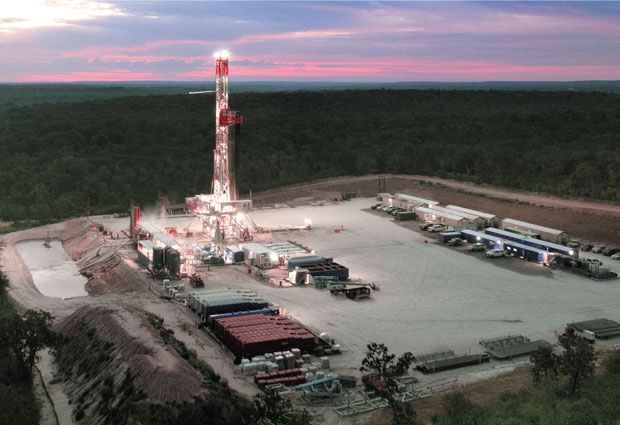
Comstock Resources holds 535,000 net acres in the western part of the Haynesville play in Freestone, Leon, Limestone and Robertson counties, halfway between Dallas and Houston. Gas reserves could top 50 trillion cubic feet with an estimated drilling inventory of 3,343 wells. The company is running four rigs and plans to add 24 new wells to a producing inventory of 30 western Haynesville wells.
On its legacy position in North Louisiana and East Texas, Burns estimates that up to 14 Tcf can still be tapped even with about 50% of a 300,000 net-acre position already developed. Five rigs are adding 47 wells this year. Initial productivities last year on 35 core wells averaged 25 million cubic feet a day on laterals of 11,738 feet on average.
Still, he says the greatest growth prospects are westward, where wells can be 4,000-6,000 feet deeper and the average IP on a dozen wells with 9,481-foot laterals was 33 MMcf/d, split evenly between the Haynesville and the Bossier. “The potential is huge because of the large acreage position compared to our legacy Haynesville footprint, where we have about 900 drilling locations,” Burns explains.
With an eye on drilling, Comstock is benefitting from strategic asset sales to reduce debt and improve leverage. Last year, the company divested legacy Cotton Valley and Shelby Trough assets for $445 million. Included were 1,084 wells producing 17.2 MMcf/d net to the company.
Drilling Innovations
To improve drilling efficiencies, Comstock is deploying rotary steerables on core drilling projects with an eye on exporting RSS to the west, says Chief Operating Officer Dan Harrison. The combination of RSS and coated drill pipe is ensuring lateral placement and speeding drilling in a hot-hole environment approaching 400 degrees Fahrenheit.
To date, Comstock has successfully made about a dozen runs in a handful of legacy wells with RSS as vendors work to boost heat ratings, Harrison notes. The pressure rating on a rig is going to be increased to 10,000 psi, and the pressure rating on one frac spread is being increased to 20,000 psi in the western Haynesville, where vertical depths can eclipse 18,000 feet.
Drilling some two-well pads is already boosting western efficiencies and speeding up strategic HBP efforts, he adds.
While an expensive, largely untapped western footprint is far from drilling constrained at this point, Comstock is successfully deploying horseshoe laterals on its core position after drilling its first horseshoe design in 2024, Harrison notes. On the first project, a 9,400-foot lateral was drilled in an isolated unit that only allowed for single laterals less than 5,000 feet.
This year, the company expects to drill about 15 horseshoe laterals, with plans to add 15 more next year on a legacy inventory of 115 future horseshoe locations that convert four sectional laterals into two two-mile lateral wells. The well designs save 35% in drilling costs—$800 per lateral foot versus $1,240—for a short lateral.
In the west, ownership of Pinnacle Midstream is helping optimize drilling plans over the long-term, Burns says. A lack of control over midstream buildout slowed development early on in the Haynesville core, he recalls.
“One of our goals coming into Western Haynesville was to not make that mistake again,” Burns relates. “We are going to develop the midstream and be able to take advantage of the full value chain.”
The company is already realizing more marketing opportunities. Comstock is in discussions to enter into a gas supply contract with power generator NextEra to supply 2 gigawatts initially, expandable to 8 GW, for a planned data center in the western Haynesville region. More LNG terminals are also expected to soon translate into additional opportunities, Burns adds.
In-House Marketing
A greater emphasis on in-house marketing is positioning Expand Energy to take advantage of growing regional gas demand. With commodity prices improving and demand rising, the company expects its Haynesville position to yield an estimated 3.2 Bcf/d this year as it works to attract more global clients.
In February, the company announced plans to relocate executive offices to Houston while maintaining operations in Oklahoma City. Chairman Michael Wichterich, appointed interim president and chief executive officer, said that the move helps the company capitalize on Houston’s leading role as a gateway to the global gas market as the upstream industry shifts to “wellhead-to-water” and “wellhead-to-watts” strategies.
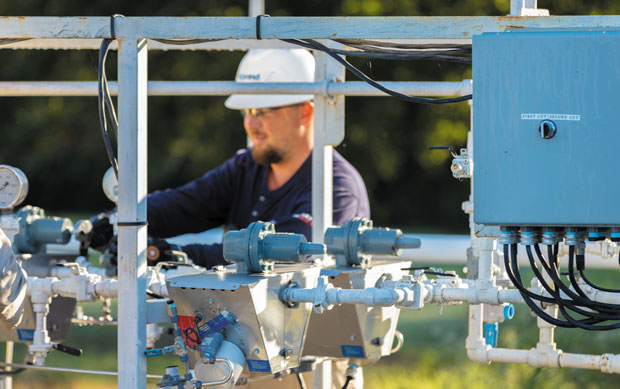
Expand Energy’s Haynesville position encompasses 745,000 net acres and includes a 22-year drilling inventory—more than 2,000 gross locations—with drilling and completion optimizations and efficiencies reducing Expand’s breakevens to under $2.75/Mcf for 1,100 wells and under $3/Mcf for another 340. Since Chesapeake Energy and Southwestern Energy merged in late 2024 to create Expand, the average breakeven price for its Haynesville inventory has improved 15%.
The near-term prize for more in-house marketing growth is an additional margin of $0.20 per Mcf equivalent. Plenty of the upside can be realized in North Louisiana and East Texas, says Andy Huggins, vice president of Expand’s Haynesville business unit.
Massive LNG expansion along the Gulf Coast provides additional outlets accessible through midstream providers that include DTM, Williams and Energy Transfer, he details. Expand also holds a 35% stake in Momentum Midstream’s NG3 system, which is connected to the Gillis Hub in southwestern Louisiana.
Optionality includes 2.5 Bcf/d of capacity to Gillis and about 2 Bcf/d to Perryville with the company’s marketing team having the flexibility to divert volumes to take advantage of pricing and optimize unused capacity with other producers’ gas, Huggins explains.
In addition to positioning the company to take advantage of growing LNG exports, the capacity enables Expand to compete with other producers looking to supply Amazon, Meta and other data centers.
The company has already agreed to be the sole supplier to the Lake Charles Methanol Plant, which is expected to reach its final investment decision this year to convert gas to low-carbon “blue” methanol for the marine fuel market, Huggins states.
Since its predecessor, Chesapeake Energy, discovered the Haynesville in 2008, and Chesapeake and Southwestern Energy merged in late 2024, Expand has grown its position to 745,000 net acres. Included is a 22-year drilling inventory—more than 2,000 gross locations—with the option to add five more years at breakevens up to $3.50/Mcf. Since the combined company’s rebranding, average inventory breakeven in the Haynesville has improved 15%.
Western Extension
Recent additions include 75,000 net acres with more than 200 drilling locations in the western extension, where Expand’s first horizontal well was being completed in late February following a vertical well to evaluate benches. One more horizontal will be drilled this year as the company assesses its acreage, Huggins adds.
“We are also watching the results of peers in the play, and we like where we are at,” he says. “We are excited about the drilling performance on the first horizontal well and the potential for multi-pay exposure.”
Although the company recently reached total depth on its first Haynesville U-lateral, few are in inventory because Expand’s huge position has minimal space restrictions.
“We have a lot of opportunities to drill 15,000-foot laterals without any letter shapes to them, but we absolutely have some two-stack units in Louisiana where a long U or a J design may make sense,” Huggins comments.
Already, drilling and completion optimization and cost efficiencies have pushed Expand’s breakevens across the Haynesville to under $2.75/Mcf for 1,100 wells and under $3/Mcf for another 340, he says.
Running seven rigs and three frac crews, Expand plans to drill 85 Haynesville wells this year. In addition to continual improvements in general drilling operations, the company is deploying artificial intelligence to help manage mud temperatures, which enables downhole tools to last longer and reduces trips, Huggins explains. The end result is trimming days from each drilling project and decreasing cost per lateral foot.
“We are excited about some internal software we have generated that essentially predicts various things as we are drilling from all these inputs,” he concludes. “We have embedded AI agents that help our drilling engineers get real-time feedback on bit health, on when we should trip, and on other drilling parameters.”
Rising IPs
With more than 400,000 net acres generating 756 MMcf/d of net production in 2025, BPX Energy is relying on technological innovation to extend laterals to 20,000 feet and achieve ever-increasing IPs.
This year, three rigs and a frac crew will add 30-36 company-operated wells on a Haynesville position with more than 10 TCF of undeveloped reserves in northern Louisiana and East Texas, where company land teams routinely engage in hundreds of acreage trades with adjoining operators to enable BPX to drill lengthy horizontals.
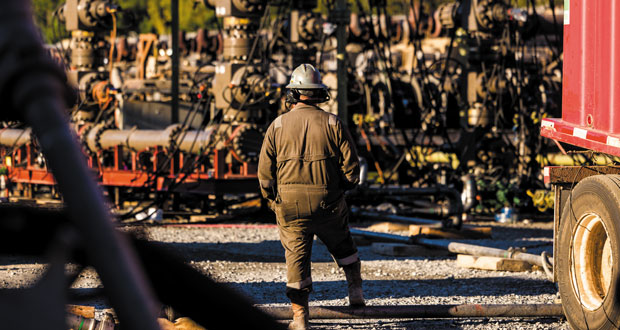
BPX is building contiguous acreage positions and refining drilling, completion and production techniques to extend lateral lengths. Last year, the company achieved a record-setting initial production rate of 80,000 million cubic feet of gas a day from a 20,000 foot lateral. It aims to push IPs even higher on future 20,000-foot wells.
Work is underway to block up acreage for the company’s next two 20,000-foot laterals, says Shawn Holzhauser, vice president of development for the Denver-based producer. The company’s first 20,000-foot well, the Sorenson 25-36-1-12 drilled last year in Caddo Parish, set an initial production record for the Haynesville of 80 MMcf/d. The completion included 3,500 pounds of 100-mesh sand a lateral foot and 10,000 barrels of fluid for each 150-foot stage. With changes in wellbore designs, BPX hopes to take IPs even higher.
“The aspiration is to get to 100 million cubic feet a day with two more of the 20Ks coming up this year,” Holzhauser details.
Looking to growth from LNG exports, manufacturing expansions and power generation, the company can take advantage of parent company BP’s formidable gas marketing team, which is working to secure long-term contracts with more LNG partners and optimize netbacks, he says.
Long Laterals
With BPX innovating and extending horizontals to produce more gas from each well, average Haynesville laterals now extend to beyond 14,000 feet, Holzhauser reports. He adds that the company shares drilling and completion innovations between positions in the Haynesville, Permian and Eagle Ford.
To drill extended reach laterals with fewer complications in less time, Holzhauser says the company is combining larger hole designs with optimal equivalent circulating densities and insulated drill pipe.
Other innovations include implementing new procedures for recognizing pinched collars from excessive downhole torque in longer wells. When the company discovered this over-torquing issue, it worked with its tubular contractor, Vallourec, to continuously monitor the tubing while tripping in hole and give the rig crew live feedback on how to optimize performance.
This continuous monitoring was initially deployed in the Roos Prop, the first “letter well” or U-turn well for BPX in the Haynesville, Holzhauser relates. Insights gained from the Roos Prop will be applied to subsequent letter wells in the Haynesville, Permian and Eagle Ford to help appropriately manage downhole conditions.
As its initial production rates grow, Holzhauser says BPX has had to adjust its approach to corrosion control. He explains that extremely high production velocities can shear corrosion treatments off the casing.
The company is also optimizing surface equipment to handle more flow at higher pressures.
Other operators are moving to accomplish similar feats involving extended reach laterals, Holzhauser observes. Together, players have accelerated drilling speeds by 30-40% in recent years.
“The industry is watching, so everyone will continue to push the limits, and that will just make us continue to get better,” he says. “We’ll try and look for ways to continue to improve just as we’ve always done.”
On the completion side, BPX is working with Liberty Energy to optimize autonomous hydraulic fracturing operations in the Haynesville. These operations are controlled by Liberty’s AI-driven software platform, StimCommander™.
To identify future steps it can take to enhance safety and improve operations, BPX’s drilling team began crowdsourcing ideas from within its drilling organization. When team members want to submit a safety observation or suggestion, they simply scan a conveniently-placed QR code. Holzhauser says technology helps sort this feedback, ensuring it informs decisions.
This crowdsourcing initiative has proven helpful enough that the company has expanded it to its land and completion teams.
Growth By Acquisition
For Diversified Energy, the use of technology to allow access to operational data from wells across five major basins and 14 states bolsters its work to expand by acquisition, a mainstay of its business strategy since an initial public offering in 2017, says Doug Kris, vice president of investor relations.
With work accelerating and interest in the Haynesville growing because of the play’s proximity to the Gulf Coast, Diversified anticipates more acquisition opportunities of assets with proved, developed and producing reserves.
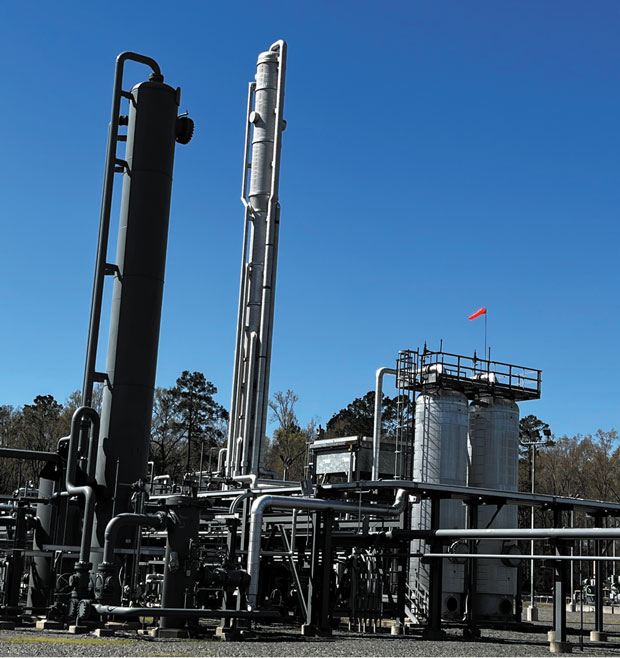
Diversified Energy recently signed a three-year supply contract with an LNG facility for regional production from its Cotton Valley and Haynesville wells. The company’s Haynesville region includes 650,000 net acres in East Texas, northern Louisiana and southern Arkansas that produce 230 MMcf/d. One of its assets is the Black Bear gas processing facility in DeSoto Parish, where Diversified has expanded daily capacity from 15 MMcf to 120 MMcf since acquiring the facility.
For companies wanting to focus on Haynesville growth through the drill bit, divesting wells tapping PDP reserves is a fast way to raise capital to fund new development with higher rates of return, Kris notes.
The company’s latest Haynesville acquisition in 2024 included Haynesville and Cotton Valley wells from Crescent Pass Energy. Now in its 25th year, Diversified is a natural buyer of other assets in the Haynesville and elsewhere.
“PDP assets are good assets. They just lack the focus that somebody else might be able to give them,” he says. “A focus on operations 365 days a year is a very good business model for us at the end of the day.”
Successful bids also allow the company to acquire PDP assets while partners get undeveloped acreage. In one bid, Diversified assumed ownership of PDP assets in the western Haynesville and Comstock received the undeveloped assets.
The company has made 33 acquisitions since 2017, including last year’s $1.3 billion deal for Maverick Natural Resources and its 900,000 acres in the western Anadarko. Later in the year, Diversified acquired Canvas Energy and its assets in the SCOOP/STACK, including 147 MMcfe/d of production that is weighted 57% toward liquids.
“Our business is focused around generating consistent, reliable cash flow and one of the ways we are able to do that is through acquisitions,” Kris explains. “We utilize low cost, investment-grade financing and a structured hedging program goes hand in hand with that.”
Its Haynesville region includes assets in East Texas, northern Louisiana and southern Arkansas. Across it, Diversified has amassed 650,000 net acres with production of 230 MMcf/d. Companywide output is 1.2 Bcfe/d. An operating footprint within 8.6 million acres across the country is 99% HBP.
Additional Haynesville benefits include midstream. For $9 million, Diversified acquired the Black Bear gas plant and gathering assets in DeSoto Parish that consist of two processing plants and a FERC-regulated NGL pipeline. An expansion has since significantly boosted processing capacity (to 120 MMcf/d).
“When we bought Black Bear, we were the only producer putting any molecules through that facility, and that was only 15 MMcf/d day there at the time,” Kris recalls.
Since then, Diversified’s share of plant processing capacity is 70 MMcf/d with the remainder accommodating output for third parties, which adds revenue from processing and marketing to recoup its investment. Recently, the company sold nearby undeveloped acreage to a developer committing additional volumes to the plant and relying on Diversified to market its gas.
Ranking among the top 25 gas marketers nationally, the company positions itself to take advantage of growing market outlets. Diversified recently signed a three-year supply contract with an LNG facility for regional production from wells tapping the Cotton Valley and Haynesville.
“Having a direct LNG contract gives us some certainty in terms of pricing over the next three years,” Kris comments.
For other great articles about exploration, drilling, completions and production, subscribe to The American Oil & Gas Reporter and bookmark www.aogr.com.