








Right Ingredients Help Compressor Fleets Realize AI’s Vast Potential
By Darnell Franco and Jero Bilic
The conversation around artificial intelligence in oil and gas is quickly changing. Over the past 18 months, our discussions with producers and midstream operators of all sizes have shown that AI and machine learning initiatives are no longer just boardroom buzzwords or efforts confined to IT departments and innovation labs, but are taking shape in the field. However, many operators are still struggling to translate that momentum into practical, operational value.
In many cases, AI and machine learning initiatives are now being led by operations and operational technology (OT) teams, backed by approved budgets and executive support. For example, one midstream operator running more than 100 compressors, several cryogenic plants, and thousands of field-gathering meters across multiple states faced growing pressure from leadership to define its AI strategy.
Despite this pressure, the operational team lacked a clear definition of what AI should deliver in practice. As the pressure grew, the company was approached by a significant cloud provider offering to build an AI solution from scratch. The head of OT described the result as a frustrating experience. The provider wanted the company to define the AI use cases, but the operations team was already stretched thin by the work necessary to keep equipment running.
That sense of urgency around adopting smarter technology is showing up across the industry. At another operator, the automation and analysis team was facing a similar push to adopt advanced technology. Leadership had recently completed its budgeting process and expressed a general desire to work more efficiently using predictive analytics or condition-based monitoring tools to better guide decisions and avoid downtime.
The Status Quo
While the appetite for AI is strong, one consistent challenge surfaces in nearly every engagement: advanced analytics are only as effective as the quality, structure, and operational context of the underlying data. Most midstream operators have invested in historians, SCADA systems, and enterprise platforms, so the data already exists. However, it is often fragmented, inconsistent, and lacking the compression-specific context required to generate actionable insight.
A typical tech stack includes a data historian, a work management system for field operations, and various add-ons for internal communication regarding projects and asset tracking. In one example, a compression engineer responsible for an entire reciprocating fleet described a common frustration with historians: They work well enough for storing data, but they are not well-suited for real-time monitoring.
That is largely because of how simplistic historians’ analytics are. Users can set up alerts, but those alerts generally have straightforward triggers, such as parameters falling outside an expected range. They also rarely include information or context that can help quickly diagnose the issue and identify next steps.
More often than not, these basic alerts become overwhelming and just accumulate in an inbox folder. As a result, workflows remain largely reactive. Issues are typically investigated only after the fact, requiring teams to reconstruct what happened.
Barriers to AI
AI could help the industry advance to more proactive optimization, but only if it can overcome two major barriers to adoption.
The first is data scarcity. In some organizations, analysts handle roughly 50 to 100 compressors each. These analysts rely predominantly on handheld data gathered during in-person site visits, with interval-based analyzer reports generated quarterly at best. That is far too infrequently to support any AI or machine learning initiative, because quarterly snapshots do not provide enough data to train a meaningful model.
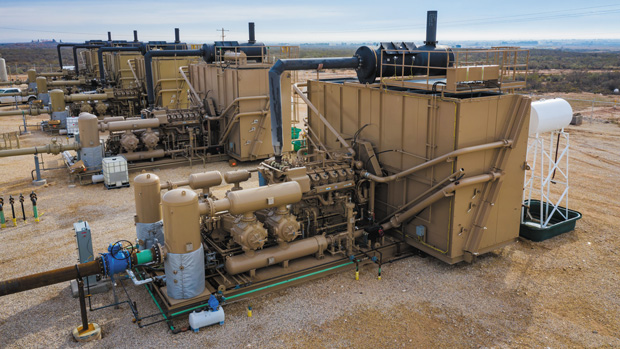
Modern reciprocating compressor stations generate vast amounts of operational data, but converting that data into actionable insight remains a challenge for many operators. AI can help as long as it is rooted in compressor physics rather than relying primarily on statistical analysis.
Second, continuous monitoring solutions from traditional analyzer providers can be difficult to scale across an entire fleet. It’s possible to deploy them on a handful of critical units, but that is not what fleets seek. They want fleetwide visibility with comprehensive coverage that allows them to prioritize by exception rather than by schedule.
Compounding these challenges, many midstream companies today are cobbled-together versions of an original plan, built through years of buying and stacking bolt-on assets. The result is disjointed processes, manual work, and data stranded in different systems. This experience underscores a broader industry reality that companies cannot simply apply a large language model to their industrial data and expect meaningful results. The data must first be federated, contextualized, and made consistent across domains.
Real Value
Where operators have begun investing in compression-specific analytics, the results illuminate just how much operational insight has been hiding in plain sight. The key is structuring data around the physics of reciprocating compression (suction and discharge pressures and temperatures, driver speeds, clearance volumes, and flow rates), then running continuous digital twin calculations to surface anomalies, inefficiencies, and failure risks.
A technical services supervisor shared one of the inefficiencies such analytics can catch. The supervisor’s teams regularly show up at compressor stations with eight to 10 units running, all at low load, where the math simply does not add up. In many cases, seven or eight units at full load could handle the same throughput while saving thousands of operating hours on the units that could be shutdown. Running fewer units would not only reduce maintenance costs and extend overhaul intervals, but also improve engine health by avoiding the carbon buildup and inefficiency that comes with chronic underloading.
So, why is deploying too many units so common? The root cause is often overly conservative pipeline models that do not account for actual compressor performance.
At higher-utilization facilities, those same visibility gaps carry a different kind of risk. In some cases, facilities are operating near full capacity, with producers quick to call the moment a compressor goes down. In the highest-utilization areas, the operations team has had to institute instant text alerts so field personnel can respond as fast as possible. In environments like these, having real-time visibility into each unit’s loading, capacity utilization, and shutdown codes is a revenue protection strategy, not a luxury.
The talent drain across the industry makes analytics even more critical. At multiple operators, the equipment analyzer workforce is shrinking as experienced analysts retire faster than new analysts come in. One operator’s analyst program went from touching every unit every two weeks to quarterly at best as headcount declined and acquisitions added more equipment to the fleet.
It’s impossible to scale a shrinking workforce to cover a growing asset base without better tools. People who know how to solve problems in the field are becoming increasingly scarce, and operators who recognize this are looking for technology that augments the expertise they still have rather than trying to replace it.
Other Equipment
While reciprocating gas compression has been the focal point of many technology-focused conversations, operators are already asking whether similar analytics approaches could extend to other equipment classes. Pumps, centrifugal compressors, dehydration systems, and fractionation equipment all generate continuous process data that could benefit from the same physics-based digital twin methodology.
In many midstream compressor fleets, the asset base includes not only reciprocating compressors but also electric motor drives, turbines, and screw compressors for pipeline and booster applications. These diverse asset types often come with their own monitoring approaches, maintenance philosophies, and data formats. The question of how to bring all of this under a single operational framework is one that nearly every midstream operator is grappling with.
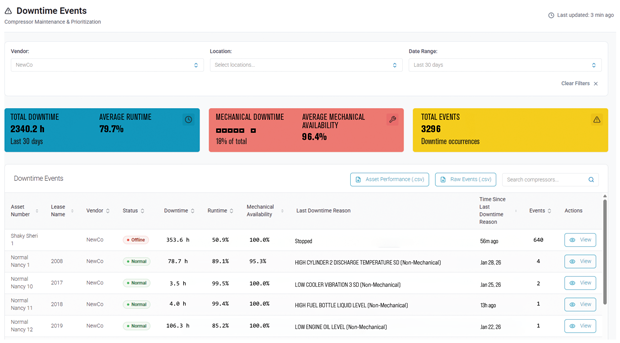
Fleet-level dashboards that consolidate compression data into a single view can help operations and gas control teams identify underperforming units and optimize loading across a station. Such optimization can deliver significant savings.
Plant-level optimization presents a related challenge. When gathering systems feed into cryogenic plants, and natural gas liquid recovery depends on consistent inlet conditions, the interplay between compression, processing, and product quality creates complex interdependencies. When a plant isn’t reaching its nameplate capacity, these interdependencies can hide the cause. Analytics that contextualize compression performance within the broader facility can help operators identify exactly where bottlenecks and inefficiencies exist.
A recurring theme across the industry has been the desire to get back to fundamentals. That means tracking more practical, decision-driving metrics, such as cost per brake horsepower hour, horsepower per million standard cubic feet per day, and maintenance cost per operating hour by unit class. These are not exotic calculations, but they do require work order data, capital spending by unit, fuel usage, run time, and horsepower.
All of that information already exists somewhere in most organizations. Yet operator after operator acknowledges that this data has become fragmented or lost over the years as companies migrated between enterprise systems or grew through acquisitions. Rebuilding that visibility, whether through internal tools or purpose-built analytics, is increasingly seen as a prerequisite for making sound modernization and capital allocation decisions.
The Path Forward
As operators evaluate how to advance their AI and analytics capabilities, three broad approaches have emerged: enterprise platform builds, modular best-of-breed solutions, and internal development. In practice, these approaches vary significantly in time-to-value and operational effectiveness.
Enterprise platforms, meaning large-scale deployments of anomaly detection layers built on top of data historians, offer breadth across asset classes but can take years and millions of dollars to configure for compression-specific use cases. Without that specificity, the anomaly detection’s value can be questionable.
Consider an online monitoring system designed to watch for deviations from normal behavior. While this system worked, the company’s mechanical analysts, using traditional analyzer equipment, would sometimes flag an issue with a compressor valve six or seven months before that issue generated a deviation large enough to trigger the generic anomaly detection.
The lesson is not that anomaly detection is ineffective, but rather that compression-specific context matters. A system tuned to the physics of reciprocating equipment will surface meaningful deviations faster than a generic statistical model.
Modular, domain-specific solutions embrace this smarter approach. Rather than building from a general-purpose analytics layer down, they start with deep equipment expertise and work outward. For compression, this means ingesting the specific data required to run digital twin calculations (such as pressures, temperatures, speeds and clearance positions) and delivering actionable outputs, including rod load violations, efficiency degradation, capacity utilization, and optimized startup configurations. These solutions can integrate into existing enterprise systems via API, complementing rather than replacing what operators already have in place.
Internal development remains tempting for operators with strong IT organizations, but the track record is sobering. Several companies across the midstream space have spent five or more years and invested significantly to build internal analytics tools. In some cases, those tools have achieved only basic functionality, such as average calculations and standard deviation alerts, and still lack the compression-specific context needed for actionable recommendations.
One OT executive at a midstream operator pointed to a more practical path forward. His team pivoted away from trying to build something from scratch. Instead, they began evaluating proven, purpose-built solutions. That shift gave them a more efficient way to advance their analytics and machine learning efforts without requiring years of internal development.
In an industry where field staffing is declining, acquisition activity is creating increasingly heterogeneous fleets, and producers are demanding higher uptime, the companies that combine structured operational data, deep equipment expertise, and scalable analytics capabilities will be best positioned to convert the promise of AI into reliable, actionable insight.

DARNELL FRANCO is a senior sales engineer at Detechtion Technologies. A certified professional engineer, he has spent 13 years working with midstream and upstream operators across North America to improve compression fleet visibility, data quality, and operational decision-making. Franco began his career on the gas compression engineering side, spending a decade delivering optimization and reliability recommendations to operators managing fleets from fewer than 10 units to more than 1,000.

JERO BILIC is a sales engineer at Detechtion Technologies. He is a certified professional engineer with 12 years of experience across oil and gas, gas compression, gas measurement, and remote power generation systems. His background includes field, design, sales, and applications roles, as well as work with compressed air solutions for methane mitigation. He also brings experience in new product design spanning software, downhole tools, and electromechanical packages.
For other great articles about exploration, drilling, completions and production, subscribe to The American Oil & Gas Reporter and bookmark www.aogr.com.