





Industry Advocacy Key To Preserving Innovation
By Danny Boyd
State and federal policy and regulatory decisions affecting operators in Texas’ oil and gas fields are made miles away, but the repercussions of distant decisions are acutely felt at home, says Hunter Carr, vice president at Carr Resources in Tyler, Tx., and chairman of the Texas Alliance of Energy Producers.
Carr Resources extends unconventional development to traditionally conventional plays in the Permian Basin and elsewhere, a modus operandi that allows it to prove up acreage and then divest it to larger operators.
This strategy requires innovation and investment. While that remains possible, Carr says adverse decisions in the halls of Congress, at the state Capitol in Austin and in the offices of state and federal agencies can needlessly complicate the planning and execution required to achieve the best results.
How do smaller players like Carr Resources and larger peers manage to stay abreast of current state and federal developments that could add time, cost and risk to operations, such as changes to methane regulations or bonding requirements? By coming together and connecting closely with the Texas Alliance, insists Carr, who has grown to appreciate the organization even more since becoming chairman.
“The main point of the Alliance is to be the government affairs wing for operators and independents,” he says. “Larger companies have government affairs folks, and the Alliance team works closely with them. We combine the voices of all our operators and members and have one stronger voice when it counts.”
Conference Set
To get the latest on the Alliance’s work, members will gather Nov. 9-10 at the Crescent Hotel in Fort Worth for the organization’s 2026 Upstream Policy Conference, which will combine intriguing panels and keynotes with updates on Washington and Austin from Alliance lobbyists and allies, says President Karr Ingham.
In previous years, the conference would have been called the association’s “annual meeting.” In addition to distinguishing the event from the association’s Annual Expo and Trade Show, which is set for April 12-13 in Wichita Falls, Tx., Ingham says the new moniker captures the event’s focus on public affairs.
“The Upstream Policy Conference is a much more accurate description of the event because we’re going to talk about policy issues that affect upstream oil and gas operators and independent upstream oil and gas especially, although we do have larger members who are not independents and who are important to us as well,” Ingham says. “The conference will be of interest to them because we’ll be talking about Permian, statewide and federal issues.”
The conference kicks off the afternoon of Nov. 9, with exhibitor move-in beginning at 1 p.m., an Alliance board meeting at 2 p.m., registration at 4 p.m. and a welcome reception with a program from 5-7 p.m.
Events on Nov. 10 begin with breakfast at 7:30 a.m. and a report on the Alliance’s insurance program for members, followed by speaker sessions from 8:15 a.m. to 12:15 p.m. and the industry luncheon at 12:30-2 p.m.
Noting that the conference takes place a week after the midterm elections, Ingham says policy insiders there will provide insights on the results’ implications for both state and federal policy.
In Texas, statewide races of interest to Alliance members include incumbent GOP Governor Greg Abbott facing a stiff challenge from Democratic state Rep. Gina Hinojosa. Libertarian Pat Dixon is also on the ballot.
After defeating incumbent Texas Railroad Commissioner Jim Wright in the Republican primary, Bo French, who previously chaired the Republican Party in Tarrant County, is running against Democratic state Rep. Jon Rosenthal and Libertarian Arthur DiBianca.
For U.S. Senate, candidates include Republican Texas Attorney General Ken Paxton, Democratic state Rep. James Talarico and Libertarian Ted Brown.
“What happens in November matters in terms of whether we continue to have a Republican majority in the U.S. House and Senate,” Ingham comments. “Democrat majorities usually mean troublesome legislation and hearings that attempt to paint oil and gas and domestic energy production in a bad light. We’ve seen this before and fairly recently, and there’s not much to suggest we wouldn’t see a return to that if the GOP loses the majority in one or both chambers.”
Protecting Majorities
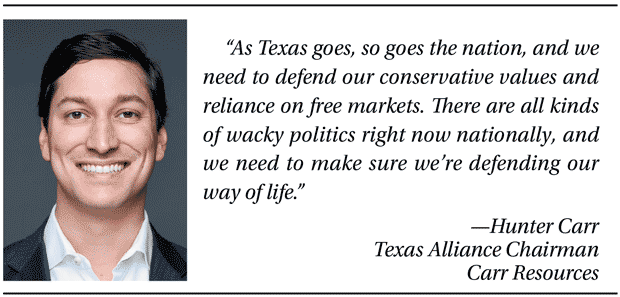
The importance of retaining conservative-leaning majorities in Congress can’t be overstated, Carr says.
“As Texas goes, so goes the nation, and we need to defend our conservative values and reliance on free markets,” he emphasizes. “There are all kinds of wacky politics right now nationally, and we need to make sure we’re defending our way of life. That has to be our point.”
At the conference, James D. Elliott, an environmental attorney who represents the Independent Petroleum Association of America, cooperating associations and energy companies, will discuss the latest on methane regulation at the U.S. Environmental Protection Agency.
The Trump administration has largely refrained from enforcing burdensome methane rules that were originally adopted during the Obama and Biden administrations, including OOOOb and OOOOc, which would have been especially harmful to small producers. Recognizing that the political pendulum can swing, the administration has also taken steps to remove some regulations from the books.
As an example, Ingham points out that on February 12, the EPA finalized a rule rescinding the 2009 Greenhouse Gas Endangerment Finding, the legal foundation for many rules that aim to limit greenhouse gas emissions. At the same time, it repealed associated federal motor vehicle greenhouse gas emission standards.
In early fall, a draft was circulated that calls for lessening regulation of methane emissions from stripper wells. The move would save the industry billions, Ingham says.
“Things are vastly better under President Trump because the first great thing he did was appoint Lee Zeldin as EPA administrator, and Mr. Zeldin immediately began to take a look at whether the regulatory regime made sense or not, how damaging it was to industry, and how costly it was to the economy overall,” he praises. “Importantly, President Trump and Lee Zeldin believe the EPA under Obama and Biden in particular took actions that were not authorized by Congress.”
Stripper wells are often the lifeblood of production for smaller operators, Carr says, and any exemptions will help preserve production and companies.
“Methane regulation and monitoring would make a lot of stripper wells uneconomic and cause undue harm to not only the people who operate the wells but to local communities and local governments who depend on taxes generated by them,” he says. “These rules would also harm operators who don’t have production from stripper wells. We’re all in the business of capturing and selling methane, so it’s already in our best interest to be responsible for it, and we are.”
Produced Water
The policy conference will include a produced water panel. As disposal capacity shrinks or moves farther away from activity to minimize the risk of induced seismicity, Ingham says it is increasingly important to find other practical solutions for growing produced water volumes.
“Produced water is atop everybody’s minds and certainly is for us and our members,” he reports. “I don’t see any way we’re going to have a legislative session in 2027 that ignores produced water.”
Turning to other state matters, the Alliance continues to spend time on power issues of particular concern to members active in the Permian Basin, who face power shortages as they attempt to electrify expanding oil and gas operations.
The Alliance and other groups successfully backed the Public Utility Commission of Texas’ approval in late August of two 765-kilovolt power line projects to transport more electricity to West Texas as part of the Permian Basin Reliability Plan the legislature passed in 2023.
“We supported the legislation that authorized that plan two sessions ago, and we worked with the PUC to get that done,” Ingham says. “There’s been a big public dust-up about this and I get it. Landowners are concerned about power lines coming across their land, but that’s the nature of infrastructure that takes power from one place to the next. We’ve got power lines all over Texas, and frankly, most of the inputs that come into the Permian have to come on something that has a right of way of some sort.”
More power will support additional processing for growing volumes of associated gas and produced water, he adds.
“We need the ability to continue to move down the road of treating produced water, and that can’t be done absent the power to do it,” Ingham says.
Inactive Wells
The 90th Legislature gavels into session on Jan. 12. Ingham says it may consider more legislation related to orphaned or abandoned wells following hearings in the interim by the state House Energy Resources Committee.
After working on an inactive well bill, SB 1150, passed during the last legislative session, the Alliance is participating in the Railroad Commission’s work on related rulemaking. The law prohibits the RRC from extending the deadline for plugging inactive wells if those wells have been inactive for more than 15 years and are at least 25 years old. However, it gives the commission the discretion to make exceptions in some situations, such as when the operator has a track record of plugging or reviving inactive wells, plans to return the well to service, or faces financial hardship.
“How this is done matters to oil and gas operators and it matters especially to smaller private independent oil and gas operators in terms of the cost burden that may be imposed on them for having to deal with mostly plugging inactive wells as well as returning wells to service,” Ingham remarks.
Oil and gas is produced in 85% of Texas’ 254 counties, he notes. That means people are employed and taxes paid to governments and schools that won’t be available if wells are not producing.
“We’re not interested in hastening the shut-in of wells through the implementation of costly regulation that makes a well uneconomic from one day to the next and puts it out of commission,” Ingham says. “It’s a big world and it takes companies doing big things and drilling big wells to supply the energy we want and demand. At the same time, we have a fantastic landscape of oil and gas operators of all sizes in Texas.”
For policymakers and regulators in Austin and Washington, it can be hard to appreciate how valuable that diversity is to the health of the oil and gas industry and how much a robust industry matters to locals’ lives. Carr says that is one reason it’s important for the industry to continue speaking with a strong voice regardless of which party holds power.
For other great articles about exploration, drilling, completions and production, subscribe to The American Oil & Gas Reporter and bookmark www.aogr.com.