





Multizone Completion And Modern Microproppant Help Revitalize Mature Field
By James Crenshaw and Will Schmid
As operators across North America face pressure to maximize returns from existing assets, mature stacked-pay reservoirs are receiving renewed attention. Many of these fields still contain significant remaining hydrocarbons, but legacy completion designs, understimulated intervals and declining production have prevented full reservoir recovery.
Across the Texas Panhandle and Mid-Continent region, formations such as the Granite Wash, Atoka, Cherokee and Des Moines have produced for decades. However, their complex geology, variable rock quality and extensive natural fracture systems have also made them difficult to stimulate consistently. Conventional sand-based hydraulic fracturing treatments have frequently screened out before the planned treatment could be placed, leaving large portions of the reservoir understimulated.
Advances in reservoir characterization, completion engineering and broad-sieved low-density microproppant technologies are now providing operators with new options for economically redeveloping these mature assets. Texakoma’s McMordie Ranch 14-2 project demonstrates how a systematic, multi-zone stimulation strategy can improve reservoir connectivity while overcoming many of the operational limitations associated with conventional stimulation methods.
Candidate Selection
The McMordie Ranch Field in North Texas contains multiple productive intervals distributed throughout a stacked-pay system that has been developed over several decades. Historical production and stimulation records indicated that several zones remained inadequately developed, while others had experienced declining productivity despite significant hydrocarbons remaining in place. Texakoma’s redevelopment methodology focused on identifying intervals that satisfied several criteria:
- Demonstrated historical productivity;
- Remaining reservoir pressure and hydrocarbon saturation;
- Evidence of incomplete stimulation effectiveness;
- Favorable mechanical wellbore integrity; and
- Potential for multi-zone access through a single wellbore.
Texakoma evaluated candidate wells based on remaining reservoir pressure, evidence of incomplete stimulation, mechanical integrity and the opportunity to access multiple productive zones through a single wellbore. The McMordie Ranch 14-2 in Roberts County, Tx., met these criteria, making it an ideal candidate for evaluating a modern multi-zone completion strategy.
Reservoir evaluation identified six primary target zones grouped into three stimulation stages. The first stage aimed to stimulate the Atoka and 13 Fingers formations, while the second focused on the Granite Wash G and H and the third tackled the Granite Wash E and F.
The three-stage approach allowed multiple productive intervals to be stimulated during a single completion campaign while maximizing operational efficiency.
Challenging Geology
The target formations consist of interbedded sandstones, carbonates and shale sequences characterized by low permeability, variable lithology and extensive secondary fracture systems.
Typical reservoir properties included:
- Bottom-hole static temperature of approximately 165 degrees Fahrenheit;
- Porosity generally below 10%;
- Reservoir pressures between approximately 1,000 and 1,500 psi; and
- Matrix permeability commonly below 0.001 millidarcies.
Although these reservoirs have produced for many years, conventional hydraulic fracturing has delivered inconsistent results. Screenouts frequently occurred before the planned treatment volume could be placed, largely because naturally fractured carbonate intervals promoted rapid fluid leakoff while thin, interbedded sand bodies limited effective proppant transport. These recurring challenges prompted Texakoma to evaluate an alternative completion strategy capable of improving fracture connectivity while maintaining reliable proppant placement.
The completion design incorporated three independent stimulation stages executed using a plug-and-perforate methodology. Each interval was perforated and stimulated separately to maximize reservoir contact while maintaining zonal isolation.
Texakoma selected the EcoReach® broad-sieved low-density microproppant system after previous conventional sand treatments repeatedly failed to achieve complete placement in the Granite Wash intervals. The team was looking for a completion design that could improve proppant transport through complex fracture networks while reducing the risk of premature screenout and allowing greater control of treating pressures.
The lightweight microproppant remains suspended within the carrier fluid for an extended period because of its small particle size and low density. According to the project team, the material remains in suspension approximately 15 to 20 times longer than conventional sand while requiring comparatively little energy to remain uniformly distributed within the treatment fluid. This enables the proppant to travel farther into complex fracture systems before settling.
Rather than simply increasing fracture dimensions, the objective was to improve connectivity throughout the natural fracture network, allowing productive intervals that had previously contributed little to overall production to become hydraulically connected to the wellbore. The completion utilized a simplified 2% KCl brine carrier fluid pumped at approximately 13 barrels per minute, substantially lower than many historical stimulation programs in the region. The lower-rate design provided greater control of treating pressures while reducing operational complexity.
Engineering objectives included:
- Increasing fracture network conductivity;
- Improving fracture complexity;
- Enhancing connectivity within secondary fracture systems;
- Increasing effective reservoir contact; and
- Reducing the likelihood of premature screenouts.
The technology moved from initial presentation to field implementation in only a few weeks, reflecting both the operator’s need for an alternative approach and confidence in the proposed completion design.
Treatment Execution
Each stimulation stage successfully received approximately 150,000 pounds of microproppant and more than 1,400 barrels of treatment fluid. Post-treatment pressure analysis and fracture modeling indicated successful stimulation of each targeted interval.
The treatment for the first stage, targeting the Atoka and 13 Fingers, generated an estimated fracture height of approximately 141 feet and a fracture half-length approaching 870 feet (Figure 1). Pressure matching indicated effective fracture creation and proppant placement throughout the targeted interval.
FIGURE 1
Post-Job Analysis For Stage 1
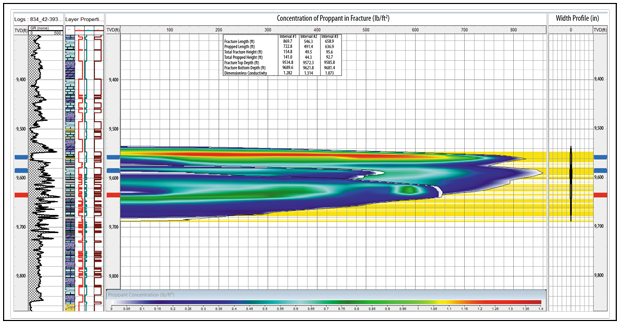
FIGURE 2
Post-Job Analysis For Stage 2
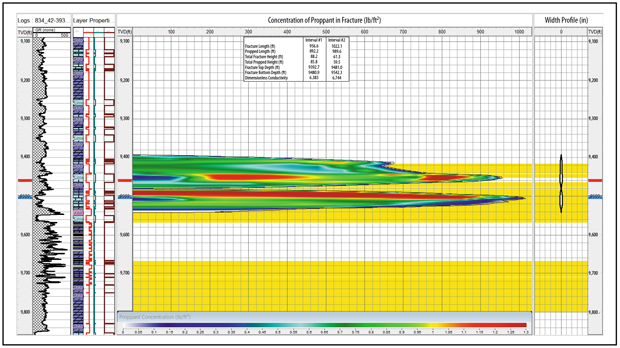
FIGURE 3
Main Treatment Plot For Stage 3
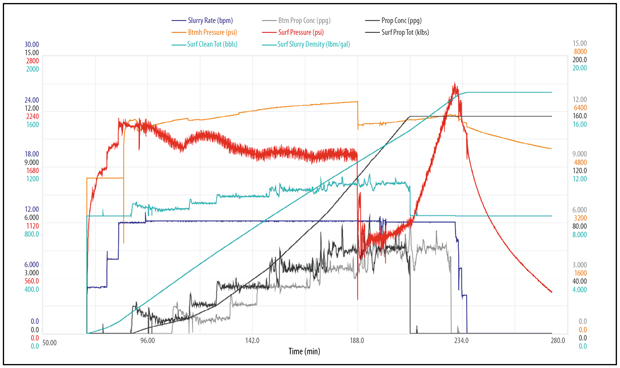
Note: Following the loss of a bridge plug at 188 minutes, pumping continued, enabling the treatment to finish placing proppant.
The second stage, which targeted the Granite Wash G and H, produced one of the largest modeled fracture geometries, with an estimated fracture height of approximately 149 feet and a fracture half-length exceeding 1,000 feet (Figure 2). Modeling suggested effective stimulation throughout the intended reservoir interval while extending fracture conductivity deeper into the formation.
The final stage, which focused on the Granite Wash E and F, provided an unexpected field demonstration of the operational resilience of the completion methodology. Approximately two-thirds of the way through the treatment, surface treating pressure suddenly declined by about 1,100-1,200 psi before briefly stabilizing and fluctuating again (Figure 3). Subsequent evaluation indicated that one of the bridge plugs separating the treatment stages had failed, exposing previously stimulated intervals during active pumping. Despite losing zonal isolation, pumping continued successfully, no screenout occurred, and no proppant was left in the wellbore.
Under a conventional sand-based treatment, the sudden loss of zonal isolation would typically increase fluid leakoff, causing sand to settle rapidly and screen out the treatment before completion. Instead, the lightweight microproppant remained suspended even after the pressure disturbance, allowing pumping to continue without screenout or proppant accumulation in the wellbore. Although unplanned, the event illustrated the system’s ability to maintain proppant transport under conditions that would likely have terminated a conventional treatment.
Early Results
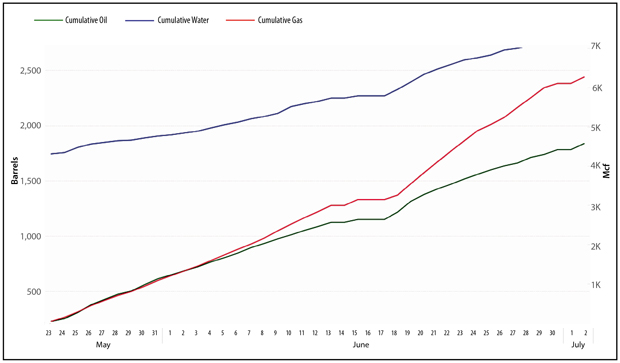
It is too soon to see long-term production, but early field performance has been encouraging. Six weeks after stimulation, the well continued to clean up while production trended upward, indicating improving fracture conductivity and communication between multiple productive intervals (Figure 4).
FIGURE 4
Post-Job Cumulative Production
Note: Following the loss of a bridge plug at 188 minutes, pumping continued, enabling the treatment to finish placing proppant.
Equally significant was the project’s economic performance. Preliminary results indicate that the completion was executed at approximately 15% lower cost than previous conventional stimulation approaches while successfully completing a treatment in a reservoir where conventional methods had historically experienced numerous screenouts and only modest success rates.
Beyond the performance of a single well, the project demonstrates a broader redevelopment strategy applicable to mature stacked-pay reservoirs throughout North America. Rather than viewing mature Granite Wash assets as declining Tier 3 opportunities, the application of modern completion engineering and lightweight microproppant technology may enable operators to economically recover reserves previously considered inaccessible.
In addition to improving stimulation performance, the completion methodology offers several operational and environmental advantages. Because the treatments can be pumped at substantially higher proppant concentrations, overall water requirements may be reduced by approximately 50-60% compared with conventional frac operations. Furthermore, the process can utilize produced water from the field rather than requiring large volumes of freshwater, reducing demands on local water resources.
Operational requirements are also simplified. Instead of deploying large spreads often consisting of ten or more pumping units, the lower-rate treatment can be executed using fewer pumps. The simplified fluid system also eliminates the need for many of the polymer additives commonly used in conventional hydraulic fracturing fluids. Together, these factors reduce fuel consumption, truck traffic, operational complexity and associated greenhouse gas emissions while lowering overall HSE exposure during field operations.
Lessons Learned
Texakoma viewed the project as an opportunity to evaluate whether a different completion strategy could overcome the stimulation challenges that had limited previous Granite Wash redevelopment efforts. The company’s team had seen too many conventional treatments fail to place the planned volume and set out to find a design that could consistently reach the intervals conventional methods struggled to stimulate.
The unexpected bridge plug failure became a defining moment of the project. When it happened, the team’s past experience told them the treatment would end in a screenout. Instead, they were able to complete it successfully.
That resilience and the well’s production response have given Texakoma the confidence to expand its evaluation of candidate wells across the field. The technical team has also identified a new productive horizon for future development.
The McMordie Ranch 14-2 project shows that disciplined reservoir evaluation, modern completion engineering and lightweight microproppant technology can help unlock additional value from mature stacked-pay reservoirs. By combining systematic candidate selection with a multi-stage completion, the project successfully stimulated multiple productive intervals while overcoming operational challenges that have historically limited stimulation effectiveness. As operators continue seeking cost-effective ways to extend field life, the lessons from McMordie Ranch provide a practical framework for redeveloping similar mature assets across North America.

JAMES CRENSHAW is a global technical advisor at Superior Energy. A graduate of Texas A&M University with a B.S. in petroleum engineering, he has spent most of his 40-year career focusing on drilling and completions. In the process, he has worked with major service companies across five companies, helping them enter new markets, launch products and complete acquisitions. He has also served private equity firms and technology startups, and he has held executive/officer positions at both private and public companies.
Crenshaw has supported development and implementation of technologies that greatly improved hydrocarbon production. For example, he played key roles in GeoVann’s tubing conveyed perforating techniques and Secure Drilling’s automated kick detection/managed pressure drilling system. He is also one of the driving forces behind EcoReach, a microproppant stimulation/production enhancement technology that was recently acquired by Superior.

WILL SCHMID is a senior drilling and production engineer at Texakoma. He joined Texakoma in 2023 following 10 years in operations and drilling engineering roles at Denbury Inc., where he worked with multidisciplinary teams on drilling and production projects in carbon dioxide and water floods across the Gulf Coast and Rocky Mountain regions. Before Denbury, Schmid managed proppant logistics for customers ranging from the Permian and Anadarko basins to the Barnett, Haynesville, and Eagle Ford shales.
Schmid’s formative leadership experiences were in service as a tank and scout platoon leader, where he was awarded the Bronze Star for target exploitation and nominated for the MacArthur Leadership award. He holds a B.S. in geopolitics with an environmental engineering track from West Point Military Academy and a B.S. in petroleum engineering from the University of North Dakota.
For other great articles about exploration, drilling, completions and production, subscribe to The American Oil & Gas Reporter and bookmark www.aogr.com.