





AI-Driven Cameras Help Drilling Rig Crews Maximize Safety And Efficiency
By Lance Ellington
AI-enabled computer vision is opening new opportunities to enhance drilling rig operations by giving automation systems a more complete understanding of what is happening on the rig floor. Cameras combined with advanced algorithms can identify the position of people and equipment in real time, enabling control systems to respond more quickly and intelligently to changing conditions.
A new application of this technology helps protect rig personnel working around automated equipment, particularly in red zone areas with a higher risk of injury. By monitoring defined areas of the rig and identifying when personnel enter them, this system provides early warnings or sends signals to rig controls to restrict equipment movement when a person may be at risk. The same underlying computer vision capabilities can also improve the efficiency of pipe tripping operations.
Without a camera system, the automation system can position the iron roughneck close to the drill pipe while the rig hoists or lowers it, but the system must wait until movement stops and the slips are set before surrounding the pipe. A member of the rig crew may then verify the clamping assembly’s position and direct the driller to raise or lower it as needed.
But by using an AI-enabled camera to track drill pipe stick-up height as pipe trips in or out of the hole, the automation system can determine the pipe’s position and anticipate where the clamps need to be, allowing the iron roughneck to begin positioning before pipe movement stops.
Saving Seconds
This can shave five to seven seconds off the time required to make or break each connection. Across a long pipe tripping operation, and as operators continue to drill ever-longer laterals, this incremental time savings can become significant.
To maximize their reliability, the cameras include heaters that keep them within their temperature specification and a washer/wiper system that periodically cleans the lens. Coupled with ongoing improvements in computer vision algorithms, this robustness makes the cameras suitable for deployment across a wide range of operating environments, from land rigs in the Permian Basin to drillships in the Gulf of America.
Augmenting Safety
Tracking stick-up height is one of many ways computer vision is helping rig crews increase safety and efficiency. For me, one of the most exciting applications involves using camera constellations to monitor the rig floor and warn employees when they have entered a dangerous area or potential red zone.
Accidental entry into a hazardous area can happen even with experienced, well-trained crews. No matter how much training they receive or how many safety briefings they attend, rig crews are still human. As they focus on completing their tasks quickly, they may momentarily forget familiar risks. A momentary lapse in situational awareness can put someone in the path of equipment that is moving or about to move.
The area around the well center is one of the most obvious danger zones on the rig floor. The top drive may be moving down to latch onto pipe, the iron roughneck may be repositioning to make a connection, and pipe-handling equipment may be delivering the next stand of pipe. Multiple pieces of equipment can be moving simultaneously within a relatively small area.
Of course, the obvious red zone is not the only one. The pipe-racking station can present similar exposure risks to moving equipment. Areas behind equipment can also create risks because personnel may enter a space that equipment has temporarily vacated, without realizing the equipment is about to reverse direction and return to its home position.
Automated rigs typically have an anti-collision system that tracks equipment locations and planned movements, helping prevent one machine from colliding with another. The red zone management system adds another layer of awareness by using cameras and computer vision to identify both personnel and location, significantly reducing safety risks without disrupting normal operations.
This system is highly configurable. In an area where crewmembers should never be present, a zone breach can halt the movement of all the equipment capable of entering that area. But for most potentially dangerous zones, it’s more practical to assess whether the zone is currently hot and adjust the response accordingly. If a breach occurs when a zone is safe, it would be inefficient to stop the equipment’s movement.
This dynamic approach helps maintain normal operations while providing protection where it’s needed. It also helps minimize unnecessary alarms. If personnel see flashing lights or hear sirens when no danger exists, they might start to tune out these signals when they’re truly at risk.
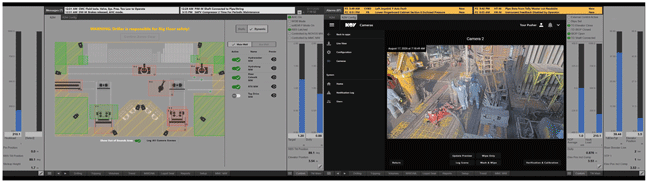
A new red zone management system for drilling rigs uses cameras and AI-enabled computer vision to track crewmembers’ locations. If someone accidentally enters an active red zone, the system can prevent automated equipment from moving into that area and alert them of the potential danger. To minimize unnecessary alerts, it can be configured to distinguish between hot red zones and ones that are currently safe. LEFT: A map of the rig, with red highlighting dangerous areas, green representing safe ones, and circles indicating people. RIGHT: The visual feed from one of the cameras at the same time shown on the map.
A Proven Concept
While pairing computer vision and smart software to manage red zones is relatively new to the rig floor, using cameras to detect and respond to unsafe situations has a strong track record of success in other applications, including warehouses, around cranes, and at factories that leverage advanced robotics.
What has changed for drilling is the maturity of computer vision technology. Modern algorithms are increasingly capable of identifying and tracking people in complex, highly congested environments like a rig floor.
That’s good news given the trend toward greater automation of drilling operations. Drilling contractors and operators are increasingly using automation to improve consistency, efficiency, and predictability. As more equipment moves on its own without waiting for direct human input, knowing whether personnel are within the equipment’s path or operating envelope becomes increasingly valuable.
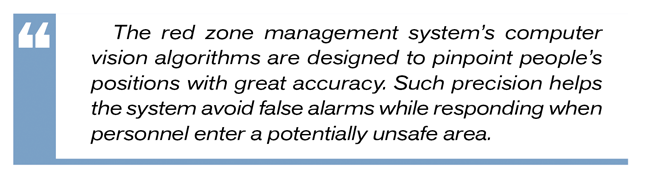
The red zone management system’s computer vision algorithms are designed to pinpoint people’s positions with great accuracy. Such precision helps the system avoid false alarms while responding when personnel enter a potentially unsafe area.
Positive Feedback
The system is still in the early stages of field deployment. As of October 2026, NOV has two deployments, one that has been operating for more than a year and a second that began in mid-June.
In both cases, crew response has been overwhelmingly positive. That’s partly because the system is constantly improved based on their input. They spend every day working on the rig floor and can point out risks or issues that might not be obvious during system design. Their observations are helping refine how zones are defined and how the system responds to different operating conditions.
The crew-first design and flexibility are critical components to the system’s success in the field. In my career, I’ve seen several promising tools fail to perform or get a negative reputation because rig crews distrusted them. Conversely, when crews understand what a new system does, see that it responds appropriately, and have a role in improving it, they are more likely to trust it and use it as intended.
A Worthwhile Investment
The configuration required for the red zone management system depends on the rig and the areas the company wants to monitor. To ensure full coverage, engineers first map equipment locations and movement envelopes and then place cameras accordingly. A dual-activity vessel, for example, may require up to ten cameras for comprehensive rig-floor coverage.
Unlike the stick-up height monitoring camera, where users can calculate a precise return on investment by adding up the time savings, quantifying the financial impact of reducing personnel exposure to a potential incident is less straightforward.
There is much to discover as we gain more experience with AI-supported red zone management, including how the technology influences crew behavior over time. Early deployments are providing opportunities to collect that experience and incorporate feedback from the people working with the system daily. Seasoned rig crews can already tell the system significantly reduces the risk that a moment of forgetfulness will leave them with a life-changing injury.
Drilling contractors are also realizing the value that the investment brings by advancing automation while maintaining what matters most on the rig floor. Even if the system prevents just one serious injury or fatality, it will pay for itself by preserving the company’s reputation with employees, insurers, and the public.

LANCE ELLINGTON is product line manager for power systems, Amphion controls, and the Red Zone Manager at NOV. Ellington joined National Oilwell Ross Hill in 1997 after serving six years as a fire control technician in the U.S. Navy. He earned the Navy Achievement Medal for exceptional work aboard the USS Antietam and the Southwest Asia Service Medal in recognition of his deployment to the Persian Gulf.
Since joining NOV, Ellington has held diverse roles spanning field services, engineering, and operations, traveling to and providing service in more than 20 countries. His accomplishments include establishing NOV’s service operations in Pennsylvania and overseeing and launching numerous products or product advances, with the most recent being the Red Zone Manager.
For other great articles about exploration, drilling, completions and production, subscribe to The American Oil & Gas Reporter and bookmark www.aogr.com.