






AI-Driven Cameras Protect Valuable Assets By Enabling Fast Reactions
By Jeremy White, Pro-Vigil
Remote sites come with risk, and that’s a truth that oil and gas operators around the country are keenly aware of. Well pads, compressor stations, and laydown yards may sit miles away from the nearest town, and even when the premises has fencing, valuable equipment still lies in the open as different crews come and go. For a long time, this reality has been viewed as part of doing business in the field.
Today, that assumption could cost more money and put continuity of daily operations in jeopardy.
For many other industries, a price swing causes heightened theft risk. For car dealers, for example, when the price of copper goes up, so does the value of the vehicle and its parts, and therefore the risk of theft or vandalism. But oil and gas operators function in a different environment. When the price of crude oil goes up, the oil itself is the attractive target. If the price of oil plummets and activity falls, thieves’ eyes turn to unused generators, pumps, vehicles, and tools.
In either price environment, an unsecured gate can affect far more than a replacement invoice. It can cause a chain reaction that delays crews, interrupts production, builds liability concerns, and strains landowner relationships.
A Growing Risk
Theft is a persistent enough problem that regulators and law enforcement have been forced to treat it as a coordinated industry crisis. In 2025, Texas passed oilfield theft protection legislation to address theft across West Texas.
In April, the U.S. Department of Justice announced that 14 defendants from Texas and New Mexico had been indicted in an alleged Permian Basin oil theft conspiracy that involved transporting stolen crude oil across the New Mexico-Texas border.
In an oil and gas context, theft is rarely as straightforward as a missing piece of equipment. The real damage often comes in the form of cascading operational disruption that spreads across a site, a crew, and a production schedule in ways that are difficult to fully quantify in the moment.
Consider what happens when fuel is drained from a tank battery overnight. A crew arrives at a remote location before dawn, ready to begin the day’s work, and finds equipment that cannot run. The immediate response pulls supervisors and field personnel into an incident that wasn’t on anyone’s schedule. The day is disrupted. Emergency procurement is initiated. Insurance calls are made. And the crew, whose time isn’t cheap, is standing by while decisions are made at a level above them.
Or consider copper theft at a compressor station. Beyond the replacement cost of the wire itself, operators face potential SCADA communication failures, safety system interruptions, and the real possibility that the site cannot be confirmed safe to resume operations until a full inspection is completed. What begins as a materials theft can quickly become a downtime event, a safety review, and an insurance claim layered on top of one another.
This ripple effect is why security strategy for oil and gas operations needs to be understood as a continuity issue, not just a loss prevention one. The ability to keep a site ready to run each morning is a business-critical function, and threats to that readiness have to be treated accordingly.
The Role of Lease Gates
Lease gates deserve more attention than they get because they sit at the crossroads of security, landowner relations, and liability.
A gate unwittingly left open can lead to livestock getting out, causing roadway hazards and disputes over who was responsible. On properties with cattle or other livestock, the consequences can be significant. Even if operators don’t own the land, they can still be roped into the problems that arise when access isn’t controlled under their watch.
Ensuring better visibility at lease gates helps reduce ambiguity. With better visibility, operators can show when a vehicle entered, when it left, and whether the gate was secured afterward. That information can make all the difference when it comes to a potential theft, cattle incidents or other liability issues.
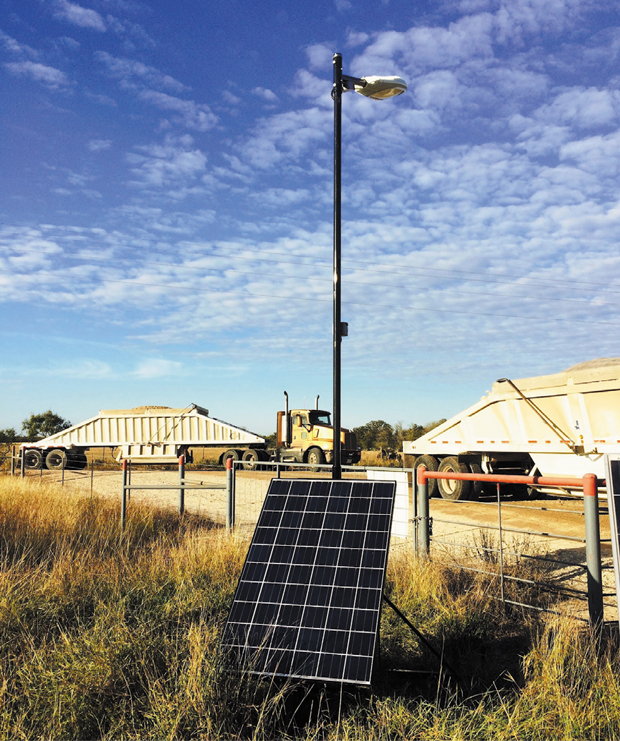
This mobile camera is one of many that now protects well pads, tank batteries, compressor stations and equipment yards from theft and vandalism. By leveraging modern AI, the camera constantly watches for anomalies and shares concerns with human monitors, who can then issue warnings, and if necessary, call law enforcement. Such rapid responses make the cameras quite effective at deterring crime.
In the past, security-minded operators might have considered installing a traditional record-and-store camera near the lease gate or at other locations on site. Such cameras can be useful after an incident, as they can show what happened, when it happened, and who was present. But because the review always takes place after the fact, it does little to prevent theft or vandalism— nor can it close a gate to keep livestock from escaping.
Today, operators have a more powerful option: Remote video monitoring (RVM) systems that provide real-time awareness. RVM cameras, with AI-powered detection, can quickly identify activity and escalate suspicious persons or behaviors to trained human monitors to verify whether that activity appears routine or suspicious. If deemed suspicious, the human monitor can then trigger an audio warning, flashing lights, a recorded message, or another deterrent to ward off bad actors. If necessary, the monitor can escalate and involve law enforcement.
The human verification step is especially crucial for oil and gas sites, where legitimate activity occurs at unusual hours. Crews may arrive early. A contractor may be called out in the middle of the night. A pumper may check a site over the weekend.
To decide whether activity is legit, the monitoring teams draw on industry expertise, behavioral analysis, and, of course, previous conversations with the site, to understand both who and what is allowed during operational and off hours. Monitors are trained to assess whether site activity aligns with the expected and agreed-upon access, permitted vehicles, entry points, and more, as the site demands. When activity is ambiguous, our protocol is to contact a designated company representative to avoid false alarms.
In 2025, my company’s RVM systems processed more than 821,000 motion alerts across our customers’ U.S. oil and gas sites, resulting in 6,600 alarms and 20 law enforcement escalations. Numbers like that point to an important reality: not every movement is a security event. However, there is value in filtering, verifying, and escalating the right events.
Diverse Benefits
Although security is the obvious use case, RVM visibility can support broader field operations.
For production sites, remote visibility can help confirm whether a crew arrived, a service visit occurred, or vehicles remained on site longer than expected. For lease gates, RVM cameras can help document access and gate status (secured shut or left open).
Additionally, RVM cameras can help protect outdoor assets at laydown yards over nights or weekends and during slow periods. With eyes on the site 24/7, there is less need to drive to remote locations for a security check.
Of course, that doesn’t mean RVM should replace established field procedures or other practices. Rather, it should complement them. Oil and gas operations already rely on plenty of forms of remote information, from production data to equipment sensors.
Given how varied sites and companies’ risk profiles can be, successfully deploying RVM solutions begins with understanding the location and goals, not with the product.
No two sites are the same, and no two security or monitoring strategies should be identical. The number of access points, laydown yards, pumping areas, etc., can determine the need for more visibility.
RVM solutions come in both fixed and mobile set-ups. Fixed RVM cameras are secured in-place, while mobile RVM cameras are able to move as desired.
Whatever form the cameras take, power and connectivity are key. Many oil and gas locations do not have reliable grid power or broadband service where monitoring is needed most. For these situations, solar-powered mobile solutions are typically the best fit. Mobile RVM systems can move with a specific site’s strategy, helping to keep eyes on risk-prone areas.
Such mobility is particularly useful for oil fields during moments of volatility, where oil prices skyrocket and plummet with geopolitical news. Because oil and gas fields are especially attractive to thieves, keeping eyes on all areas—from the well pad to the laydown yards—is especially important.
In general, the best deployments are uniquely tailored. A small property with several access points may need more gate visibility than a much larger property with one controlled entrance. A compact yard full of high-value equipment may justify a different configuration than a remote production site where the primary concern is after-hours access.
Future Direction
Oil and gas operators are already collecting and analyzing more remote data to manage distributed assets. Site security should become part of that broader shift, because security is now part of the operational reality.
The future of field security will rely less on passive footage and more on verified awareness, access accountability, and practical operational intelligence. And more than that, security has to rely on a system of interwoven strategies to effectively secure and monitor a site—and that’s even truer for remote sites.
No company’s strategy should end with a perimeter fence and lease gates. Many sites call for cameras, but in today’s world, proactive—not reactive—prevention is key. That means embedding RVM to expand visibility over the operation and using the power of AI to accelerate both the speed and consistency of detection, so that human monitors can focus on evaluating the situation and triggering deterrence procedures shortly after bad actors appear.
The fence line still matters, but so does everything happening around it.

JEREMY WHITE is the CEO and founder of Pro-Vigil, a provider of AI-enabled remote video monitoring solutions. White founded Pro-Vigil in 2006 and helped to pioneer the RVM industry, drawing on his entrepreneurial spirit and leadership style to play a key in the success of the company and the industry as a whole. White graduated from the University of Texas Permian Basin and completed studies toward an MBA at the University of Texas at San Antonio.
For other great articles about exploration, drilling, completions and production, subscribe to The American Oil & Gas Reporter and bookmark www.aogr.com.