






Durable Reforms Needed To Accelerate Construction Of Critical Energy Pipelines
By Thomas L. Sharp
Is it easier to build pipelines right now?
In some respects, yes, but the shift is more incremental than transformative. The Federal Energy Regulatory Commission has a fully seated Commission operating with a collaborative posture under Chairman Laura Swett. The Supreme Court’s 8-0 Seven County decision narrowed the required scope of National Environmental Policy Act reviews and reinforced deference to agency judgment. The administration’s pro-gas disposition has been evident from the start, and Congress has a handful of permitting bills under consideration.
Those are real tailwinds. They can only move the needle so much on their own, but against a backdrop of AI-driven load growth, tightening reliability conditions, and sustained basis pressure from the Permian to the Appalachian corridor, the “build, baby, build” sentiment is palpable.
However, pipeline execution risk has always turned on two indicators:
- Regulatory vulnerability, meaning whether an approval can withstand a legal challenge; and
- Organized opposition, which drives whether such challenges are brought.
Recent developments, such as Seven County, have reduced some forms of regulatory vulnerability. Whether the smaller attack surface has caused organized opposition to decline as well is less clear. To find out, we need to look beyond the headlines and into the data that precedes litigation: public comments, motions to intervene, and the organizations filing them.
Early Indicators
Public comments and interventions in FERC pipeline proceedings are one of the earliest measurable signals of organized opposition to pipeline development. They establish legal standing, preserve issues for rehearing and litigation, and shape the administrative record. Sustained comment activity often precedes rehearing requests and court challenges.
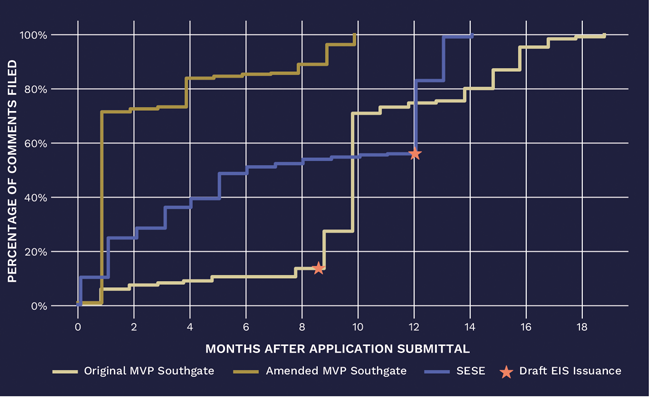
If organized opposition were declining, comment intensity and nongovernmental organization participation would be falling. The data does not yet show that. Consider comment activity across MVP Southgate’s original and amended project proposals.
The original project (filed in 2018) was approximately 73 miles of pipeline designed to transport roughly 375,000 dekatherms a day into North Carolina. The amended version (filed in 2025) shortened the route to 31.3 miles, increased capacity to 550,000 Dth/d, reduced water body crossings, and eliminated the compressor station. Despite the reduced footprint, the amended project generated more comments than the original. As we expected, MVP Southgate’s Clean Water Act Section 401 certifications and its FERC certificate have drawn legal challenges.
The Southeast Supply Enhancement project—a 1,596,000 Dth/d Transco expansion filed in 2024—drew similar levels of opposition engagement (Figure 1). The project is now facing litigation by environmental NGOs in the 4th Circuit related to its Clean Water Act permit and in the D.C. Circuit challenging its FERC certificate.
FIGURE 1
Comments on FERC Dockets for Three Pipelines
At the national level, the Sierra Club has commented on just over a third of the roughly 180 pipeline and LNG projects filed since 2016. Activity in 2025 appears lower, but because many newer projects have not yet reached draft environmental review, the stage at which NGO engagement typically accelerates, it’s too early to draw firm conclusions.
States’ Potential Role
While federal NEPA litigation remains active, it is less likely to stop a project than it was before. That shift is driven first by Seven County, which narrowed the scope of environmental effects agencies must consider and broadly reinforced deference to agency judgment. That directly undercuts the types of claims that drove recent certificate vacaturs, including the D.C. Circuit’s decision on the Rio Grande LNG and Texas LNG Brownsville terminals, where environmental and connected action analysis drove the outcome under the prior framework.
The result is not necessarily less litigation, but rather a lower probability of NEPA-related litigation significantly delaying or stopping a project in federal court. Some of that risk may be moving to state proceedings. In Louisiana, a state court vacated the Louisiana Department of Conservation and Energy’s coastal use permit for the Commonwealth LNG terminal based on environmental justice and localized climate impacts, showing how similar arguments can be redirected into state-level permitting challenges that aren’t based on NEPA.
The Louisiana case offers an early signal, but not yet a clear trend. It is too early to determine how courts will apply post–Seven County standards across jurisdictions or whether litigation will meaningfully migrate to state venues.
CWA Concerns
Regardless of how much opposition ramps up their overall state activity, the Clean Water Act will likely remain a central pressure point for pipeline development. This pressure will come not only through opposition groups’ litigation, but also through state permitting procedures that can deny, delay, or condition projects.
This isn’t speculation. Several projects derailed in the Northeast, such as Constitution, the Northeast Supply Enhancement (NESE), and Northern Access, were not blocked by FERC or federal courts, but through state CWA Section 401 certification processes and resulting litigation. The certification process functioned like an endless reset button, driven by three factors:
- The law’s broad scope allows states to add conditions unrelated to water quality.
- Bespoke state requirements shift over time.
- States could restart their one-year decision deadline by deeming an application incomplete or otherwise prompting applicants to withdraw and resubmit an application.
The ability of states to force these resets led to the Supreme Court’s decision in Hoopa, which held that coordinated withdrawal and resubmittal schemes were impermissible, and led to determinations that states had waived their Clean Water Act 401 authority as applied to the Constitution and Northern Access projects. Those waiver determinations also became mired in litigation.
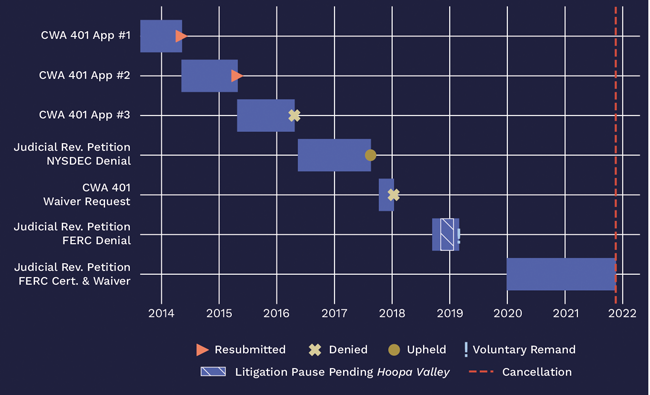
The combined pressure from multiple Clean Water Act lawsuits and cumbersome state procedure is significant when viewed together. Constitution spent just over eight years in the Section 401 ecosystem, cycling through multiple applications, a waiver determination at FERC, and three separate lawsuits without reaching the merits (Figure 2). Ultimately, the developer walked away.
Northern Access spent just over five years in litigation that ultimately upheld FERC’s waiver determination but still ended in cancellation.
FIGURE 2
Constitution’s Eight-Year Section 401 Ordeal
NESE resubmitted Section 401 applications six times across New York and New Jersey. Throughout multiple NESE application cycles, Williams revised methodologies and mitigation plans to address evolving concerns about mercury and copper impacts, adapting to shifting burial depth requirements and changing mixing-zone assumptions. However, each resubmittal answered one set of questions only to surface another.
CWA Reforms
The U.S. Environmental Protection Agency has sought to mitigate CWA-induced delays by proposing a more concrete definition for Waters of the United States that no longer treats interstate waters as a stand-alone category and excludes ephemeral features. If this definition is adopted, it will narrow where the CWA applies.
The EPA has also proposed revisions to Section 401 certification regulations that would further narrow the law’s scope by limiting certification to discharges from point sources. The draft rule would also require denials to be tied to specific water quality requirements with clear explanations—a direct response to the shifting-standards problem that plagued NESE.
The PERMIT Act would limit Section 401 review to direct water-quality impacts and specify grant, denial, or waiver as the only options for action on a certification. As of mid-April, the bill had passed in the House but had not yet made it out of committee in the Senate.
H.R. 3668, which has also made it to the Senate, proposes a fundamental statutory restructuring: it would remove the stand-alone state certification requirement for natural gas pipelines entirely and place responsibility for Section 401 compliance with FERC. States would still participate in water quality reviews as cooperating agencies, but FERC would retain final authority over which conditions are necessary.
These proposals target some of the sources of delay seen in prior projects, particularly in the Northeast. However, producers and midstream companies in every producing state have a stake in whether they are enacted. For now, Section 401 remains a live risk—one highlighted by Energy Secretary Chris Wright at an April meeting of the House Appropriations Subcommittee: “We’re doing everything we can in the administration, but I think if we can get serious permitting reform that addresses 401C water permits as well, (we can) make it easier to build what businesses want to build.”
NEPA Reforms
NEPA is now less likely to stop or delay projects. Seven County narrowed when agencies must analyze indirect and downstream effects and reinforced deference to agency line-drawing in NEPA analysis. Although it’s early, subsequent appellate court decisions have confirmed that shift. The D.C. Circuit’s treatment of NEPA analysis for the Cumberland project and the Fifth Circuit’s approach to GTN XPress both applied this standard in ways that favor agency discretion.
Two additional developments reshaped NEPA implementation during 2025:
- The recission of the Council on Environmental Quality’s binding NEPA regulations, which were replaced with nonbinding guidance; and
- Statutory amendments allowing project sponsors to pay for expedited reviews (with unclear implementation mechanics).
The combined effect of these initiatives is greater durability for federal NEPA approvals and the potential for faster timelines. However, FERC already conducts consistently efficient environmental reviews, so the new expedited option may be more useful as applied to other agencies.
While NEPA litigation is less likely to stop or severely delay projects, litigation risk remains as project opponents modify their tactics.
For example, in a recent rehearing request, Sierra Club argued that the Natural Gas Act’s “public convenience and necessity” standard should compel FERC to assess upstream environmental impacts of induced production even if NEPA did not. The Commission rejected that argument, asserting that:
- The NGA is focused on regulating interstate gas transportation and sales;
- NEPA is where environmental review is defined and applied;
- There is no requirement in the NGA to go beyond what NEPA requires; and
- There is no precedent requiring FERC to do so.
FERC also made clear this wasn’t a case where environmental review was skipped, but rather one where the Commission declined to expand it. That distinction may be tested on appeal.
FERC Efforts
FERC has taken several steps to improve procedural efficiency, including:
- Rescinding Order 871, removing the bar on construction during the rehearing window;
- Temporarily raising blanket certificate cost limits from $41.1 million to $61.65 million (expiring May 31, 2027);
- Initiating a rulemaking to consider making the cost limit increase permanent and investigating other ways to improve the blanket program;
- Launching proceedings to explore blanket authorizations for certain activities at LNG facilities;
- Resolving long-running oil-indexing disputes;
- Clarifying its market-need analysis in its rehearing order on the reinstated Regional Energy Access Expansion certificate; and
- Officially closing the dormant Glick-era draft greenhouse gas policy statement, which would have required applications to predict the emissions originating from the hydrocarbon production and consumption the pipeline supported.
FERC has also reissued the previously vacated NESE certificate—a first for the Commission that suggests it’s willing to remove potential procedural barriers where demand signals remain strong.
Reforms’ Longevity
The current reform environment includes changes at three levels of durability, and understanding their complexity is key for assessing future project viability.
Statutory reforms are the most durable. The Fiscal Responsibility Act of 2023 codified NEPA time limits (two years for an environmental impact statement and one year for an environmental assessment), page limits, narrower alternatives analysis, and a one-federal-decision framework. These changes require an act of Congress to reverse.
The Seven County holding is almost as durable. The Supreme Court decision has already been applied in multiple pipeline cases, and should only change through new legislation or a rare judicial about-face.
Regulatory reforms are moderately durable. FERC’s policy changes—rescission of Order 871, the blanket certificate threshold increase, and withdrawal of the GHG policy statement—could be undone with rulemakings. A future Commission with different priorities could initiate that process, but it is a lengthy one.
Executive and regulatory proposals are fragile until finalized or enacted. The NEPA regulations that CEQ rescinded could be re-promulgated by a future administration. The EPA WOTUS and Section 401 rules remain in the rulemaking process. And the House-passed SPEED Act and PERMIT Act face a Senate that requires 60 votes for stand-alone legislation.
The SPEED Act warrants particular attention. The bill proposes two compressed 240-day windows for judicial review: 60 days for record filing plus 180 days for judgment at trial level, then 60 days for appeal plus 180 days for appellate decision. Arbo’s analysis found that energy-related NEPA appeals from 2013 through 2022 took an average of 3.2 years to resolve (Figure 3). The SPEED Act would compress this judicial review to 16 months.
FIGURE 3
Time to Settlement of EIS and
EA Appeal Cases, 2013–2022
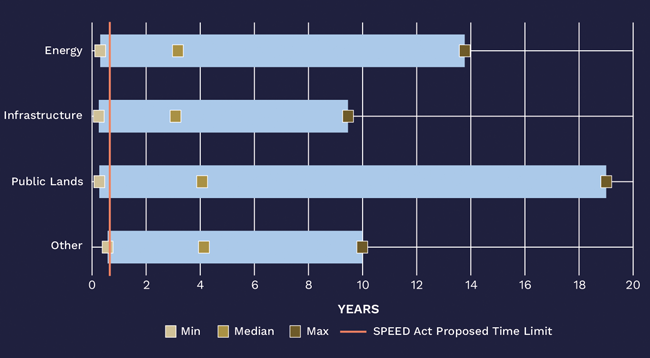
The bill would also limit remedies to remand without vacatur, restrict the venue to the project’s location, raise the evidentiary standard from “arbitrary and capricious” to “clear and convincing,” and limit standing to plaintiffs who engaged meaningfully in the administrative process. In addition to these litigation reforms, it would codify NEPA as strictly procedural, narrow causation analysis beyond Seven County, and align “purpose and need” explicitly with the applicant’s goals.
One open question is whether these provisions would apply to FERC proceedings, and if so, how. The bill assumes a trial-to-appellate pathway, but FERC orders are reviewed directly by appellate courts. Whether the compressed procedures apply to FERC petitions for review is unclear—though if they do, non-NEPA issues could be swept into the same expedited schedule.
Looking Ahead
The energy evolution demands more infrastructure, faster. The regulatory environment is responding, though unevenly, with varying degrees of durability, and with risk migrating from federal courts to state proceedings.
For producers and their associations across every producing state, three practical questions emerge.
The first relates to opposition. As additional projects move through environmental review, will the Sierra Club and allied groups engage at rates consistent with their historical patterns, or will their participation become more selective? The data so far is ambiguous, but we will continue tracking it.
On Section 401 of the Clean Water Act, will the Senate pass the PERMIT Act or H.R. 3668? If not, rulemaking proposals that can be rescinded by future administrations will remain the only available tool, but will play a limited role in addressing the scope of review.
FIGURE 4
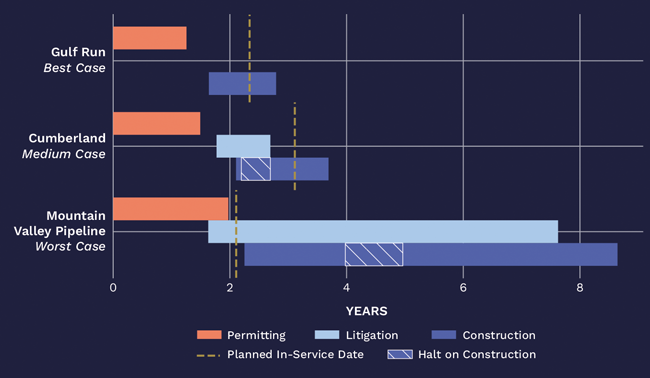
Time to Build Pipeline Projects
On NEPA, will the SPEED Act’s litigation compression survive the Senate, and if not, does the combination of Seven County and FERC’s reformed posture provide sufficient durability on its own?
For energy producers, it’s worth engaging with policymakers, regulators and the courts to increase the chance the answers to these questions favor pipeline development. A typical pipeline project once went from application to in-service within three or four years. Today, that timeline only occurs in the best-case scenario. A more typical situation involving moderate legal challenges adds delays of several months, while worst-case projects stretch beyond 8 years (Figure 4).
By applying the judicial reform provisions currently under consideration to past projects, our analysis indicates it’s possible to reduce extended permitting timeframes resulting from litigation by about 50%. During an era of unprecedented demand growth, this would make the United States far more capable of leveraging its abundant energy supplies.

THOMAS L. SHARP is the director of permitting intelligence for Arbo, which provides energy regulatory intelligence data, software and services to pipelines, producers, policymakers and trading houses. His perspective is informed by 12 years of federal experience, most recently as director for permitting excellence at the Federal Permitting Improvement Steering Council, and by positions at the White House Council on Environmental Quality (CEQ), including deputy director for the National Environmental Policy Act, attorney in the Office of the General Council, and senior adviser for infrastructure.
Sharp also worked for nine years as an attorney at FERC, specializing in natural gas pipeline certificates and hydropower licenses. He graduated with a certificate in environmental law from Tulane University and enjoys teaching law classes focused on NEPA and permitting reform.
For other great articles about exploration, drilling, completions and production, subscribe to The American Oil & Gas Reporter and bookmark www.aogr.com.