







Ramping Data Center Demand Prompts Improved Coordination Between Gas, Electric Sectors
By Housley Carr
HOUSTON—Power plants fueled by natural gas provided about 40% of the United States’ total electricity needs in 2025—up from 33% in 2015—and many more gas-fired plants will be built over the next five to 10 years, most of them to help power the slew of artificial intelligence-related data centers being planned. Gas plants, with their high degree of operational flexibility, also play important roles in balancing the variable output of wind and solar facilities, and in helping utilities navigate through periods of peak demand.
With all of that, it is not a stretch to say that the natural gas and electric power sectors have never been as intertwined and interdependent as they are today, or that smooth coordination between the two has never been more critical. But natural gas and electric coordination, or the dynamic and multifaceted process of ensuring that gas plants have the gas they need when they need it, is complicated, challenging to improve, and an even bigger deal than it was only a few years ago.
Fortunately, there is a new effort—and a new cross-industry determination—to address the gas-electric coordination more fully. Tighter integrated coordination is not merely a good idea or a policy direction, but it is increasingly becoming a national imperative. The ongoing boom in data center development and the buildout of gas-fired plants to power these energy-hungry facilities make improvements in gas-electric coordination more important than ever before.
Last June, U.S. Energy Secretary Chris Wright asked the National Petroleum Council to “assess how rising natural gas and electricity demand and shifting load patterns are straining natural gas pipelines in key regions of the United States; examine what impact these strains might have on energy reliability; and recommend actionable strategies to address the misalignment between these two industries that can prevent or mitigate reliability impacts.”
In response, the NPC in December released a comprehensive report titled “Reliable Energy: Delivering on the Promise of Gas-Electric Coordination,” which highlighted the reliability- and resilience-related risks associated with the increasing interdependence of gas and electric markets amid surging electricity demand, much of it tied to data centers. The report also discussed the need to facilitate the buildout of new gas and electric infrastructure. Finally, the NPC made a series of recommendations aimed at improving gas-electric coordination.
So what are the primary issues/challenges, and how might this latest effort to improve gas-electric coordination play out? To answer these questions, we need to examine the underlying issues that have complicated the relationship between the gas and electric sectors for the past few decades and have made it difficult—but not always impossible—for the two sides to agree on operational and other changes.
Distinct Models
The most important reality to acknowledge up front is that while there are some general similarities, the U.S. natural gas and electric power markets operate under different and distinct economic and regulatory models.
Electric utilities, including the local distribution companies that sit between unregulated generators and end users, operate within a specified service territory and have a mandated obligation to serve customers within it, whether that customer is a single-family residence, a retail business, or a data center consuming hundreds of megawatts a day. In exchange for their commitment to providing this universal service, electric utilities are granted monopoly rights within their territory and are authorized by state regulators to recover prudently incurred costs and earn an approved rate of return on equity on those investments. (This service obligation model also applies to local gas distribution utilities.)
Electric utilities’ obligation to serve does not hinge on whether the utility owns generation. Even in regions with lots of competitive supply, the load-serving entity still has to make sure customers have electricity either by self-supplying from utility generation, contracting with others, or buying from independent power producers (IPPs) through wholesale markets because the duty to serve runs to the retail customer and the reliability of service. As a result of this overarching duty, investments made in transmission and distribution wires tend to be “socialized,” or spread over the entire customer base, as they are made.
In contrast, midstream companies that develop, own and run the interstate pipelines that transport vast volumes of gas to electric utilities, IPPs and gas distribution companies operate under an entirely different construct. Mid-streamer operators are on-request service providers; their core role is to transport gas to their customers under tariffs (i.e., terms and rates) determined to be just and reasonable by the Federal Energy Regulatory Commission. (Note: Even discounted and negotiated rates are subject to FERC oversight.) Put another way, pipelines act simply as contract vendors to their customers, with their mix of capital facilities (pipelines and storage) and service offerings based on what their customers want and are willing to pay for.
That is not to say gas pipelines do not have public responsibilities. They are required to operate safely, to stick to rates acceptable to FERC, and (barring a force majeure event) to fulfill their contractual obligations to customers. But it is not their responsibility to make sure that everyone—whether a power generator, a local distribution company, or a homeowner with gas heat—gets as much gas as they may need on, say, a bitterly cold day in February.
That is the “misalignment” recognized at the heart of the NPC report, namely that power markets increasingly rely on gas-fired generation for reliability, but when power and gas are needed most, the commercial/regulatory frameworks for gas supply and transportation simply do not line up with the capacity, speed, volatility, and “must-serve” expectations that electricity providers have to contend with. This is especially true in pipeline capacity-constrained parts of the country during extreme weather, such as extended polar vortex or bomb cyclone events when gas demand for space heating is maxing out and electric utilities are scrambling to find enough power to keep up with customer needs.
At the same time, pipeline operators are dealing with shipper nominations, contract rights, and operational limits that represent a difficult balancing act across their customer populations, frequently involving consumers in multiple and quite different regions of the nation. The need for stability and balance in operating the pipelines means they frequently collide with the substantial swings in power requirements as electric utilities follow their public service obligations to keep the lights on.
Firm Transportation
There are at least a couple of other key issues that hinder fuller gas-electric coordination. One is the incentives (or lack thereof) for some power generators to contract for firm transportation service for gas supply. This is where the “contract vendor” role of pipelines puts pressure on power generators and their market managers—regional transmission organizations (RTOs) and independent system operators (ISOs)—to commit to the capacity they need to ensure reliability.
Old-school, vertically integrated electric utilities are generally encouraged to sign firm transportation deals to ensure they will have sufficient gas for the plants they would need to supply during periods of very high electricity demand. That makes sense, in that utilities have their obligation to serve. However, in competitive generation markets, IPPs whose plants run only some of the time (depending on economic dispatch by an RTO or ISO) would understandably seek to minimize their fixed costs and be disinclined to pay the much higher and constant cost of super-dependable firm transportation service.
Instead, they sometimes rely on low-cost, interruptible transportation arrangements that provide them with the gas they need most of the time, but sometimes not when their power is needed most. Interruptible transportation is much less expensive than firm transportation, primarily because the party only pays if it uses the capacity, but it is the ongoing monthly revenue from long-term, firm transportation contracts that underpins the development of gas pipeline capacity.
Sure, there are a few things pipelines and power generators can do to help mitigate gas supply squeezes, such as preemptive line packing to push extra gas into pipelines in advance of anticipated high-demand periods to help sustain deliveries. Also, many gas plants in regions susceptible to gas supply challenges are dual-fuel facilities capable of switching to diesel (stored onsite); others produce and store liquified natural gas for backup use. However, for gas to fulfill its promise to support the current growth in power generation, more than that will be needed.
Centralized Governance
There is another matter, too, namely the fact that there is no centralized, unified governance of U.S. gas and electric markets. Most important, there is FERC, which it is fair to say comes the closest to national oversight under uniform rules in that it regulates interstate gas pipelines, interstate electric transmission, and the RTOs and ISOs that manage that transmission. However, it has its limits. Beyond FERC, there are state regulatory commissions; the National Association of Regulatory Utility Commissioners (NARUC); the North American Electric Reliability Corp. (NERC); the North American Energy Standards Board (NAESB); and finally, the NPC, which advises the Secretary of Energy on natural gas and other energy issues.
FERC has already played a lead role in enhancing coordination. Often building on business practice standards initially developed by NAESB, FERC has issued a number of orders that ratcheted up gas-electric coordination, mostly by having each sector share more information with the other about what they are up to. All of this has helped, of course, but shortfalls in gas-electric coordination remain evident and still need to be addressed, even more so as gas demand for power rises.
So, how might this play out? The surest way to guarantee there is sufficient gas pipeline capacity to supply all gas-fired generators during periods of high power demand would be to add more pipeline capacity. In particular, the NPC report called for many more “fit-for-purpose” facilities—not just regular point-to-point pipeline capacity, but facilities capable of managing large fluctuations in demand in real time, including storage capacity. But most plant owners, particularly non-utility IPPs, do not want to commit to long-term firm transportation contracts for pipeline space or for special facilities and services they may only need a few hundred hours a year.
A looming question is, can FERC launch a meaningful initiative to resolve the various issues? Most importantly, can the role of pipelines as vendors be recognized in such a way that the electric industry can select what it needs and find a way to fund its choices? And can the way be cleared for pipeline companies to build what is required in time to avoid problems?
Touching Grass
Of course, the interdependence of gas and electric markets will only increase as a new round of gas-fired plants come online to power the many AI-related data centers being planned. While the number of plant announcements is staggering, it is important to touch grass by remembering three things:
- Only a subset of them are likely to proceed to a final investment decision, construction and operation;
- The buildout of a new fleet of gas-fired generation will take several years; and
- Data centers will have a far smaller impact on gas demand than LNG exports.
At RBN Energy’s recent GasCon 2026 conference in Houston, Rusty Braziel, the consulting firm’s founder and executive chairman, as well as a member of the National Petroleum Council, said that while the data center boom will goose U.S. gas demand, the impact is likely not to be a monumental tidal wave that sends the gas industry scrambling for supply. Braziel examined where things stand today, made a number of reasonable assumptions about future data center demand, and then did the math:
The roughly 4,000 existing U.S. data centers consume about 235 terawatt-hours (TWh) of electricity per year, and if one splits the difference between the high and low estimates of future demand, the data centers likely to be online by 2030 will demand another 265 TWh, for a total of approximately 500 TWh.
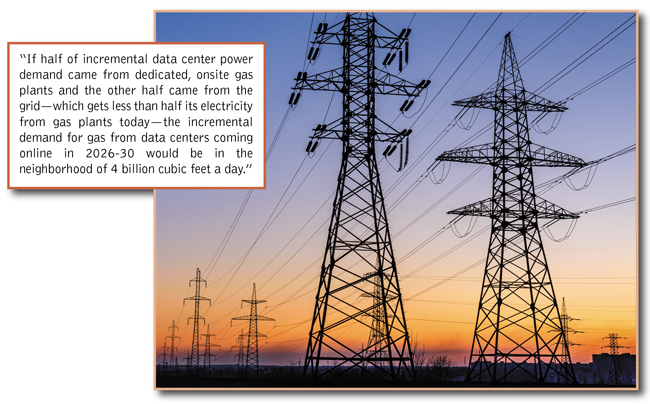
If, say, half that incremental power demand came from dedicated, onsite gas plants and the other half came from the grid—which, again, gets less than half its electricity from gas plants today—the incremental demand for gas from data centers coming online in 2026-30 would be in the neighborhood of 4 billion cubic feet a day. About 1 Bcf/d of that would come from Texas, which is second only to Virginia in proposed data centers development.
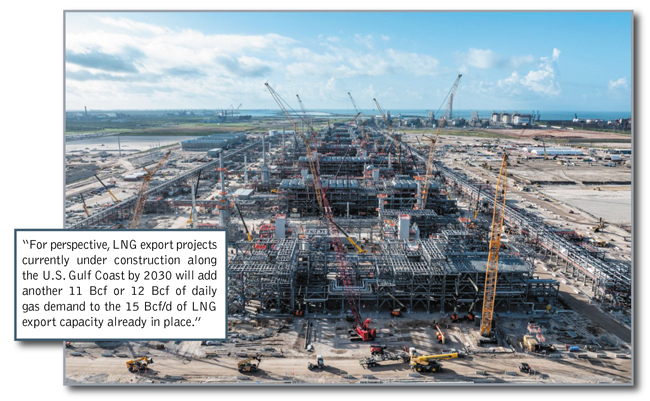
For perspective, LNG export projects currently under construction along the U.S. Gulf Coast by 2030 will add another 11 Bcf or 12 Bcf of daily gas demand to the 15 Bcf/d of LNG export capacity already in place. In other words, new liquefaction plants will demand three times as much gas as new gas-fired power plants largely serving data center demand loads. In recent months, in fact, LNG export terminals along the Gulf and Atlantic coasts have been receiving 19 Bcf/d of feed gas, with some 24-hour periods exceeding 20 Bcf/d.
And here is the kicker, something to consider every time someone mentions another multibillion-dollar data center project: Using the “split-the-difference” scenario described above, $10 billion in data center investment generates only 150 million cubic feet a day of new incremental gas demand. In contrast, a $10 billion investment in new LNG export capacity generates about 2 Bcf/d of new gas demand, or about 13 times the per-dollar impact of new data centers.
This is not to diminish the opportunity that data center-driven electricity demand represents to the natural gas market for supplies flowing from both associated and non-associated gas basins. Braziel acknowledges that the data center boom is real, and it will add meaningful natural gas demand over the next five years. After all, 4 Bcf/d of new baseload is not a trivial number, and a sustained increase of that scale would rank among the larger demand shifts the gas market has seen in the past quarter-century.
The incremental power and gas needs of data centers also will put new emphasis on the need for more gas-electric coordination as existing gas pipeline networks—many of them already stressed during periods of very high demand—need to accommodate the anticipated bump up in power demand to support AI. An issue this big and important will need federal leadership, likely from FERC and Congress too.
Editor’s Note: GasCon 2026 was held on February 25 in Houston. For information about obtaining an on-demand replay of the conference, visit rbnenergy.com/gascon.

HOUSLEY CARR is an energy writer/analyst at Houston-based RBN Energy, where he authors blogs and reports on both domestic and international crude oil, natural gas, NGL, LNG and refined products markets. Before joining RBN in 2016, Carr had served for 36 years as an energy and environmental journalist for industry and trade publications. He holds a B.A. from the University of Virginia.
For other great articles about exploration, drilling, completions and production, subscribe to The American Oil & Gas Reporter and bookmark www.aogr.com.