








NMOGA Pushes State To Ease Regulations, Expand Grid Infrastructure
By Colter Cookson and Andrew Linnabary
SANTA FE, N.M.—New Mexico has a long history of stringent environmental regulations, but it is becoming even more difficult to operate in.
“We are facing an increasingly intense regulatory environment,” reports Missi Currier, president and CEO of the New Mexico Oil & Gas Association. “Our rulemakings have increased threefold in the last couple years in response to requests by third-party environmental groups or the agencies themselves.”
The rulemakings do everything from increasing bonding requirements and fees to changing how agencies implement the Oil and Gas Act, Currier notes. While some aspects of them may make sense in isolation, she says they have the net effect of discouraging investment in the state.
“Capital follows the path of least resistance,” she says. “The rock in New Mexico is incredible, but it is not an easy state to operate in. Whether they are smaller or larger, at some point, companies have to ask themselves if the difficult political and regulatory climate means they should invest elsewhere.
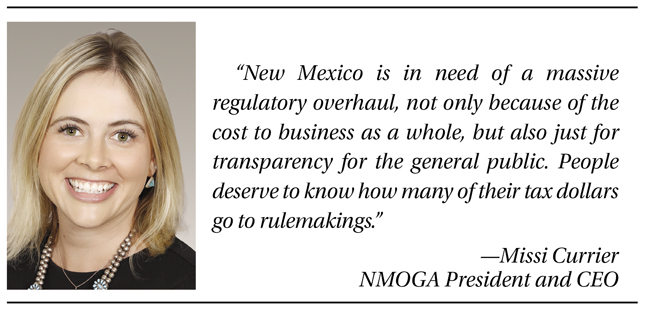
“New Mexico is in need of a massive regulatory overhaul, not only because of the cost to business as a whole, but also just for transparency for the general public,” Currier says. “People deserve to know how many of their tax dollars go to rulemakings.”
The association’s public outreach and regulatory efforts will be among the topics discussed at this year’s annual meeting, which will take place Oct. 5-7 in Santa Fe. Speakers will include several federal and state policymakers, such as Department of the Interior Deputy Secretary Kate MacGregor, New Mexico Governor Michelle Lujan Grisham, EPA Region VI Director Scott Mason, and BLM Director Stevan Pearce, as well as legislators and candidates.
High-Stakes Election
Currier urges pro-business voters to make it to the polls on Nov. 3. She points out that the governor’s race will pit Gregg Hull, a Republican with a track record of implementing business-friendly policies as mayor of Rio Rancho, N.M., against Debra Haaland, who served as Secretary of the Interior during the Biden administration and has a long history of expressing concerns about oil and gas development.
Every seat in the state House is up for election, Currier notes. For now, the House consists of 44 Democrats and 26 Republicans, while the Senate contains 26 Democrats and 16 Republicans. That balance might shift slightly after the election, but Currier says it’s unlikely to swing wildly one way or the other.
“We are just shy of a supermajority for Democrats in both the House and the Senate, so we work very closely with Republicans as well as moderate Democrats to help them understand the importance of defending the industry,” she says. “At the same time, we try to educate the more progressive Democrats about the science, technology, and innovation around oil and gas.”
The association also emphasizes how important industry activity is to the state’s tax base and therefore its ability to fund education, infrastructure, roadway improvements, healthcare and many other projects without raising other taxes.
Recognizing that public sentiment helps determine policy, NMOGA has increased and refined its outreach to New Mexicans in targeted areas throughout the state, Currier reports. In the process, it tries to make the benefits of oil and gas development more concrete and visible by highlighting the many products made from plastics and other materials that originate from hydrocarbons.
“Despite our companies’ efforts for many years, it’s amazing how few people understand how oil and gas is part of their everyday life,” Currier says. “It’s in everything from the glasses they wear and the cell phone in their pocket to the car they drive, whether it’s electric or not.”
Produced Water
One of NMOGA’s biggest priorities is to accelerate development of a regulatory framework for using produced water outside the oil and gas industry. “Looking ahead, one of the largest threats to our industry in New Mexico is the amount of produced water wells generate,” Currier explains. “We have to find better ways to utilize treated produced water.”
According to data from the New Mexico Oil Conservation Division, the state’s wells bring up more than three barrels of water for every barrel of oil. From 2020 to 2025, the total amount of produced water doubled, rising from 1.38 billion barrels to 2.75 billion. As concerns about induced seismicity restrict access to saltwater disposal wells in both New Mexico and Texas, these growing volumes will need an outlet.
It’s possible to use some of the water in completion fluids, she says, but that application can only absorb a tiny fraction of the total volume.
To push for beneficial use outside the industry, the Water Access, Treatment and Reuse Alliance, which introduces itself as a coalition of water management companies, municipalities, ranchers, engineers, landowners, energy producers, and treatment experts, filed a petition with the State Water Quality Control Commission on June 20 of 2025 asking it to establish permitting standards for a variety of applications. The petition envisions produced water supporting industrial processes, dust control, geothermal wells, and cement production, or with particularly thorough treatment, irrigation of non-food crops and environmental restoration projects.
In response to that petition, the Water Quality Control Commission will need to hold hearings to discuss appropriate treatment standards for different uses. “Unfortunately, the commission has not set a date for those hearings, so we do not anticipate that happening until 2027,” Currier says.
“Reuse is such an important topic to our companies, knowing that New Mexico is such an arid state and the treated produced water could be utilized in many different ways,” she says. “It would allow us to essentially create a new water source as well as conserve fresh water for agriculture and other options.”
“So, that is one of the number one priorities for NMOGA and oil and gas in New Mexico: continuing to push for science around treated produced water to ensure that appropriate standards can be set as soon as possible,” Currier says.
Electrification
Another major priority for NMOGA is streamlining the processes required for building transmission lines and power plants so it is easier for operators to connect to the grid. “If we could electrify the oil field, we could continue to cut methane emissions by 50% or more,” Currier enthuses. “But for now, it is incredibly difficult to get electricity to the oil field for a multitude of reasons, whether it’s access to the grid or changes through New Mexico’s Public Regulation Commission.”

In addition to reducing emissions, Currier says electric equipment enhances operations by simplifying remote monitoring and allowing more precise control of equipment. She describes it as a boon for the environment and production.
Even without electrification, New Mexico already meets tough environmental standards. “Because of our regulatory and political environment and because of the innovative nature of the companies that operate here, small and large, the industry continues to find ways to produce oil and gas that are more affordable, sustainable, and most importantly, environmentally friendly,” she praises. “Local companies’ willingness to push the envelope has made New Mexico oil one of the cleanest barrels in the world.”
Currier says NMOGA will continue to advocate for policies that allow New Mexico to preserve the environment but eliminate unnecessary regulatory burdens and support continued innovation. She says the association has grown to represent more than 250 members as companies drawn to the fantastic geology in the Permian and San Juan basins recognize the importance of a strong industry voice.
“Our members include everyone from incredibly large producers to smaller producers that have been in New Mexico for multiple generations,” she notes. “We’re very grateful for the support they provide and their willingness to partner with us to work on their behalf in the legislative and regulatory spheres as well as on the public education aspect.”
Unfortunately, NMOGA lost one of its most active members when its chair, Stephen Flaherty, passed unexpectedly in late July.
Flaherty spent most of his career in oil and gas, working for service companies such as Halliburton and producers such as Noble Energy, Coterra Energy, and most recently, Devon Energy. His roles universally involved government relations and public outreach.
“He was just such a fierce advocate for oil and gas as well as trade associations,” Currier says. “He worked at both the federal and state level and really understood the importance of working collectively in a one-for-all, all-for-one mentality.
“More importantly, outside of oil and gas, he was a great friend, a fantastic father and a really wonderful husband to his new wife,” she continues. “He is incredibly missed, but his legacy will live on throughout oil and gas because his presence made many companies and many operations better.”
Derek Albro, senior director of public and government affairs at Devon Energy, has stepped in to serve as interim chair.
For other great articles about exploration, drilling, completions and production, subscribe to The American Oil & Gas Reporter and bookmark www.aogr.com.