







Nutrients Bolster Mature Waterfloods
By Paul Welch and Zach Broussard
Mature U.S. onshore waterfloods contain significant volumes of remaining oil in place, yet many independent operators struggle to economically access that resource. Conventional options, including additional drilling, recompletions, polymer floods, or chemical enhanced oil recovery, often require substantial capital investment, infrastructure upgrades, or operational complexity that late-life assets cannot easily justify.
As a result, large volumes of bypassed and immobile oil remain stranded even as operators pursue incremental production and improved cash flow from existing fields. This holds true for many mature waterfloods in East Texas.
A recent pilot at Buccaneer Energy’s Pine Mills Field in East Texas demonstrates the power of an emerging solution: organic oil recovery. OOR can provide a low-cost, operationally simple alternative to improve oil mobility and recovery in mature waterfloods.
Implemented in January, the pilot delivered a rapid production response, including a 100% increase in area oil production and a dramatic reduction in water cut in one of the treated wells. Importantly, the program achieved these results at a cost comparable to a routine workover.
Vast Opportunity
The Pine Mills Field represents a long-producing waterflood typical of many East Texas assets operated by independent producers. After decades of production, the reservoir still contains significant volumes of residual oil trapped within the formation.
Water cuts in parts of the field had climbed as high as 90%, and incremental production opportunities had become increasingly limited.
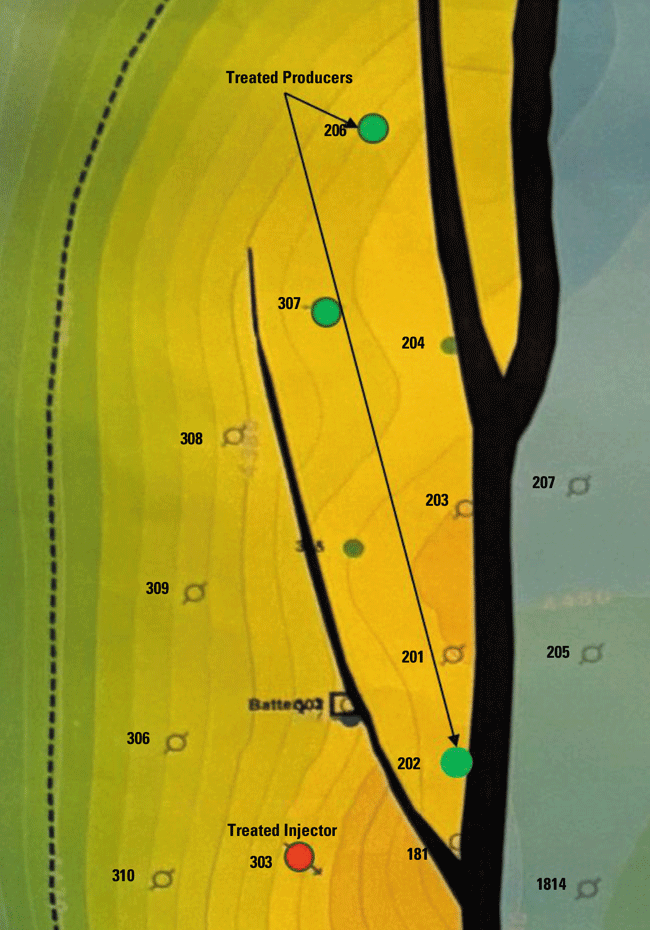
In the northern portion of the field—specifically the Battery 3 area (Figure 1)—Buccaneer Energy recently returned a water injector to service following a series of workover operations. The injector had remained shut in for more than two years, creating an opportunity to evaluate whether targeted reservoir stimulation could improve sweep efficiency and mobilize remaining oil.
FIGURE 1
The Pilot’s Location in the Pine Mills Field
Rather than pursue capital-intensive EOR techniques, Buccaneer elected to evaluate OOR through a controlled pilot program. Organic oil recovery improves oil mobility at the pore scale by leveraging reservoir-adapted biological processes. During treatment, the injection water introduces into the formation a tailored nutrient formulation designed to stimulate indigenous microbial populations already present within the reservoir.
Once activated, these microorganisms generate metabolic byproducts that influence rock-fluid interactions, including changes in wettability and reductions in interfacial tension. These mechanisms improve the ability of trapped oil droplets to detach from pore surfaces and move with the flowing waterflood.
Unlike traditional microbial EOR approaches that rely on introducing foreign organisms, OOR leverages microorganisms already adapted to reservoir conditions. This approach improves reliability and reduces operational risk.
Because the treatment utilizes existing injection infrastructure, Buccaneer could deploy OOR without installing additional surface equipment or modifying field operations.
Impactful Results
The Pine Mills pilot evaluated OOR performance in a focused portion of the Battery 3 area. The program involved one injector and two producing wells selected from the four active wells in the area.
The remaining wells were left untreated during the initial phase to enable a performance comparison and operational control.
Before treatment, oil production across the pilot area averaged approximately 15 barrels of oil per day from January 1 through January 15, 2026. Water cuts in the treated producers measured approximately 80% and 90%, reflecting the maturity of the waterflood.
The treatment was deployed through existing injection infrastructure and required no modifications to field equipment. Operationally, the program resembled a standard field intervention.
The production response occurred quickly following treatment. During the post-treatment period from January 29 through February 15, average oil production across the pilot area increased to approximately 30 bbl/d, a 100% increase relative to pre-treatment levels.
FIGURE 2
Battery 3’s Recent Production History
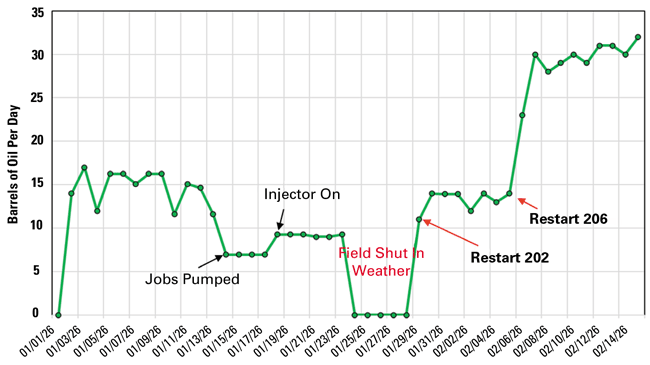
Importantly, production levels remained elevated beyond the initial response window (Figure 2).
One of the treated producers exhibited a particularly notable response, with water cut dropping from approximately 80% to 0% immediately following treatment.
Although individual well responses can vary, the magnitude of this change highlights the potential for OOR to significantly improve oil mobility in mature waterflood environments.
Equally important, the treatment introduced no operational disruptions, surface issues, or production upsets.
Why OOR Excels
In late-life waterfloods, residual oil frequently remains trapped due to capillary forces and unfavorable wettability conditions rather than a lack of reservoir pressure.
Over decades of water injection, microbial communities naturally adapt to reservoir temperature, salinity, and pressure conditions. OOR leverages this established microbial ecosystem rather than attempting to replace it.
By stimulating beneficial microorganisms already present in the formation, the treatment alters rock-fluid interactions at the pore scale. Even modest changes in wettability or interfacial tension can significantly improve oil displacement efficiency.
These mechanisms explain the rapid production response observed during the Pine Mills pilot.
If OOR required a significant investment, that production increase might be less impressive. But its cost resembles that of a routine workover, and it utilizes existing field infrastructure. No additional facilities or capital upgrades were necessary.
Incremental production of approximately 15 additional barrels per day translates directly into near-term cash flow—an important outcome for late-life assets approaching economic limits.
Buccaneer Energy estimates that Pine Mills carries an NPV10 of approximately $9.6 million at $60 oil. Within the pilot area, the company estimates the OOR program generated an internal rate of return approaching 99%, with payout in less than one year.
Scalability and Next Steps
Following the encouraging pilot results, Buccaneer plans to treat the remaining producing wells in the Battery 3 area. The company is also evaluating whether to expand the program across the broader Pine Mills Field.
The simplicity of OOR deployment supports phased implementation. Operators can begin with targeted pilot programs, evaluate performance, and expand treatment areas as results justify.
Buccaneer’s initial pilot demonstrates that OOR provides a pragmatic option for operators seeking incremental gains from existing fields without increasing operational complexity. The technology delivered a step-change in performance using standard field practices and a cost structure familiar to independent operators.
That operational simplicity means OOR can be widely applied. It is not a replacement for all enhanced recovery methods, but it can create possibilities in fields that no longer produce enough to justify more expensive techniques.
As the industry continues to focus on capital discipline and maximizing value from existing assets, organic oil recovery’s combination of technical effectiveness and easy implementation will become increasingly important. When applied thoughtfully, subsurface microbiology can play a meaningful role in extending field life and improving recovery.

PAUL WELCH is the CEO of Buccaneer Energy, a publicly-traded, London-based independent that operates the Pine Mills Field in East Texas and several wells in the Permian Basin. Welch has more than 30 years of energy industry experience, including time as co-CEO and chief operating officer of ALT Resources, CEO of SDX Energy, CEO of Chariot Oil & Gas, and managing director of GEO International. Earlier in his career, he served as a regional manager for Pioneer Natural Resources, a chief engineer for Hunt Oil Company, and a senior reservoir engineer and manager of international ventures for Shell.

ZACH BROUSSARD is the organic oil recovery product manager for Hunting Energy Services. Since graduating from Texas A&M with a B.S. in genetics and biochemistry in 2012, he has spent most of his career applying microbiology to petroleum reservoirs. Before joining Hunting, he co-founded and served as chief technology officer for Gold H2, which commercialized a technology for converting oil reservoirs into hydrogen-producing assets. Gold H2 grew out of Cemvita Factory, where Broussard held several leadership roles related to microbiology. Broussard came to Cemvita from ChampionX, where he helped develop and launch chemical technologies and service offerings.
For other great articles about exploration, drilling, completions and production, subscribe to The American Oil & Gas Reporter and bookmark www.aogr.com.