







Rugged Systems Leverage Field Gas For Fast Power Solutions
By Danny Boyd
To power the massive Hyperion data center in Louisiana, Meta plans to underwrite 10 natural gas-fired power plants that collectively generate more than seven gigawatts of power.
With an estimated cost of $200 billion, Hyperion represents the largest private investment in Louisiana history. While it is one of the most extreme examples of data centers’ seemingly insatiable appetite for power, it is far from alone. Goldman Sachs estimates that in 2025, U.S. data centers’ power demand reached 31 gigawatts. The firm sees this number rising to 41 gigawatts this year and 66 in 2027.
If that prediction comes to pass, data centers’ electricity consumption will have doubled in only two years.
Because so much electricity comes from natural gas power plants, that rapid demand growth represents a huge opportunity for producers to do more. That is true whether their fields are connected to the grid or require robust remote power generation to support their operations.
The Role of Field Gas
The industry will continue to use some of the abundant gas it produces to power its operations because treating field gas for use typically costs less than running generators that demand diesel or compressed natural gas. The economic advantages of field gas will only get stronger as gas conditioning equipment, generators and microgrid distribution systems continue to improve.
That is welcome news as the industry electrifies more tasks. While it’s possible for equipment to connect to utilities in some areas, growing electricity demand often means the already-lengthy wait times to do so have gotten longer. And in many remote plays, utility power is either inadequate or unavailable.
“We’ve started to see a shift where all our midstream customers, particularly in New Mexico amid some of the largest concentration of oil and gas wells, are finding it difficult to get good power connectivity,” says Harlan Smith, CEO of Schwob Energy Services.
The company has relied on strong relationships with vendors to procure power generating equipment in increasingly short supply. In many cases, manufacturers are out past 2030 in filling orders for new equipment, Smith reports.
Even with those relationships, he says it’s worthwhile to investigate alternative suppliers. “We have found some unique turbine providers that offer some smaller turbines in the three to four megawatt range,” he shares. “Turbines do not work well everywhere, but in the areas where they make sense, these suppliers can help us shorten lead times.”
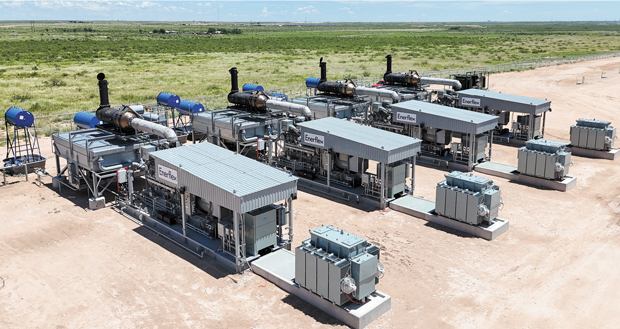
To provide the power necessary to support increasingly electrified field operations, Schwob Energy Services builds power generation islands with distribution systems that allow them to support several midstream facilities. The company says such centralization simplifies logistics and regulatory compliance. The facilities’ generators typically run on residue gas from processing plants rather than diesel, significantly reducing fuel costs
Central Power
With roots in commercial and oil and gas construction, the 35-year-old Dallas-based company has evolved into an engineering, procurement and construction business that also designs and installs power solutions for midstream players and others. Much of Schwob’s work takes place in remote fields on the New Mexico side of the Permian Basin, where power is scarce.
To supply that power, the company builds centralized power generation islands that feed distribution systems serving several facilities. These islands’ generators frequently run on field gas.
“The saying out there right now is ‘molecules to electrons,’” says Randy Larkin, Schwob’s vice president of energy. “Companies are monetizing their molecules for the power that they need rather than buying it off the grid.”
By fueling generators with residue gas from plants rather than diesel, those companies can significantly reduce their fuel costs, Larkin explains. This arrangement also minimizes the amount of gas they need to market through the Waha hub, where prices periodically turn negative.
The centralized gas-fueled power islands can use reciprocating engines or engine-driven turbines to produce electricity. Power from each island is supplied to multiple sites through separate networks of overhead power lines or other distribution systems built by subcontractors for Schwob or its clients.
As power generation becomes a standard consideration for new processing plant design, more customers are seeking centralized power generation to serve existing operations across a broad footprint, Smith says.
Schwob’s systems, driven mostly by Caterpillar and Waukesha engines, routinely meet power needs ranging from 2 MW to 20 MW to support processing plants and pumps. The company mentioned in late June that it was preparing to install a 50 MW power island serving multiple facilities.
Power systems engineering and construction timelines vary by project, but some can be designed, installed and operational within six months, Smith says. If customers own the land, distribution can be installed quicker than systems that require customers to procure rights-of-way.
Centralizing power generation has many logistical advantages, Smith says. He adds that it can simplify regulatory compliance by shifting emissions permitting from processing plants to generation facilities, which qualify for permits-by-rule in both New Mexico and Texas. This gives companies greater flexibility to make changes as their needs evolve.
Securing Assets
Even with longer equipment lead times, HiVolt Energy is securing assets for projects in the Permian and elsewhere, says founder and CEO Josh Evans.
Founded in 2019, the Midland business has evolved from an early focus on power generation to company-owned and managed microgrids providing power and distribution to oil and gas fields, he says.
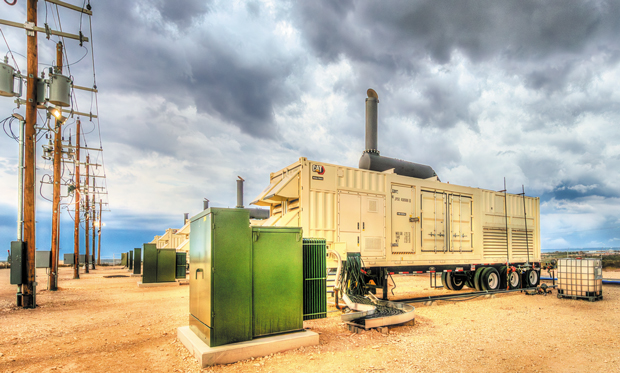
When designing power generation facilities, HiVolt Energy says it’s vital to understand the anticipated load profile and include enough redundancy to provide reliable power. The company notes that some microgrids support both the routine operations of ESPs, compressors, transfer pumps and other production equipment, as well as transient demand spikes from electric drilling rigs and service equipment.
“What we have tried to do is provide a midstream-like experience for power,” Evans outlines. “HiVolt is not a utility, but what we’ve done is figure out the regulatory side so we can very reliably deliver power, normally from a centralized location that we own and operate. We don’t put out any equipment that we don’t operate ourselves. We are involved for the full life cycle of that project and have remote capabilities that allow us to control the equipment from anywhere.”
The company, which also serves data centers and other industries, is technology agnostic. It can use turbines or reciprocating engines to generate power depending on which is best for a particular location, he says.
To enhance dependability, the company sometimes leverages a technology historically used primarily to support solar and wind: GridVest’s lithium-ion batteries. Evans points out that HiVolt developed proprietary PLC control logic to integrate battery storage with gas-fueled generation and maximize the combination’s benefits.
Although HiVolt aims to expand into other areas, its early concentration of work in the Permian has enabled the company to refine its engineering approaches, build scale, and learn what works best in different applications, Evans relates. It has completed multiple oil field projects with power capabilities as high as 50 megawatts to drive ESPs, compressors, transfer pumps and other components at upstream, midstream and saltwater disposal well sites. Its systems can be designed to support transient demand hikes from electric-powered service equipment, such as electric drilling rigs.
According to Evans, all projects start with understanding a customer’s load profile and determining how much redundancy and reliability needs to be built into the system.
“It’s really important for customers to understand the impact that power has on their production and the cost of not getting the right solution,” Evans says.
In one case, a Permian operator was told that the utility had no plans to add capacity and serve oil and gas production facilities. After initially using mobile generators, the operator commissioned HiVolt to build a 10 MW generating facility burning pipeline-quality gas and to install connecting infrastructure. The extra capacity enabled the operator to power the equipment needed to bring more wells online, increasing production by 35% and boosting the company’s value.
Eventually, Evans says, the operator sold for a premium in part because of the power solution already in place.
Vast Opportunity
With a recent name change, Gravity Power & Rental LLC continues to add to a generation fleet serving oil and gas operations in eight states. Despite more intense competition in the segment, there is plenty of room for growth, assesses Chad Wolf, vice president of operations.
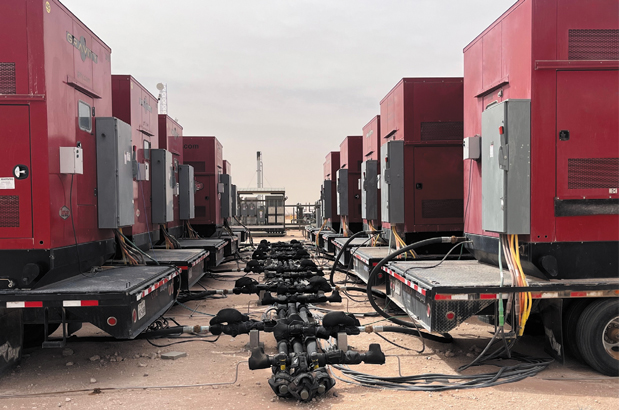
Many generators can run on lightly-treated field gas, Gravity notes. While the company’s individual units range in capacity from 36 KW to 360 KW, they can be connected in parallel to deliver a collective output of 4-5 MW.
For starters, utilities have little extra grid capacity as they look to add long-term load that now includes data centers and other large infrastructure that may last 50 years or more. By comparison, a remote oil and gas well site may last 15.
“The oil and gas industry winds up being the odd man out in that the utilities don’t see a site or wellhead as a long-term need,” Wolf says.
That means more remote power will be needed to drive both production equipment and midstream processes. This generation needs to adapt as fields mature, more wells come online, and the existing wells transition to different artificial lift techniques, he says.
Running on field gas that requires little processing, Gravity’s generators can power single loads on pads or work in tandem with each other to handle several loads from an operator-owned grid connected to a central generation station. Units range in capacity from 36 KW to 360 KW. As many as 10-12 units can be connected in parallel to deliver a collective output of 4-5 MW.
Under a previous company name, Gravity in 1994 began providing diesel-fired field generation, light towers and frac tanks. As part of a commitment to standardization, its fleet today consists mostly of gas-fired generators driven by reciprocating engines from Power Solutions International and packaged with the same controllers, fuel scrubbers and other components.
“Uniformity creates a lot of repeatability for our field technicians,” Wolf says. “It standardizes the parts they need on the service trucks, and the volume of training is narrower. There are a lot of advantages to having one engine, one controller, and just a couple of alternators.”
By installing telemetry on all its units, Gravity can provide access to data through a proprietary portal. Customers can see total power being produced, which units are online or offline, engine oil pressure, water temperature, speed, battery voltage and other measurements, Wolf notes. He says AI on the back end can issue alerts when trends get outside certain parameters.
Today, the company serves up to 300 customers from 11 locations in North Dakota, Wyoming, Colorado, New Mexico, Texas, Oklahoma, Louisiana, and Pennsylvania. In the long run, Wolf sees plenty of opportunities for the company to grow in the Permian and beyond.
Some of those opportunities exist in Colorado, the Northeast, and other areas that favor stricter environmental standards because gas generators create 60% fewer emissions compared to diesel. Smaller units may be deployed to power air compressors so operators can replace gas-operated valves, which emit tiny amounts of methane as part of routine operations, with pneumatic ones.
North Dakota is another area with a strong need for gas generators, Wolf continues. Restrictions on utility construction on reservations there translate into consistent demand for portable power. The state’s quest to minimize flaring has strengthened this demand. Operators that have no outlet for their gas will sometimes bring in mobile computer banks to mine Bitcoin or other cryptocurrencies. These computers need power, and that power comes from natural gas generators capable of burning field gas.
Entrepreneurial Approach
An entrepreneurial foundation coupled with designing, building and operating its own industrial operations has equipped Atlas Energy Solutions with the ability to identify the right power projects for operators and midstream companies as it expands across basins and into other power segments, says power division President Tim Ondrak.
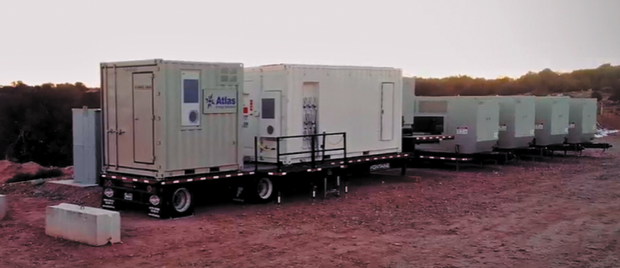
The demand for power generation systems that can support large loads continues to grow, Atlas Energy Solutions reports. That growth comes not only from the oil field and data centers, but also from the manufacturers. For example, Atlas is working on a project for a technology manufacturer in El Paso, Tx., that will require 30 generators capable of producing as much as 120 MWs.
The acquisition last year of mobile power provider Moser Energy Systems came with positions in the Williston, Powder River, Uinta, Denver-Julesburg, Eagle Ford and the Permian, where Atlas has long operated sand mines and maintained a proppant delivery business. Often installed on pads close to producing and processing assets, Atlas gas-fired generation units employ reciprocating engines that provide 70 KW to 350 KW each and may be paralleled together to boost overall power output.
Outside the oil and gas industry, Atlas has a behind-the-meter power project now under development for a technology manufacturer in El Paso, Tx., that will include 30 generators capable of a collective 120 MW.
Austin-based Atlas got a firsthand view of remote power’s importance three years ago while planning the 42-mile Dune Express, an electric frac sand conveyor system that can move 13 million tons of proppant annually from Kermit, Tx., to New Mexico.
When the Atlas team learned that it would take years to get grid power, the light went on for the entrepreneurial company founded by Ben M. “Bud” Brigham. Recognizing that others would face the same grid constraints, Ondrak says Atlas began searching for opportunities in the distributed power space.
After contemplating whether to grow the resulting power division organically or expand through acquisitions, Atlas added Moser in a deal with little customer overlap. In addition to getting a seasoned power generation team, the transaction has enabled Atlas to embark on larger deployments in both power size and unit scale, Ondrak says.
“We’ve started to migrate the legacy business more to what the market sees as microgrids,” he says. “We define that as a power system that operates independently of the grid. It can be tied to the grid or not tied to it, but supports power generation where the grid is unavailable or unreliable.”
As competition in the segment intensifies, Ondrak says Atlas is leveraging new technologies to enhance reliability. For example, the company’s hybrid power generation technology combines a battery system with a series of generators to provide power in the event of a reduction or outage.
“What customers get from the battery is a smaller footprint on their locations,” he explains. “We need fewer generators and the generators burn less fuel because some of the power comes from the battery. The battery also offers a more consistent power supply. If the generators go down because the gas supply is interrupted, it can keep the equipment on until fuel supply is restored and the generators can turn on.”
Atlas builds the cabinets and wiring and installs third-party battery racks. The technology has proven to be extremely reliable, Ondrak assured in late June. He cited a unit that had been on a wellsite since January with no power interruption.
The power division has grown quickly, Ondrak reflects. Today, he says much if its work involves deploying power systems secured through a long-term supply agreement with Caterpillar. “These are large reciprocating generators designed to provide multi-megawatts for data centers and other large load users. We have the team in place to execute on these projects, and there is substantial demand in large load growth, particularly in Texas,” Ondrak explains.
Fast Solution
With the overriding need for reliability and fast solutions, Baseline Energy Services is building its own gas-fired mobile generation units at an Oklahoma City plant.
Acquired in 2025 by Pennybacker Capital Management, the Fort Worth-based company serves customers across several basins, says Josh Mueggenborg, vice president of sales.
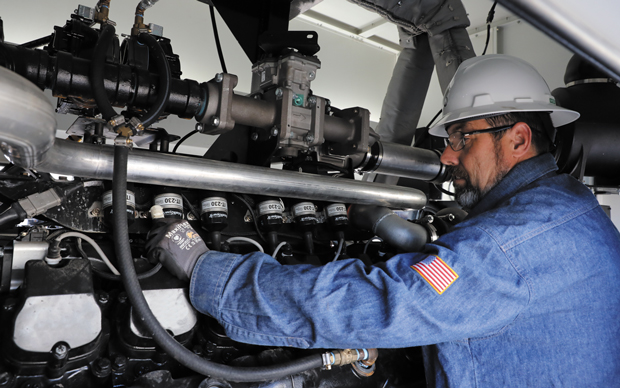
Baseline Energy Services says it can often get generators to site within two days. In some locations, these generators provide reliable power at a lower cost than the utility, making them attractive even when companies already have a connection to the grid.
Its fleet contains 1,200 trailer-mounted units in sizes ranging from 50 KW up to 385 KW. Each is equipped with reciprocating engines that are robust enough to handle high-BTU field gas and can also run on compressed natural gas or propane.
CEO Graham Radler founded the company in 2012 to test if water quality met baseline specs at oil production sites in Kansas. After seeing the need for gas-fueled remote power generation, Radler chose to expand into the segment. In 2017, Baseline grew its fleet by acquiring generators from a large E&P operator in South Texas. That customer remains one of their largest in that market today.
On some central power sites, 10 or more generators act as a single unit that feeds a distribution point connected to a grid. Baseline says redundancy on any system is crucial.
“In the event a unit goes down, we want to make sure there is enough built-in redundancy to ensure that the customer still sees 100% of the power,” says Brian Green, president of the oil and gas segment at Baseline.
Green says he knows how important reliability can be to customers. Before joining Baseline, he spent almost 20 years in executive roles at TOPS, a company that specialized in electric-driven gas compression, until the company was acquired by a strategic buyer in August 2024.
Baseline’s equipment can accommodate various field setups and be deployed on site within 24-48 hours, although many customers provide longer lead times on projects to ensure equipment availability for their power generation needs. The long-term need for power is also driving customers to secure multi-year power generation equipment contracts.
In addition to providing power on short notice, Mueggenborg says Baseline’s projects often reduce costs while delivering greater reliability than the local grid. In these situations, operators elect to use the company’s equipment even if they have access to grid power.
As power demand continues to evolve, Mueggenborg says Baseline is building on its strong foundation in oil and gas while expanding into data centers and other commercial and industrial markets. He indicates these markets all seek engineered power solutions that maximize uptime and provide operational flexibility.
For other great articles about exploration, drilling, completions and production, subscribe to The American Oil & Gas Reporter and bookmark www.aogr.com.