







UC Berkeley: U.S. Shale Gas Delivers Huge Consumer Savings
BERKELEY, CA.—Between 2007 and 2025, the emergence of shale gas plays has saved U.S. gas consumers at least $3 trillion, according to research by the Energy Institute at Haas, which is affiliated with the Haas School of Business at the University of California, Berkeley.
“Shale gas has saved U.S. natural gas consumers a total of $3.1-$4.3 trillion since 2007. This is equivalent to $164-$227 billion annually, or $494-$685 annually per capita,” the Energy Institute’s Lucas Davis writes in a working paper, “How Much has Shale Gas Saved U.S. Consumers?”
For comparison, the U.S. Department of Energy estimated in 2020 that 100% adoption of LED light bulbs would save U.S. consumers $72 billion a year. “LED light bulbs use 80% less electricity than traditional incandescents, have been called a ‘once in a century disrupter,’ and were the basis of the 2014 Nobel Prize in Chemistry,” Davis notes. “We are finding that the annual savings from shale gas are about three times larger.”
To estimate those savings, the paper compares the price for natural gas at Henry Hub with prices in Europe and Japan, both of which rely heavily on LNG imports. “The underlying assumption in our calculations is that without shale gas, the U.S. would have been importing LNG and thus U.S. consumers would have been paying the prices observed in Europe or Japan,” Davis says. “This does not require any specific assumption about the counterfactual path for U.S. gas production, but it does assume sufficient scarcity of natural gas that the marginal unit would have been supplied by LNG in all years.”
According to the paper, that is a strong but not ironclad assumption. “U.S. LNG imports were growing prior to shale gas but still a tiny share of the market,” Davis observes. “It is certainly possible that, without shale gas, weak U.S. supply and strong U.S. demand would have led to sharply increasing U.S. LNG imports. But the opposite is also possible. Conventional U.S. natural gas production could have increased or U.S. demand could have decreased, making LNG imports unnecessary.”
While it never makes this connection itself, the paper does offer some facts that suggest a surge in natural gas production from conventional wells would have been unlikely. “In the mid 2000s, U.S. natural gas production had been flat for a decade, and the United States was importing liquefied natural gas, with plans to import much more,” it recalls. “As of February 2007, there were four additional U.S. LNG import terminals under construction and another 10 U.S. LNG import terminals had received approval from FERC.”
Huge Impact
Before shale gas began transforming into a major contributor to U.S. natural gas production, which the paper puts around 2007, U.S. natural gas prices resembled those in Europe and Japan. From 1995 to 2006, the price per Mcf at Henry Hub averaged within $1 of Europe’s price at the Netherlands Title Transfer Facility and within $1 of the price Japan paid for LNG imports, Davis reports.
“Then prices diverged sharply,” he relates. “Every single month between 2007 and 2025, the U.S. price was below or equal to the price in Europe and Japan. Relative to Europe, U.S. prices have averaged $9 lower per Mcf. Relative to Japan, U.S. prices have averaged $11 lower.”
Figure 1 compares prices in three countries using 12-month rolling averages based on monthly data from the World Bank. To allow fair comparisons across time, the graph converts prices to 2025 dollars.
FIGURE 1
Natural Gas Prices in the U.S., Europe and Japan
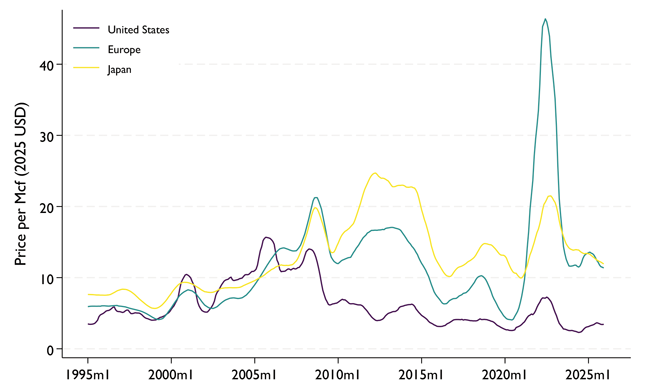
Source: Energy Institute at Haas, based on World Bank data
The consumer savings from relying on domestic production rather than LNG imports add up to more than $3 trillion, driven by the size of the U.S. natural gas market. “U.S. natural gas consumers now use 30 billion Mcf of natural gas annually,” Davis says. “Combine this high level of consumption with price differences that have averaged $9-$11 per Mcf, and it makes sense that the savings from shale gas would be very large.”
Those savings have benefited many sectors. “39% of savings went to electric power customers, with 30%, 18%, and 13% for industrial, residential, and commercial customers, respectively,” the paper details. “In terms of geography, Texas has saved more than any other state, and Louisiana has saved the most per capita.”
Major supply shocks highlight the benefits of domestic production. “The war in Ukraine sent natural gas prices through the roof in Europe, while U.S. prices increased only modestly,” Davis says. “The Iran war is similar. Our data do not include 2026, but prices in Europe and Japan doubled in the first 10 days of March 2026, and attacks on LNG infrastructure in Qatar and elsewhere pushed prices up further. In contrast, U.S. prices barely budged.”
While some regions and sectors benefit more than others, the paper argues the gains are broad. “If you heat your home with natural gas and use a lot of electricity, plastic and fertilizer, then you have benefited more than average,” Davis says. “However, because natural gas is an important input into so many production processes, it is not an exaggeration to say that every single person in the United States has enjoyed lower prices because of shale gas.”
The full report includes several maps that show per-capita savings in each state across all sectors and for individual sectors, as well as tables that present the total savings for each sector. It also explains why the Energy Institute’s estimate of consumer savings easily exceeds decade-old prior research and includes a brief survey of research into shale development’s other benefits and potential trade-offs. It’s available at How Much Has Shale Gas Saved U.S. Consumers?
For other great articles about exploration, drilling, completions and production, subscribe to The American Oil & Gas Reporter and bookmark www.aogr.com.