



Modern Tools Help Fleet Owners Improve Utilization Rates
By Michael Maltsev
In oil field operations, where downtime can cost hundreds of thousands of dollars an hour, managing equipment utilization is essential for operational success. Achieving a high utilization rate improves asset performance to enhance profitability, maintain safety standards, and preserve competitive positioning.
Within the oil field and offshore equipment rental sector, utilization management is a key driver of profitability and client satisfaction. Idle assets directly impact profit margins, while unplanned equipment replacements result in operational delays and potential contract penalties. Industry-leading organizations approach fleet performance management strategically, minimizing downtime and optimizing billable utilization by conducting integrated analysis of telemetry data, service records, parts inventory, and contractual obligations.
In an industry with compressed margins, maximizing rental equipment utilization is a strategic priority with far-reaching implications for project economics, service delivery, and sustainable profitability.
Defining Equipment Utilization
Equipment utilization measures the percentage of time assets actively generate revenue compared to their total available time. This metric encompasses several operational dimensions: deployment efficiency across job sites, scheduled maintenance windows, transportation delays between locations, and operational readiness for immediate deployment. Accurate utilization rates require careful consideration of operational nuances and contextual factors that impact both measurement accuracy and decision-making quality.
Deployed days span from job start date to completion date, but three scenarios require special classification:
- Rental breaks, which are temporary billing pauses while equipment remains on-site but is not being used;
- Idle time before or after job phases, when equipment is present but not operational; and
- Standby equipment, which is ready for deployment but awaiting assignment.
Each organization must establish consistent classification protocols tailored to its operational model to ensure accurate utilization tracking.
Days in fleet typically run from acquisition or commissioning through disposal or retirement, though circumstances can modify this time frame. New equipment often requires assembly, configuration, and commissioning before reaching full operational availability. During major repairs, refurbishment projects, or extensive upgrades, some companies temporarily exclude these units from utilization calculations to maintain metric accuracy and prevent artificially low percentages that don’t reflect true fleet performance.
Utilization calculations require standardized methodologies and consistent measurement approaches across all departments to ensure accurate interpretation and meaningful comparison. Physical utilization metrics alone provide an incomplete picture. Smart companies integrate financial metrics to create comprehensive dollar utilization assessments that incorporate total cost of ownership: equipment investment, maintenance expenses, certification and compliance costs, inspections and safety checks, and operational costs that impact true profitability.
Simple utilization calculations can use basic spreadsheets and manual tracking, but comprehensive analysis requires specialized software capable of handling complex variables, multiple data sources, and intricate scenarios. Key metrics include utilization rates (active deployment time versus total available time), idle time analysis to identify improvement opportunities, deployment hour tracking to understand usage intensity, and strategic maintenance scheduling to minimize disruption to availability and revenue generation.
Well-managed fleets typically achieve 75%–90% utilization rates, with industry leaders consistently maintaining above 85% through optimized deployment and proactive management. Organizations below 60% utilization face significant operational inefficiencies requiring immediate intervention. Research demonstrates that even a 5% increase in utilization rates can generate approximately 20% revenue uplift, highlighting the financial impact of optimized deployment strategies and effective utilization management.
How To Monitor Utilization
Traditional tracking methods, such as manual logs, paper systems, and whiteboards, can’t keep up with modern oil field operations. Today’s monitoring approaches use digital solutions, Internet of Things sensors, and real-time telemetry to provide complete asset visibility across dispersed locations.
Modern tracking systems capture multiple data streams: run hours, equipment assignments, downtime causes, location coordinates, maintenance status, and operator performance. Radio frequency identification tags, GPS trackers, and QR codes enable continuous visibility into equipment location and condition. Advanced sensors monitor vibration, temperature, and pressure to predict failures before they cause costly disruptions.
Real-time dashboards and business intelligence platforms transform how operators access utilization data, delivering immediate fleet performance insights that improve deployment and scheduling decisions. The best platforms integrate asset tracking with broader operational management, covering each asset’s complete lifecycle, repair status, maintenance schedule, and real-time location.
Automated data collection through telemetry and IoT sensors improves accuracy while eliminating manual data entry errors. These systems continuously monitor equipment performance, automatically update utilization calculations, and alert operators to emerging issues before they disrupt operations or affect client commitments.
Barriers to High Utilization
Equipment mobility and remote locations complicate oil field operations. Frequent movement between remote sites makes monitoring equipment and coordinating maintenance difficult. Fortunately, GPS tracking and satellite communication can enable companies to maintain visibility into dispersed fleets.
Incomplete or inaccurate data collection persists, especially with manual reporting. Field conditions, heavy workloads, and communication limitations create data gaps that hinder optimization. Digital solutions with offline capabilities and automated synchronization address these issues.
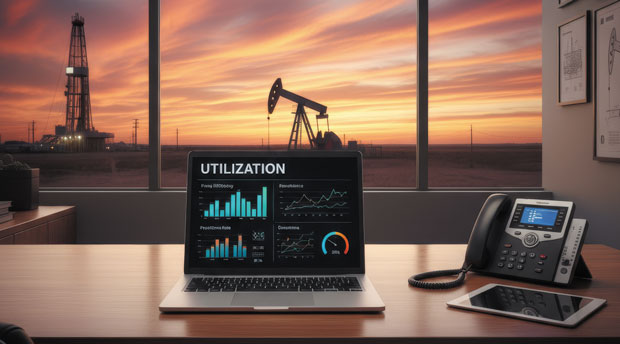
By clearly defining and consistently tracking utilization rates, fleet owners can get more from their existing assets and make smarter decisions about future investments. This is especially true today, as modern technologies can automate data collection to provide real-time insights on where equipment is, what it’s doing and how well it’s performing.
Maintenance scheduling conflicts impact utilization when preventive maintenance clashes with high-demand periods. Effective management requires sophisticated scheduling systems that can balance maintenance with operations, often using predictive analytics.
Regulatory compliance and reporting requirements complicate utilization management across jurisdictions. Companies must maintain detailed records of usage, maintenance, and inspections while maximizing efficiency.
Underutilization due to poor scheduling or lack of visibility challenges operators significantly. Without real-time insight into location, status, and availability, dispatchers may deploy suboptimal assets or leave high-value equipment idle.
Other challenges that can limit utilization include weather and environmental factors. Extreme temperatures, precipitation, and remote terrain impact equipment accessibility and performance. These conditions force delays and increase wear. Weather monitoring and contingency planning help mitigate these challenges.
Supply chain issues can extend downtime by limiting access to replacement parts. Remote locations worsen this, as specialized components require significant lead times. Strategic inventory management and supply chain partnerships minimize delays.
To maximize the benefit of a well-run supply chain, companies need skilled personnel. Qualified operator and technician availability directly impacts utilization. Industry-wide shortages and high turnover in remote locations complicate access to the necessary operational expertise, but training programs and retention strategies can address such workforce limitations over time.
To track utilization effectively, companies’ systems must be able to communicate with each other rather than operating in isolated silos. Fragmented systems result in conflicting information and suboptimal decisions. Integrated solutions that allow seamless data flow improve effectiveness.
Balancing lifecycle considerations with immediate demands presents ongoing challenges. Replacement, refurbishment, or retirement decisions require analysis of performance, costs, and requirements. Comprehensive lifecycle strategies optimize timing while maintaining utilization.
Getting Good Data
The prerequisite to optimizing utilization is understanding where equipment is and what it’s doing. To gain this visibility, companies should centralize asset management and communication using modern systems that can provide real-time information on equipment locations, status, and availability. Maintaining accurate information will almost always require teams to collect data using mobile-friendly systems that can operate offline, allowing them to maintain records in areas with limited connectivity.
Such mobile systems can help companies establish clear operational procedures for recording data about equipment deployment and utilization. For example, the systems’ workflows could take the form of digital checklists that workers walk through every time they complete a specific task. Consistent procedures enable reliable interpretation of utilization data and appropriate action when thresholds indicate need for equipment reallocation.
Ideally, the procedures should apply across teams so that utilization data remains meaningful regardless of who collects it. Even then, companies should conduct regular audits to identify discrepancies impacting utilization calculations.
Leveraging the Data
High-quality data matters because it can empower companies to use their assets more strategically. That is especially true today, when modern scheduling systems help users analyze data and coordinate equipment deployment, maintenance windows and crew assignments. Where it makes sense, these workflows should be partially automated to ease the burden on staff.
Implementing new processes takes time, but the investment pays off. Smart platforms can increase utilization by as much as 20% by providing visibility into asset location and availability.
The best platforms also help companies refine their predictive maintenance programs by making it easier to monitor each asset’s condition and forecast its future performance. Companies that embrace predictive maintenance save 8%-12% compared to ones that rely on less nuanced preventative maintenance and 40% over reactive approaches.
For some asset classes, it’s worth rotating equipment to distribute wear evenly across assets. This extends lifespans while ensuring operational readiness and preventing excessive hours on specific assets.
Regardless of whether they use equipment rotation, companies should schedule maintenance during natural downtime to minimize its impact on utilization.
Getting Equipment to Site
When it’s time for equipment to move to a new location, implement just-in-time delivery to synchronize the equipment’s arrival with operational needs. This requires precise scheduling and communication, but significantly reduces nonproductive time.
Maintaining just-in-time delivery requires contingency plans that offer a backup in the face of weather, unexpected maintenance issues or scheduling conflicts. Such plans ensure operations continue with minimal disruption when primary equipment becomes unavailable.
Sometimes even the most well-maintained equipment needs to leave the fleet because it is no longer aligned with end users’ goals. To notice these situations consistently, companies should implement quarterly reviews that identify utilization patterns and look at performance metrics. Selling underutilized equipment recovers capital while reducing maintenance costs and administrative overhead.
It’s important not to be overzealous about selling assets, though. A thorough review should also help fleets maintain enough spare capacity to meet peak demand and ensure that future additions address likely market needs.
All the best practices outlined above ultimately depend on skilled personnel, so one of the keys to maximizing utilization is comprehensive training for operators and dispatchers. Well-trained workers complete tasks more quickly and effectively, meaning equipment spends less time down for maintenance and delivers better performance.
Consider implementing cross-training programs that equip operators to handle multiple equipment types. Cross-trained teams have the flexibility to adapt quickly to changing requirements, which can improve fleet utilization.
Enabling Technologies
Digital asset tracking systems simplify fleet management by providing real-time equipment monitoring through GPS, radio frequency identification (RFID) tags, and mobile apps. These platforms should offer deployment management, location tracking, inspections, and maintenance status to help companies shift from reactive to proactive management.
IoT and sensor integration automates data collection and enables predictive maintenance. Sensors monitor engine hours, vibration, temperature, and pressure, updating utilization and flagging issues early while reducing manual entry.
Mobile workforce management applications give field teams real-time equipment status, work orders, and communication tools with offline capability. They cut paperwork, speed up responses, and keep dispatchers informed.
Advanced analytics and reporting capabilities turn utilization data into insights via dashboards and reports. They spot trends, predict maintenance needs, optimize deployment, and benchmark performance for continuous improvement.
Integrated maintenance management systems balance preventive maintenance with operations to reduce downtime. They look at usage data to time maintenance, generate work orders, and schedule work during low-demand periods.
Remote monitoring and control systems let operators manage equipment centrally, reducing site visits. They support hybrid work, enabling remote expert guidance and faster responses at lower cost.
Practical Implementation Guidelines
Begin utilization optimization efforts by focusing on the most expensive or critical equipment in the fleet. These assets typically have the greatest impact on profitability and provide the best return on optimization investments. Establish baseline utilization rates for these assets before implementing improvements to measure progress accurately.
To avoid overwhelming field teams, adopt new technologies in phases. Start with basic tracking and communication tools before advancing to predictive analytics and automated systems. This approach allows teams to adapt gradually while building confidence in new processes and technologies.
To assess progress, set clear utilization targets based on industry benchmarks and historical performance. Remember, properly-managed fleets usually reach utilization rates between 75% and 90%, with particularly strong fleets staying above 85%. Use these benchmarks to set realistic improvement goals and track progress over time.
To align optimization efforts across all functions, develop coordination protocols between dispatch, maintenance, and field operations teams. Regular communication and shared visibility into equipment status prevents conflicts between operational demands and maintenance requirements.
Finally, establish continuous education programs that keep teams current on technology updates and optimization techniques. Regular training ensures consistent system usage and helps identify opportunities for process improvements based on field experience and feedback.
Long-Term Implications
Managing equipment utilization well requires a long-term commitment to technological advancement and operational excellence. Leadership must recognize that optimization is an ongoing process, not a one-time project. Organizations should benchmark their practices against industry leaders while developing strategies that address technology, operations, workforce development, and training through integrated approaches that maximize immediate results and long-term sustainability.
The returns—improved profitability, enhanced service delivery, increased reliability, and competitive advantage—justify the investments required. For oil field service providers facing competitive markets with price pressure and rising client expectations, the costs of continuing to rely on outdated systems far exceed the investment needed to transform to optimized utilization management. Such transformations position organizations for enduring success, market leadership, and profitable growth.

MICHAEL MALTSEV is the CEO of RigER, which provides digital oil field solutions for energy service and equipment rental companies in the United States, Canada, and the Middle East. For most of his career, Maltsev has focused on applying expertise in business analysis, automation and software to help companies optimize operations and simplify processes. He founded RigER in 2012 after serving as the chief financial officer for an oil field rental company, Rigstar Communications Inc. Before that, he spent two decades developing, implementing and using software in various financial functions.
For other great articles about exploration, drilling, completions and production, subscribe to The American Oil & Gas Reporter and bookmark www.aogr.com.